
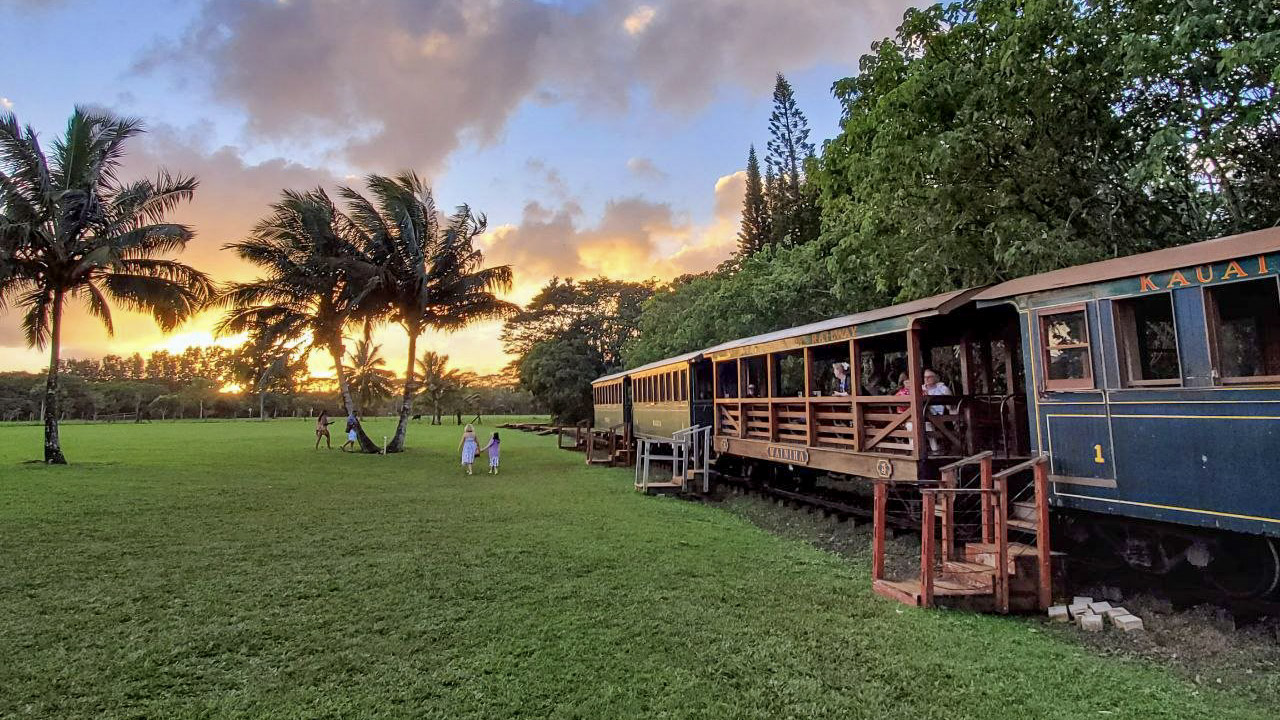
Five years ago this week, Disney transformed a stretch of Kauai beside Kapaia Reservoir into a complete 1916 Amazon port town. It was built from nothing, used for weeks of filming, and then dismantled until almost no outward sign remained that it had ever stood there at all. While Kapaia Reservoir became the film’s Amazon port, other scenes were shot at the Kauai Plantation Railway at historic Kilohana Plantation in Lihue, Wailua Falls, and the Huleia River.
The movie was Jungle Cruise, released five years ago this week, on July 30, 2021. The construction began on Kauai three years earlier, in 2018, when months of planning turned a familiar part of Lihue into an elaborate place that existed only long enough to appear on screen.
Disney did not find the Amazon on Kauai. It built one.
The production did far more than add temporary docks and dress up a few existing buildings. According to the Kauai Film Commission, crews built a fully functioning Amazonian port town from scratch on the banks of Kapaia Reservoir near Lihue.
The project reportedly began with about one month of scouting, followed by two months of design and four months of construction, set dressing, and landscaping. By the time filming started, the reservoir shoreline had been transformed into a detailed version of an Amazon river port from 1916.
The set included the Hotel de Fereira, a tavern, docks, Jungle Navigation Company facilities, and competing boat moorings. Two full-size boats measuring 39 feet each were also constructed for the production, adding to the scale of a waterfront designed to feel occupied, functional, and established rather than newly assembled for a movie.
The filming here on Kauai lasted roughly seven weeks in 2018.
The Kauai jungle set was built to function, not just look convincing.
Kapaia Reservoir wasn’t used only as scenery behind the actors. The production actually created usable waterfront structures, working docks, and full-size boats that could be used as part of the action taking place on the water.
Boats could approach the docks, performers could move through the buildings and waterfront spaces, while cameras filmed the town from multiple directions without immediately revealing that it was all taking place on a temporary set on Kauai.
The production took the same practical approach at Kilohana Plantation, where the Kauai Plantation Railway was heavily featured in the movie’s train sequences. Instead of creating the impression of a railway entirely through digital effects, filmmakers incorporated the actual operating train and historic plantation setting into the fictional South American journey.
Kauai played several parts of South America.
The Kauai Plantation Railway at Kilohana was used for the film’s train sequences, bringing an existing piece of Kauai infrastructure into the movie’s fictional world. Unlike the massive Amazon port built at Kapaia Reservoir, the railway is still operating today. Visitors can ride the approximately 40-minute narrated train tour through Kilohana’s 105-acre plantation, passing orchards, gardens, and farm animals while seeing one of the movie’s filming locations for themselves.
Wailua Falls also remains one of the movie locations visitors can see for themselves. The waterfall is reached by road and viewed from the public overlook above it, making it far easier to recognize today than the Amazon town that disappeared after production ended. To ri
Kapaia Reservoir served as the location for the large port town and its waterfront activity. That was where Disney made its most dramatic physical transformation, with elaborate construction of all the elements needed to create the film’s gateway into the Amazon jungle. Wailua Falls and the Huleia River also appeared in the production, helping expand the scenery beyond the principal reservoir set in Lihue.
The port town supplied the human-built environment, Kilohana Plantation provided the railway, and Kauai’s own waterways and waterfalls created the larger landscape audiences thought were in South America.
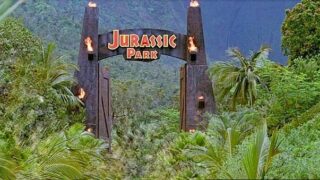
The illusion worked partly because Kauai already has the scale, vegetation, water, and dramatic terrain filmmakers often look for when creating distant tropical worlds. Jungle Cruise added another layer by constructing an entire town on top of that landscape rather than relying on the island alone, as Jurassic Park had done.
Then Disney removed almost everything.
Once filming ended, the Kapaia Reservoir set was entirely demolished, and the land was restored. The Amazonian port had required months and millions to design and build, but it was never intended to remain a permanent place for Kauai visitors to explore afterward.
Kapaia Reservoir is also on private property, so it is not a movie location where travelers can walk through the remains or search for abandoned buildings. Anyone hoping to find the Hotel de Fereira, the tavern, or the Jungle Navigation Company facilities would discover that the physical town seen in the movie no longer exists.
The photographs shared by the Kauai Film Commission reveal just how complete the transformation was. Without those images and the finished movie, most people driving through that area today would have little reason to imagine that there was an enormous production that five years ago occupied the banks of the reservoir.
Kauai has been becoming other places for generations.
Kauai has a long history of standing in for locations extending far beyond Hawaii. The island has appeared in movies including Raiders of the Lost Ark, Jurassic Park, and Pirates of the Caribbean, often convincing audiences that they were seeing remote jungles, prehistoric islands, or distant tropical shores.
Jungle Cruise followed the same tradition but went a step further in this important way. Instead of filming Kauai largely as it appeared, Disney constructed the fictional Amazonian town detailed enough to support a major movie production.
Five years later, little suggests what was once there.
Today, Kapaia Reservoir does not appear as any former home of a massive Disney production. There are no preserved details or tours showing visitors where the fictional port once came to life.
For a brief period starting in 2018, however, the reservoir shoreline featured a complete working movie world, including buildings, boats, moorings, and carefully landscaped waterfront spaces. Crews spent months bringing it into existence, audiences saw it as the Amazon jungle, and then the entire place was dismantled. One of Disney’s most elaborate Hawaii sets once stood near Lihue, while today most Kauai visitors could pass nearby without ever realizing what had been there.
Did you know that parts of Disney’s Jungle Cruise were filmed on Kauai, or have you visited another Hawaii filming location that surprised you?
Lead Photo: © Beat of Hawaii at Kauai Plantation Railway.
By Rob and Jeff, Beat of Hawaii.
Some of the most meaningful parts of Hawaii are the ones visitors walk right past without knowing they are there. We’ve spent nearly 20 years finding them firsthand for BOH as full-time Hawaii residents reporting on travel, culture, and island life, and telling you what they mean for your trip. Join us →
Get Breaking Hawaii Travel News


Movie companies are very good at restoring movie sites back to original. I was told once that was always written into the contract so they don’t have to copyright everything they build. Also, since everything is temporary and not up to code, the insurance would be prohibitive to allow anything to stay other than pictures and memories. A friend of ours had some fancy sports car that a director wanted for one of the 007 movies. They promised a new paint job in the original paint and color…it was some fancy paint made with red beetle wings. He got it back in pristine condition. Along with the bragging rights about his car seen by millions. In Nebraska they leased a farmer’s field, built a house, burned it down then cleaned it all up and reseeded his field.
I don’t think I’ve seen that movie, but maybe now I’ll check it out. I’m not too informed on this, but my guess is that the locals and governmental permitting procedures actually preferred the “leave no footprint behind” approach? Maybe I’m wrong. Could there be some people in Kauai that would have preferred for some of the infrastructure to remain for local uses? Maybe it wasn’t up to code for permanent use, would be my guess. Am thinking how future movie productions can leave a useful legacy to the locals, if that is even wanted. I’m genuinely curious, and maybe I’m missing something major in my hypothesis? Mahalo everyone from the mainland.