
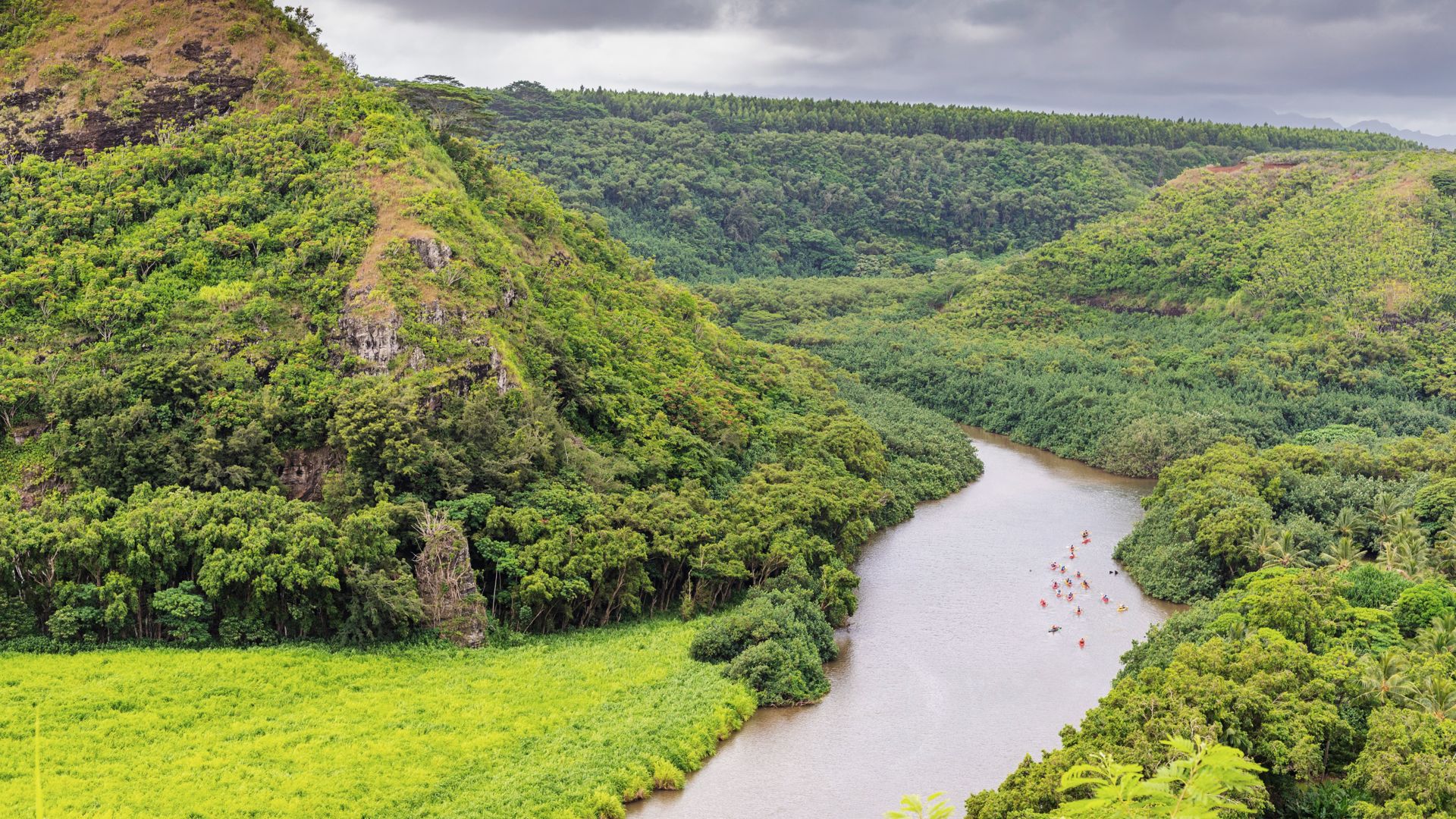
One of Kauai’s most popular visitor activities is a kayak trip up Hawaii’s only navigable River, the Wailua River, to Secret Falls. Tens of thousands of visitors do it every year, many with kids and many without a guide. Last week, 19 people from Nevada, including 14 children, had to be rescued from that route after getting stranded in severe weather. A woman died there while doing the same trip in 2016. The state said new rules were coming. They never did.
The bigger issue is that this happened in almost the exact place where the visitor died in 2016, after the state publicly said new rules were coming. Nearly a decade later, there is still no visible sign that those rules ever became a hard operating standard. Beat of Hawaii covered that state response in New State Rules Coming Following Flood Drowning, when DLNR said it was planning new rules and said those rules would likely cancel tours when a flash flood watch was posted.
This is not just one visitor family making a bad call in bad weather. This is a known risk on one of Kauai’s most popular visitor attractions, at a crossing that has already produced a death and repeated rescues. A Flash Flood Watch for Kauai was issued at 6 p.m. that same day. Guided operators say they cancel under flash-flood conditions. The bigger question is why rental outfitters do not appear to be held to the same standard when they send unguided people down the same route as a major Kona storm system that had been forecast and warned about for days was already bearing down on the island.
A death that was supposed to change everything.
On December 3, 2016, Aimee Abrahim, a 32-year-old visitor from El Cajon, California, drowned after a guided Wailua River kayak tour ran into flash flood conditions. Beat of Hawaii reported that she was on a Kayak Wailua tour, that she was washed away while trying to cross the stream with her sister, and that the death was the direct trigger for DLNR’s statement that new rules were coming.
That should have produced immediate rules. Not suggestions or operator discretion. But rather hard rules with enforcement teeth. Instead, the public was told that change was coming, which sounded like the right response at the time and suggested that DLNR understood exactly what had gone wrong and needed to be fixed. But nearly ten years later, the same location is still producing rescues, and the same weather risk is still being pushed back onto customers who may know very little about how fast conditions change right there.
The rules that never came.
As of early 2026, the rule everyone expected after that drowning still does not appear to exist in any clear way that the public can see or rely on. Beat of Hawaii’s New State Rules Coming Following Flood Drowning said DLNR was planning new rules and that those rules would likely result in cancellation of tours during flash flood watches. The March 2026 county press release, by contrast, reads like a rescue notice and warning rather than an announcement that any existing mandatory weather shutdown rule had been enforced.
After a fatality, the state wasn’t lacking warning or time to act. It did not lack exact records of what had gone wrong. What appears to be missing is an actual rule that would prevent this from recurring, and if one were ever adopted, it has not been clear enough to change behavior on the ground.
That also leaves the gap between guided and unguided trips as the question nobody has answered. Guided operators say they cancel when flash flood conditions are present. Rental outfitters, on the other hand, do not appear to be held to the same standard.
A visitor can easily assume that if a business is willing to rent kayaks to them, the trip must be reasonably safe. Sunshine at the launch area does not mean that a later crossing near Uluwehi Falls will remain passable. Rain uphill (mauka) can change that quickly, and businesses on this river should know that better than visitors.
The same Kauai river crossing, nearly a decade later.
This was not the first major rescue there after the 2016 death either. On December 2, 2021, 13 kayakers were rescued on the Wailua River near Uluwehi Falls after the river rose and became impassable. Firefighters used the rescue boat, reached the kayak landing, found the group stranded on the other side of the river, and shuttled them back before escorting them downriver to safety. Even that didn’t stop the March 19, 2026, rescue of 19 more visitors from Nevada, including 14 minors, again in severe weather.
Two Tennessee visitors faced a very similar situation on the Hanalei River in May 2024, rescued after losing their kayak in elevated water and clinging to vegetation upriver from the bridge, and that case raised the same question this one does. If a vendor rents kayaks during bad conditions, where does responsibility belong? That was the exact issue Beat of Hawaii raised in Visitors Rescued from Hanalei River Spark Wake-Up Call Over Responsibility.
No outfitter has been named in the most recent incident. And this is not about accusing a specific company without facts. It is about how the whole thing is working for visitors or not. If businesses can rent to unguided groups during severe weather, including large groups with children, and no one is clearly violating a rule that the public can point to, then the system remains broken.
What the mayor said this time.
Mayor Derek Kawakami did not soften it. In the county press release, he said this incident should remind people that entering the water during severe weather puts lives at risk, not only those in the water but also first responders. He also directly called out businesses that facilitate outdoor activities during dangerous weather.
We urge both individuals and businesses that facilitate outdoor activities to exercise sound judgment, take weather warnings seriously, and prioritize safety at all times. — Kauai Mayor Derek Kawakami.
Kauai Fire officials have been warning about this same problem for years. In last year’s Hanalei rescue case, Fire Chief Michael Gibson warned against outdoor activities during heavy weather because rescues in those conditions can become complex and dangerous. That same point applies here, where someone already died on the route, and that was supposed to be the point when the rules changed.
The burden cannot sit only on the visitor. Yes, people have personal responsibility. Yes, visitors should check the weather and warnings. But the business renting the equipment knows the route better than anyone, just how fast the crossing can change, and that many customers are first-timers and perhaps distracted by the warnings. They are the last line of defense before an unguided group gets on the water.
Who bears responsibility?
The answer is probably both, but not equally, and visitors still need to exercise common sense. They should not ignore such warnings, nor assume that every popular activity here is safe just because it is sold every day. But vendors know best what a flood watch or severe weather can mean for that river. They know many customers are unfamiliar. That means they should clearly bear more responsibility, whether the state has spelled it out or not.
The state also owns a large share of this problem. In 2017, DLNR said new rules were coming after the 2016 drowning and indicated those rules would likely cancel tours during flash flood watches. Yet nearly a decade later, Kauai was still rescuing an unguided group from the same route in severe weather. If the state meant to fix this after someone died, it appears to have never finished the job.
Clear rules are needed such that rental companies on the Wailua River must refuse rentals when severe weather warnings or flood watches are posted. And that needs impactful enforcement.
Until that happens, this will keep repeating. Same river. Same crossing. Same argument afterward about personal responsibility, vendor judgment, and public warnings. Just different names, and hopefully, no worse outcome.
Should kayak rental companies on the Wailua River be required to cancel rentals when severe weather is forecast, the same standard guided tour operators say they already follow?
Get Breaking Hawaii Travel News





Folllow the money!
I’ve seen “surf” lessons at Kahalu’u beach park in flat conditions and
kayakers sent out to Captain Cook in three foot wind chop with no guide and no instruction.
Greed and laziness are fatal combination.
I’ve kayaked on the Hanalei and the Kalikiwai (wrong spelling) as well as the Wailua many times. Why did you say the Wailua was the only navigable river?
Hi BOH,
Love you guys for going on 13 years now!!
Yes, rental outfitters should be required to follow the same rules as tour/ guide operators. However, I see a larger deficit – — the morals of the rental company. They were likely well- aware of the flash flood watch/warning, so should have refused to rent equipment to Anyone until safer conditions returned. Am ethical and moral obligation to their customers and would-be customers prioritizing Safety over the almighty dollar!
When will the counties start charging rescue fees for tourists that continuously lack common sense?
Why only tourists…..everyone should be fined regardless of where they’re from.
I have kayaked the river many times over the years. I always made sure of the weather and water level. The scariest part was looking at the underneath of the bridge. I think people need to take responsibility for their actions. Quite simple 3 rules: ask a local, watch to see if anyone else is doing it and do not turn your back to the ocean. Life jackets for visitors who do not know the river, the currents etc and good common sense.
Absolutely Yes. Safety has to come first!
I wonder what a rental briefing there actually sounds like. Are customers being clearly told not to go or turn back if conditions change suddenly? Are they being warned specifically about anything? Or is it more like a casual waiver, a paddle, and see you later? This shouldn’t keep coming up and it’s on the state to be sure it doesn’t.
Most visitors are not reckless. But they are inexperienced. There is a difference. They are in a place they do not understand, doing an activity sold to them as normal and safe, by people who absolutely should know better. That is why the vendor side of this matters so much in addition to personal responsibility.
If a rental company hands me the equipment and takes my money, I, like most people, am going to assume conditions are reasonable. That is just reality.
I have done this trip, and what strikes me is how normal it feels when you begin and how quickly the weather changes there. It does not feel like something that would carry so much risk. That is probably why people let their guard down.
I do think the companies bear more responsibility than they want to admit. This is the kind of thing visitors misread because the outing can look so tame at the start. Calm river, rented kayak, kids along, everybody smiling. But when the weather shifts suddenly it is not a vacation activity anymore, it is a rescue.