

For years, Hawaii’s tourism machine has pushed a more upscale vision of the islands, higher-spending visitors, better-quality tourism, and more premium positioning. The airlines, which have better booking data than anyone else, keep sending out old jets and dense cabins. It is a clear verdict on who they believe is actually buying these seats. It may also be one reason fares have not yet gone fully out of reach. Either you get the old plane and the tighter cabin now, or you get the upgrades and pay for them.
So, when one airline just revealed something completely different for long-haul domestic flights that excluded Hawaii, we weren’t surprised Hawaii wasn’t in the discussion. But is it a win or a loss for island-bound travelers? The answer is, it all depends.
United just proved what airlines build for routes they actually care about.
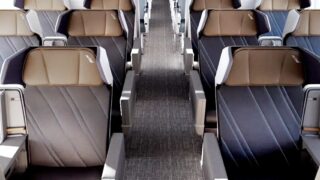
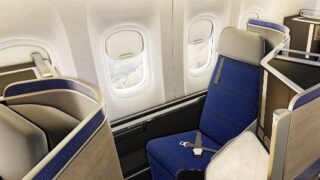
United just announced Coastliner, a new premium domestic narrow-body A321neo aircraft configuration built for five-hour transcontinental routes. But not for Hawaii. Lie-flat Polaris business suites. Premium Plus premium economy section. Snack bar in the economy. The first aircraft is expected this summer.
Newark-to-Los Angeles gets that treatment. Yet Los Angeles to Honolulu takes almost the same time in the air. One gets the premium domestic showcase. The other gets a 30-year-old 777 or a narrow-body 737 MAX. Why?
Transcon gets the suits, the airline’s corporate accounts, and the travelers who can support a premium-heavy model. Hawaii gets families, couples, and leisure travelers who are more price-sensitive, even when the overall trip is expensive.
Airlines know exactly who is in those seats, what those customers will tolerate, and what they can sell without over-investing. When airlines roll out their nicest domestic products, and Hawaii is nowhere near the front of the line, that is no oversight or accident. If they truly believed Hawaii needed the same premium treatment to win, they would be building for it. They are not.
Why this keeps happening, and why travelers may not love the alternative.
Airlines are not being stupid here by any means, and are seeing Hawaii more clearly than the people trying to market it as a premium destination. A premium-heavy aircraft has fewer economy seats, which means less inventory and more upward price pressure. A denser aircraft heading to Hawaii can carry more people paying economy-level fares. That helps keep the route more affordable for families and other leisure travelers. It also gives airlines a way to fill a plane consistently in a market where many customers are highly price-sensitive.
Hawaiian’s A321neo, for example, carries 173 economy-class seats. United’s Coastliner version of the same plane will carry just 129 total economy seats in its much more premium configuration. Same basic domestic length. A very different revenue strategy is in play.
If these upgrades ever come to Hawaii flights, it is unlikely to feel like any kind of gift. It will mean fewer economy seats, more premium inventory, and decidedly higher fares. The aircraft might be nicer, but a lot of travelers who can still make Hawaii work today may find it harder to afford.
Hawaii keeps getting old widebodies and uncomfortable narrow-bodies.
They still work economically. The planes are full enough, the fares are acceptable, and demand remains strong. If airlines believed they could make more money sending premium-heavy planes to Hawaii, they would already be doing it.
The issue is not just about comfort. It is about expectation. The airlines have split longer domestic flights into tiers. Some routes get lie-flat suites, upgraded cabins, and premium-heavy planes. Hawaii, even when the flying time is nearly identical to trans-continental, gets the old jets and the cramped new ones. But that also helps explain why fares have stayed more accessible than they otherwise would be.
Some travelers still think of Hawaii as a widebody market, two aisles, room to move, a flight that felt different from the moment you boarded. Even outside premium cabins, it felt like a real long-haul trip. That version is disappearing fast, and the replacement is not what most travelers expect or dreamed of.
Some Hawaii routes still get widebodies, but as often as not, they are the oldest ones in the airlines’ fleets and in configurations no airline would think of on more valuable routes. Hawaii routes get narrow bodies, which are newer on paper but can feel tighter, harsher, and more like a short domestic shuttle stretched out over a distant ocean crossing.
A Hawaii vacation already costs a lot before you even get on the plane. Airfare, hotel, car rental, food, activities, resort fees, parking, and taxes all quickly add up to serious money for a family trip. When the flight itself feels cheapened, it changes how the trip feels.
The oldest jets still flying keep showing up on Hawaii routes.
Last week, United flew a 777-200 from San Francisco to Honolulu, which is 31 years old. The next day, a 30-year-old version of the same aircraft makes the same run.
Those are not isolated examples from a museum fleet. United operates 19 of these 777-200s. The youngest are around 25 years old. These aircraft used to fly long-haul international routes, such as London to Tokyo. Now, instead, they show up on flights to Hawaii.
That alone would be enough, but the worst part for travelers is how they are configured. Economy is ten-abreast in a 3-4-3 layout. Seatback entertainment is gone outside first class. The first-class cabin itself is old, with alternating forward- and rear-facing seats from an earlier design era. United calls this “high-density.” Travelers call it uncomfortable.
Delta is not offering a dramatically different story. The 767s flying JFK, Minneapolis, or Salt Lake City to Honolulu are themselves more than a quarter century old, delivered in the late 1990s. Sometimes they play equipment roulette, and even on days that get an A330, it might be over twenty years old. It isn’t that the airlines don’t have newer planes, they just don’t use them for Hawaii.
The new planes are not saving Hawaii travelers either.
Every major carrier has been shifting Hawaii routes toward narrowbody flying, driven by economics rather than passenger experience. Whether A321neo or 737 MAX, the airlines have pushed the same logic onto most of their Hawaii flying.
These planes are newer and clearly more efficient, built around airline economics rather than making a five- or six-hour overwater flight feel good. Some say the A321neo is the least bad version of this. Wider cabin, slightly more tolerable. Hawaiian, American, and Delta fly it. But it is still a single-aisle aircraft on a flight that takes five to six hours. Others will argue the 737 MAX is more comfortable.
Hawaii, in many ways, is not just another domestic destination. The trip is expensive, emotional, and heavily anticipated. One family told us their A321neo flight from Los Angeles to Honolulu left them stunned. Even in first class, they said, it did not feel like Hawaii any longer.
Hawaii flying used to have at least a little ceremony to it, even when it was imperfect. Two aisles. A game. More room to get up. Something to reduce the feeling that you were locked in a tube for six hours. That has been replaced by one of two options. Either you get an older widebody, or you get a new narrow-body that feels like the wrong aircraft for this job.
Neither is really built around the traveler’s experience. One squeezes more life out of older assets while the other lowers operating costs by keeping the route full.
Have you already noticed the difference between your Hawaii flights and trans-continental domestic routes?
Get Breaking Hawaii Travel News




On a recent trip in May 2024, my wife and I had to suffer the travel complications of an older American Airlines narrow body leaving out of Phoenix. After flying over California and making it about 100 miles out over the ocean, the pilot announced they were having trouble with one of the engines, and had to return back to Phoenix to swap planes. Then we had to circle over Arizona for over an hour to burn fuel. Then it was time to de-plane and reload to another similar older narrow-body, then back in the air. Instead of arriving in Kona at 8:00pm, we arrived at 1:30am the next day. Factor in rental car pick up and a drive to the resort to check-in, we did not get to bed until 3am, making for a 15 hour travel day, and feeling exhasted for the first two days of your vacation….not fun.
This shouldn’t surprise anyone. The airlines have always focused on the business travelers
I just flew on Hawaiian from Ogg to Las Vegas on first class! No pre-flight beverage and DVR not available anymore!
With Hawaii attempting to “pivot” to fewer, richer, overpriced resort hotel-loving visitors, with moves such as severely reducing STR inventory, building neighborhoods full of luxury villas, etc., maybe the airlines will upgrade accordingly. When there is nothing but Rockefellers on the planes to Hawaii, the airlines will naturally rethink the quality of comfort. Heck, maybe the airlines won’t be needed anymore, and the Rockefellers and their ilk will all simply arrive by private jet.
40 plus years later and deregulation remains one of the worst things to happen to travel.
Bob, yes and no.
When deregulation came along, I was young and had very limited funds. The reduced prices allowed me to travel the world, beginning with Hawaii on Continental when I was 17. Later, I took advantage of many opportunities offered as a result of deregulation. Unlimited flights on Eastern Airlines, $236 for up to 3 weeks (mostly Caribbean). Round the World on Pan Am for $999. Central and South America on Eastern for $279, and more. All before I was 25 years old. All 3 of those airlines have disappeared, probably due to deregulation.
Now, as a retiree, I would be willing to pay more for better service. There are always tradeoffs.