
Hawaii has quietly just become the most competitive battleground in electric civil aviation. The islands check every box that electric aircraft developers have been looking for: short flights, high jet fuel costs, no driving alternative, and a captive population that flies the same routes repeatedly. Multiple companies are now targeting Hawaii as their launch market, and the race to put the first commercial electric aircraft into regular island service is accelerating quickly.
The latest move comes from Surf Air Mobility, the parent company of Hawaii’s Mokulele Airlines, which has signed a firm order for 25 electric BETA Technologies ALIA aircraft and announced that demonstration flights will take place in Hawaii in 2026. That makes this year the first time electric aircraft will operate within Hawaii’s interisland system in any capacity.
These are demonstration flights, not regular passenger service yet. Cargo operations are planned after that phase, and passenger flights would follow only after the passenger version of the aircraft receives FAA certification. No precise timeline for certification has been announced. Surf Air Mobility also holds options for another 75 aircraft beyond the firm order.
Why Hawaii is the first market.
Mokulele’s route network closely matches the operating profile that electric aircraft developers have been targeting for years. The airline flew about 36,000 flights last year, and the average leg distance was roughly 51 miles between islands.
Mokulele currently flies Cessna Grand Caravan turboprops on these interisland flights, connecting airports such as Molokai, Lanai, Kapalua, and Hana with larger hubs. The ALIA CTOL aircraft is intended to operate in the same regional role within that network of short island flights.
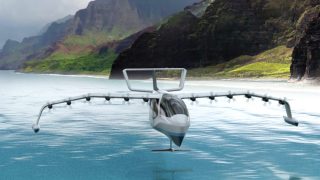
Electric interisland travel has been proposed before. The recently set back REGENT seaglider project we wrote about earlier this week has promoted a harbor-based electric craft designed to move between islands on the water rather than through airports. That concept remains uncertified, and no production aircraft are flying. The ALIA approach instead uses existing airports and their aircraft that have already flown 100,000 nautical test miles.
The ALIA CTOL was built by BETA Technologies.
CTOL means conventional takeoff and landing. The aircraft uses normal runways and existing airports rather than specialized vertical aircraft pads or any new infrastructure.
The airplane is fully electric and powered by batteries rather than jet fuel or aviation gasoline. BETA says the ALIA aircraft family has accumulated more than 100,000 nautical miles of test flying, including long cross-country flights across the continental United States, although FAA certification is still required before regular passenger operations can begin.
A first phase is demonstration flying.
The aircraft will operate in Hawaii, flying routes as part of operational testing while working with the state, airports, and infrastructure where they will eventually operate.
Cargo operations are expected after that phase because those flights require fewer regulatory steps than passenger service. Passenger flights remain the final step and depend on FAA certification of the passenger-configured aircraft, which is pending scheduling.
Infrastructure and charging systems.
Electric aircraft will require charging systems at the Hawaii airports where they’ll operate. BETA Technologies says it has already installed more than 50 aircraft charging sites across the United States and Canada as part of its electric aviation network.
Hawaii would add to its existing network once operations begin, although the companies have not announced which specific airports in Hawaii will host the first demonstration flights or charging installations.
Surf Air Mobility also plans to establish Hawaii as the exclusive BETA-authorized maintenance, repair, and overhaul center for the aircraft. That designation would place servicing and technical support for the region in Hawaii rather than on the mainland and would anchor the company’s electric fleet support operations and personnel in the islands.

What to watch for next.
The first visible step will be the demonstration flights in Hawaii skies, followed by cargo operations and the FAA certification process that would allow passengers to board these aircraft.
If the demo flights proceed as scheduled later this year, Hawaii will become the first place in the United States where electric aircraft operate within a real commercial airline network. Passengers will eventually follow, depending on how the aircraft performs and how quickly certification progresses.
What’s your take? We invite your comments.
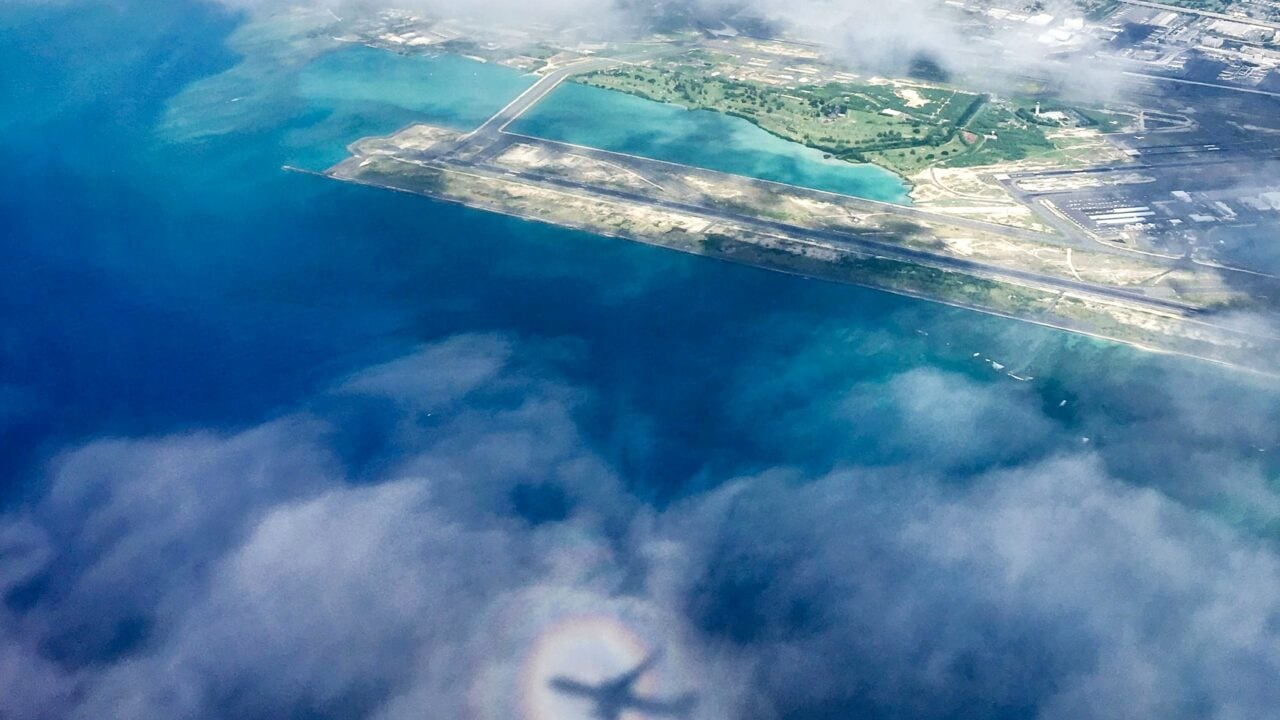
Lead Photo Credit: © Beat of Hawaii from the air showing HNL reef runway.
Get Breaking Hawaii Travel News


A lot of opportunities here. I see a day when you can catch a flight at Kihei boat harbor to Lahaina for the day, or to Oahu alawai boat harbor, then off to shop at Ala Moana. In Lahaina but want to see Hana? Grab a Water taxi? I just don’t see them 12th in line for takeoff at HNL.
I was just thinking the same thing ……I live in Lahaina and manage my condo in Kihei ….when there is an emergency while we have a flood watch in effect, taking the sea glider would be a welcome choice. More importantly, they could help in emergencies.
Great Idea. But I don’t think it will happen anytime soon. Respectfully.
Besides having expensive jet fuel costs, Hawaii has some of the most expensive electricity in the country. Unless they have huge solar arrays with battery banks near the airport, there is no energy savings in electric motors. And, a Cessna Caravan can be refueled in 10 minutes, I wonder how long it will take to recharge the batteries on these machines. Perhaps they will be able to pop in new recharged batteries quickly. We’ll see.
And I care how my flight is powered…why?
I think electric planes are a great idea! It’s cleaner; I worked for an commercial airline for 12 years and had to smell jet fuel when I was near the aircraft. It gave me headaches. With the solar farms on the islands, clean energy is the way to go to keep the islands beautiful and environmentally friendly.
As of 2023, approximately 71% of Hawaii’s electricity was generated from petroleum, therefore, these are essentially oil-powered electric airplanes. How is this clean energy…?
In 2025, 37% of Hawaiian Electric achieved 37% renewable energy portfolio standard (RPS) across its five-island service territory, which is projected to increase further in 2026 due to new projects. This 37% includes a mix of wind, solar, geothermal, hydro, and biomass, with wind and solar making up the majority of that, alongside a significant contribution from residential rooftop solar systems. Hawaii is moving in the right direction, since your example from 2023 was 29% using renewable energy, although I agree that it has been moving slowly in those 2 years (up from 29 to 37%)
I agree with you. I hate the smell of gas, one of the many reasons I drive an electric car.
It seems to me Hawai’i really blew it on the ferry. If instead of trying to be the first at something “new”, they should have taken a page out of the Alaska Ferry system. I believe it is one of the best ferry systems around. They have a fleet of workhorse boats that can handle people, cars, mail, cargo in any weather. Am afraid the seaglider is another flash in the pan, something bright and shiny that is being tried for an application it is probably (in my opinion) not suited for. As for an electric plane? Jury is out, happy it will have a long process to qualify before moving people. At least they won’t freeze up like all the electric buses back east on the mainland.
It will be interesting to see how this plays out long term… limited cargo and passenger capacity (5) will likely be a challenge and will make it difficult to be competitive with airlines.
Better option than Seaglider though.
I am all for “electric” flights, but looking at these, I wonder if they will be for the “elite” rather than the average local passenger. I liked the idea of the “sea glider”, may be they can combine both?
While this seems far more promising than Regent’s proposed Seaglider project, the Beta CTOL aircraft can seat only 5 passengers, which is half the capacity of Mokulele’s current Grand Caravan. How is that going to work financially?