
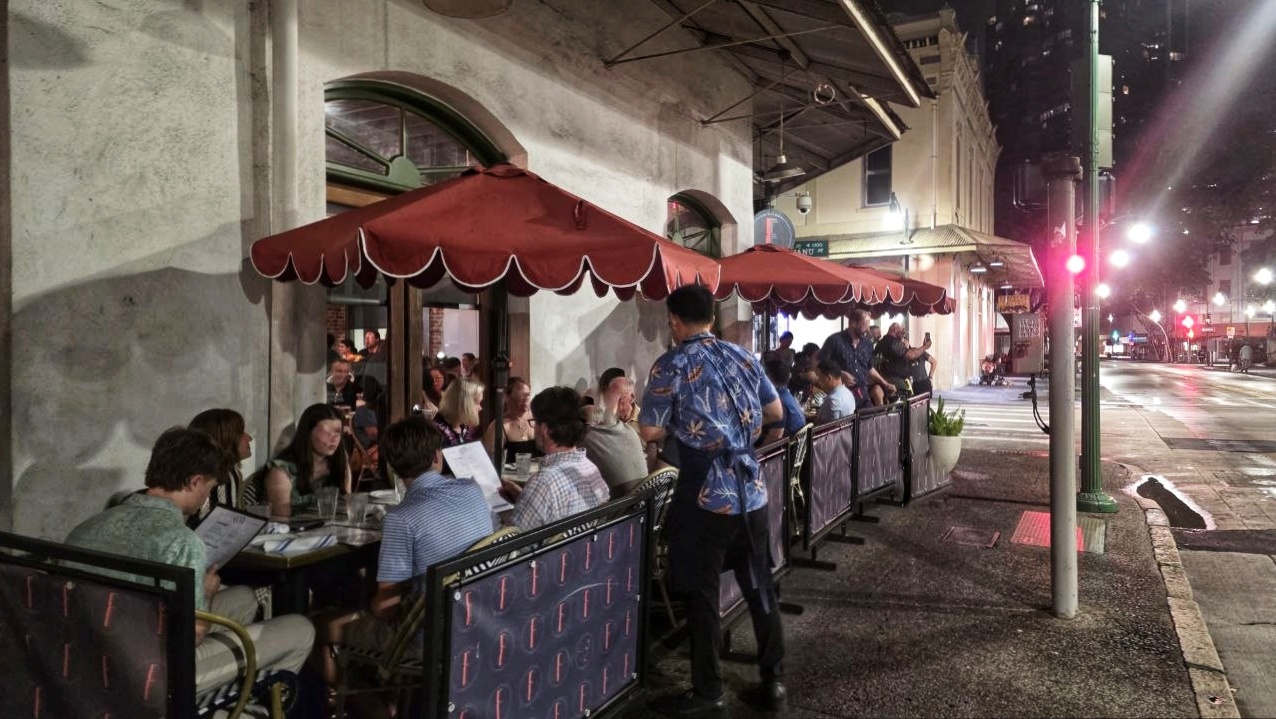
Visitors keep asking whether Chinatown is safe at night. We had dinner at one of Hawaii’s most recognized new restaurants and walked the surrounding blocks to find out.
Most visitors do not come to Chinatown after dark unless they have a reason. A destination restaurant is usually what gets them there, and then the real question starts the moment dinner ends, and they step back onto the street. That was the setup for us, too. We went to Giovedi, the most talked about new restaurant in Chinatown, stayed for the meal, and then paid close attention to what the neighborhood actually felt like at about 9 p.m. on a weekday.
That answer is more useful than either another recycled warning or a blanket reassurance. Visitors aren’t asking for theory about Honolulu Chinatown; they are asking us whether they can have dinner there, walk outside afterward, and feel okay about it. Based on this recent visit, the answer was yes. The blocks we walked felt active, mostly busy, and more comfortable than some nighttime stretches visitors walk through in Waikiki without even thinking twice.
Honolulu Chinatown still gets talked about as if it were riskier than it felt to us that night. For many visitors, it remains one of those neighborhoods people talk about and wonder about, even before they have actually spent time there at night. That gap between what people think and what they may find on the ground is why this keeps coming back.
Why we ended up in Chinatown after dark.
Giovedi gave us the reason to be in Chinatown at exactly the hour when many visitors say they start to hesitate. We had previously reviewed the restaurant and why it has become one of Honolulu’s hottest reservations. For today’s article, the question started when dinner ended, and we stepped back out onto the street around 9 p.m.
What the streets actually felt like.
The first thing that stood out was how normal everything felt. Not sleepy, empty, or tense. Instead, the streets around the restaurant felt busy. People were out, there was movement, and enough visible activity that the area did not feel at all abandoned or uneasy.
There were some homeless people in the mix, but not an unusually large number for Honolulu, and not in a way that changed the feel of the walk. What stood out more was that they were just part of the street scene, alongside diners and people heading somewhere, rather than the dominant presence.
We started down Smith Street from Nuuanu, and that stretch felt active and busy. We were not just stepping outside the restaurant and making a snap judgment either. After dinner, we kept walking around and ultimately down toward our parking lot, which was almost back at Ala Moana Boulevard. At no point did we feel uncomfortable. Nothing about it suggested the kind of situation that would make a visitor instantly regret making a dinner reservation in Chinatown.
The clearest comparison came fast. Editor Jeff commented that walking in Chinatown that night felt safer to him than walking from the zoo parking lot toward Waikiki. That may surprise people because Waikiki is the place visitors assume is safer by default, but it can have more of what he called the “hustle” feeling in certain stretches. Chinatown that night felt more straightforward. It felt like a neighborhood people were still actively moving through, with some homeless people, walkers, and other diners all sharing the same blocks.
That does not mean every block in Chinatown feels identical, nor does it mean anyone should ever switch off common sense. We did not check Aala Park, so this is not a sweeping claim about every corner of the district. It is a report from the blocks we actually walked, at the hour visitors have most often asked us about, and from that ground-level perspective, the area felt fine.
Why the numbers and the vibe do not line up.
The data on crime in Chinatown has been moving in one direction, while public perception of it has stayed stuck in the past. HPD data shows arrests in the district fell from roughly 10,000 in 1997 to just over 400 this year. The department’s Beat 154 dashboard shows violent crime down in three of four categories over the past five years. Citywide, reported crime in Honolulu dropped 28% between 2021 and 2024.
And yet if you ask visitors, or even plenty of residents, too, many still talk about Chinatown as if nothing has changed. That helps explain why the question keeps surfacing. People are not responding only to current conditions. They are also responding to past memories, reputation, and stories that travel much farther than our uneventful weeknight ever will. Reader Nancy commented that Chinatown is exactly the kind of place visitors should consider if they are willing to explore beyond Waikiki’s hotels and mainstream restaurants.
Even with the numbers moving in the right direction, reputation lags. Chinatown still gets judged by what people remember hearing about it, not just by what a visitor finds on an ordinary visit now.
Once Chinatown got a bad reputation, it seems to have kept it long after street conditions had changed. BOH reader Lei said Chinatown has changed enormously over the years, from mostly markets and noodle shops to a place where new chefs keep bringing fresh energy.
Visitors pick up that older reputation whether they know the backstory or not. They hear “Chinatown” and think, maybe not after dark. Then places like Fete, O’Kims or Giovedi give them a reason to test the assumption, and what they find can feel far more normal than expected.
What visitors should realistically expect.
The useful answer here is not that Chinatown is perfectly safe, because no urban neighborhood qualifies for such a blanket promise. The more useful answer is that during our weekday night visit to the blocks surrounding some of Chinatown’s best restaurants, it felt active, busy, and not uncomfortable. If you are visiting Honolulu and wondering whether dinner in Chinatown automatically means signing up for a sketchy experience after dark, our answer based on this walk is no.
You should still do what you would do in any city. Stay aware and do not walk alone. Know where you are going. Do not wander aimlessly into areas you have not thought through just because one stretch felt fine. If you are uneasy about being out late, leave while the streets are still active rather than waiting until later. That is not anything Chinatown-specific; that is city advice.
What deserves reconsideration is the automatic assumption that Chinatown after dark is a bad bet for visitors. That was not our experience. What we saw was a neighborhood that felt more comfortable to us than some of the nighttime stretches visitors walk near the zoo and into Waikiki proper, without giving it much thought. For visitors trying to decide whether dinner there is worth it, that is probably the most practical answer.
Have you been to Chinatown after dark recently, and did it feel anything like what you expected?
Lead Photo: © Beat of Hawaii outside Fete.
Get Breaking Hawaii Travel News





One thing you might have looked at with HPD is not just the ‘numbers’ of arrests in the Chinatown area, but the types of violations persons were being charged with and the associated numbers. It makes a lot of difference if the majority of the ‘crimes’ were composed of relatively ‘petty’ crimes (disturbing the peace, fighting, intoxication), or of more ‘violent’ crimes (assault, battery, robbery, etc.). Thanks for the enlightening report on the area.
‘
As in any city, exercising common sense is important. I wouldn’t meander aimlessly around there at night. Know where you are going. Maintain situational awareness, scan the many doorways and alleys in your direction of travel, and yes it is more comforting not to walk alone. I’ve been there early and mid evening many times (Maunakea, Smith, Nuuanu, Bethel, Fort, Hotel, and King streets) and can think of many worse places in Honolulu after dark. Word of caution: day or night careful where you step … watch out for animal (4 legged or 2 legged variety) droppings on sidewalks.
Hi!! Stayed in Waikiki about 3 weeks ago – visited Chinatown twice for late dinner 8-9pm ish – once with a rental car and once with an Uber. No concerns at all! There was a rowdy ‘blitzed’ group we passed on our weekend visit but that was it! Was completely as you described – no ominous, lurking vibes.
Agree that some of the best food is there!! Want to support these chefs and establishments. Have included Chinatown in our last two trips – on purpose.
Will probably be overrun and generic on our next visit though – as these things go.