

In October 2025, a prototype seaglider built by REGENT, the company behind the much-discussed Hawaii Seaglider Initiative, was undergoing hydrofoil testing in Narragansett Bay, Rhode Island, when the craft’s wing struck the water and sustained structural damage. Two licensed captains were on board during the test run, and although no one was injured, the prototype had to be pulled from testing while engineers examined what happened and evaluated whether the design might need to change.
The aircraft involved in that run was demonstrating the transition between the three phases that define the vehicle: floating in the water, rising onto hydrofoils, and operating just above the ocean in ground effect.
Those transitions both define the craft, and until they work reliably, the Seaglider remains a prototype rather than a transportation system that regulators and passengers will see as routine. The October incident showed how early the aircraft still is in development and how far it remains from the routine Hawaii interisland service it was built to provide.
Hawaii has been waiting for a real alternative to interisland flights ever since the Superferry shut down in 2009. When electric seagliders started getting pitched as the next way to move between the islands, the idea spread quickly across Hawaii because the transport promise sounded like something that should have occurred years ago. Skip the airport, walk down to a harbor, step onto a small electric craft, and cross the channel for about $30.
Interisland flights are short but already expensive and expected to become much more so. The schedules are limited, and the experience still revolves around airports built for longer trips. Residents traveling for work, family visits, or medical appointments have complained about the cost and hassle of what should be simple hops between islands, and visitors planning multi-island itineraries quickly run into the same issues.
The promise being repeated was straightforward: bypass airports entirely and run short harbor-to-harbor crossings between the islands, with electric seagliders connecting Hawaii islands held up as the next big thing.
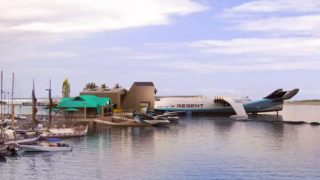
A smaller version seats 12 passengers and is the model most often discussed for the shortest Hawaii routes, with Mokulele listed among the airlines interested in operating it should it ever enter service. The vehicle itself is unusual but easy to imagine. It starts in the water like a boat, lifts onto hydrofoils as it accelerates exiting the harbor, and then flies just feet above the ocean surface in ground effect, allowing the craft to move quickly across the ocean without needing any runway.
Early timelines tied to that smaller aircraft suggested it could be in service sometime around the middle of this decade. That date appeared often enough in presentations and coverage that many readers came away thinking that at least the first harbor-to-harbor travel might be arriving soon.
The concerns were always there.
Even when the seaglider idea was getting its biggest accolades, BOH readers kept circling back to the same problem. Hawaii’s channels are not calm demo water, as in Rhode Island. The Kaiwi Channel between Oahu and Molokai, and the Alenuihaha Channel between Maui and the Big Island, are exposed to significant open-ocean swells, trade winds, and conditions that regularly delay or sideline even conventional boats.
One licensed pilot in our earlier coverage asked a question that remains unanswered: what are the actual wind and wave-height limits, and how often will Hawaii blow past them, especially in winter? If the craft only runs when conditions are good, exactly what happens the rest of the time.
Wildlife is the other problem. Hawaii’s waters are home to humpback whales, green sea turtles, and spinner dolphins, all federally protected. A breaching humpback can reach up to 50 feet above the surface, higher than the altitude where a seaglider is expected to operate. Readers raised early questions about whether scheduled service during whale season could move ahead without a federal environmental review that might take years.
Superferry got burned in part because it tried to move ahead without that process, and people here have recounted exactly how that ended. No public environmental review for seaglider operations in Hawaii appears to have been launched yet, although the Hawaii Seaglider Initiative and HDOT have said environmental issues are part of the planning process.
The damage from the October testing did not raise any of those concerns. They were already there. What it did was strip away some of the futuristic glow around this and bring it back to what it actually is: a vehicle still being sorted out. In Hawaii, where the promise was always routine service between islands, the same question remains. Is this really built for Hawaii, or was Hawaii just the easiest place to sell the idea?
The timeline has moved far beyond the early promise.
When seagliders first started appearing in Hawaii discussions, the islands were frequently mentioned as one of the early commercial markets because, while many disagreed, the geography seemed almost perfectly suited to the concept. Short water crossings between the islands and a steady flow of travelers moving between them every day made the idea easy to imagine.
Yet it is now 2026, and there are still no production aircraft. REGENT broke ground on its Rhode Island production facility in January 2025. As of early 2026, the company says the 255,000-square-foot plant is still under construction and on track to come online later this year. Certification, production ramp-up, full operational testing, and training all remain ahead. Even for established aircraft manufacturers, those steps typically take several years.
Early presentations highlighted $30 interisland fares.
The $30 fare has not disappeared. It is still referenced as recently as in REGENT’S January 2024 Hawaii initiative announcement. But in newer public Hawaii materials, including the later feasibility study rollout, that number no longer appears.
The military just became the main storyline.
As the commercial promise slipped further out, a different and potentially viable economic future for the aircraft came into focus. REGENT secured a contract with the U.S. Marine Corps worth about $15 million to explore how seagliders could be used across island chains in the Indo-Pacific.
Military planners are interested in the same features that once made the aircraft attractive for Hawaii tourism. That is the ability to leave the water, skim over the ocean, and land near shorelines without an airport runway. Throughout the Pacific, there are thousands of islands spread over vast distances, many without commercial airfields, and moving people, equipment, and supplies between those locations has always been a primary logistical challenge of the entire region.
Company leadership has described the Seaglider in those terms, discussing how the vehicle could support operations across Pacific island chains and referencing the dispersed island warfare that defined large parts of World War II’s Pacific campaign.
The geography that once made Hawaii look like the perfect commercial launch point is just what is making the technology interesting for military use across the Pacific.
The question now is how potential military funding will ultimately push the technology on so that Hawaii ultimately sees the harbor-to-harbor system that was promised, or whether the aircraft being developed today reaches Pacific battlefields long before it ever carries passengers between the islands.
Do you still believe seagliders could ever work for Hawaii interisland travel?
Get Breaking Hawaii Travel News


I hate to pop the sea-glider hysteria bubble but: 3. Practicality. OK this is the other thing. Will anyone use it. Much if not most of interisland travel by visitors is to connect to mainland transportation, so for them, it creates another connection link. Not very handy. Visitors may use it once just for the experience, like a tour, then what. Can use by locals pay for this? I think not.
4. Add up the above issues, The ticket price will have to be way more than the current cost of an airplane ticket. Locals are looking for a cheap alternative to airplanes. This isn’t it. Frankly, there isn’t one.
I2. Operating cost. So, these things are supposed to be electric, right? Hawaii has the highest electric utility rates in the USA. If they buy their recharges from Hawaii Electric, fugget-aboutit! Right away this is game over unless you recharge these batteries totally by solar to get past that hurdle. How much is that infrastructure going to cost? And where are you going to put it? Massive solar panel arrays and battery banks. Is this stuff going to be all right along the shore where these things moor? And passenger and docking facilities? Not cheap to build and maintain. hate to pop the sea-glider hysteria bubble but:
I hate to pop the sea-glider hysteria bubble but:
It will never compete economically against airplanes (without government subsidy). Who pays for that subsidy? You guessed it, tax payers. If Hawaii wastes money subsidizing this debacle, they are even stupider than I thought they were.
1. Unit cost. A Cessna Caravan which is operated by Mokulele airlines costs about 3 Million dollars. There are thousands of them in operation all over the world. FedEx has hundreds in the USA. This widespread usage reduces the unit cost of acquisition, not to mention maintenance and parts. Where else in the world are these sea gliders going to be used in order to bring the unit and maintenance costs down? I can’t think of many places. Unless they can be manufactured in scale, these costs will be astronomical compared to an airplane of similar capacity.
Hawaii has had many chances to develop an inter island system. Time after time there have been failures. Either because of ineptness or filing the incorrect documents and feasibility. Airlines will continue to prey on residents and tourists.
In addition to all the other knowledgable comments, $30??? A pipe dream being sold to a not so gullible audience later to find out the ticket cost will be may times that amount of money. Silliness…
As I mentioned before, the $30 ticket is not what attracts me to this project. What’s your background or do you just like to kill other people’s ideas? Status quo, anyone?
Please contact an aerospace engineer with knowledge about “wing in ground effect” craft before you publish your next article about this fiasco. These things work ok over flat lakes; any ocean going aircraft of this type will need a wingspan twice as wide as the expected swells are high. This guy is building model boats with other people’s money, soon he will start building full size death traps. It is sad to see the Marines wasting federal tax dollars on this, please don’t let any of your state money end up in this clowns pocket.
“It is sad to see the Marines wasting federal tax dollars”. Really? We have seen much worse here in Hawaii.: leaks from the Red Hill Bulk Fuel Storage Facility in 2021 and 2022 where the Navy not only contaminated drinking water for over $90,000 people causing widespread illness (and hiding the incident) to the P-8A plane overshooting a runway into Kaneohe Bay in 2023 …if we go further back, check out the 2001 Ehime Maru collision ….
Aloha. Hydrofoils, including personal use ones, hit and kill marine wildlife that is on or just below the surface and often can’t be seen. Some wash up on shore, like the turtles with the smashed and sliced shells, some sink in the ocean after suffering from their wounds. Hydrofoils are not the answer if we want to protect marine life, period.
I am equally concerned about protecting whales & turtles, but have you ever taken the ferry from Lanai to Maui in winter? Also, most injuries and death of whales and turtles are from discarded fisher nets and plastic, so let’s start with those, since that is an “existing” problem and has been for a while now.
Both Joby Aviation (jobyaviation.com) and Archer Aviation (archer.com) have developed all-electric air taxis that are nearly FAA-ready for commercial employment. They each have a range of up to 150 miles on a single charge and cruising speeds around 150 mph. Though the Big Island might be beyond range from Honolulu, the other neighbor islands would be within reach. With a limit of 4 passengers, the estimated cost per trip might be the same as a street taxi traveling a lengthy distance with 4 people.
A bus or train is less expensive than a taxis because you can fit more people in it. Therefor, it’s going to cost less to transport 12 or more people than just 4.
Let’s take bets on which happens first. Riding in one of these planes to the next island, or hopping on the rail at Ala Moana 😂
Rail, these things are a pipe dream.
Ground effect is typically about one wingspan above the surface. However with swells, I suspect that the one wingspan with a small craft like this would realistically mean it would have to be some distance above the top of the swells, which would indicate a craft with a larger wingspan would be required, which would then mean a reduction in the frequency of service. For a craft of the size currently being developed, to get high enough to aavoid the larger swells, would make it a regular fixed wing aircraft and thus require FAA certification which would add significantly to the development cost.
The team at Regent already has a commercial backlog of Seaglider vessel orders worth more than $10 billion, secured a $15 million U.S. Marine Corps contract & raised over $100 million from world-class investors. I have been following them since the beginning and absolutely love the idea. It’s unfortunate that other countries see their value before we do ….
We have whales randomly breaching 40-50 ft out of the water 5 months of the year. It won’t end well. Great for the great lakes, Miami to Nassau, Cancun to Cozimel. Not for Oahu to Molokai, sorry
It’s a pipe dream. If you oppose everything, you get nothing. It’s should be the state motto.
I hoped for the sake of HI that this interisland travel concept would be a winner for the islands. Bummed to see it struggle.
It can still happen and I would be so excited to “glide” from Lahaina to Molokai!
“being exposed to significant open-ocean swells, trade winds, and conditions that regularly delay or sideline conventional boats” was one of the reasons I thought the seaglider would be a better option. After all, it can lift up like a plane. That said, I am worried about them hitting whales …so that would need to be sorted out before an operation like this can ever start in Hawaii. I still like the idea because the ferry I took from Lanai to Maui (and vice versa) was not a peace of cake and I did not have the impression that the captain was worried about whales when speeding through the waves. In addition, it’s powered by oil …so yes, I am still for the all electric seaglider.
With 12 passengers and a crew of 2 the economics don’t pencil out. Most trips would be less than full and losing money unless Heavily subsidized.
The first whale strike will injure or kill all on board and end the pipe dream.
Just like California high speed rail, the solution to more efficient air travel is obvious.
Make a separate commuter terminal on Lagoon drive. Have planes waiting like busses.
No reservations.
Planes leave when full, or every 45 minutes.
Walk up, swipe credit card, show global entry or clear to TSA,
Walk thru x-ray onto plane and pick a seat.
I recently flew from Raiatea to
Papaete and there was no TSA
and it was just like the old days.
Walk 200 ft from your chair in the airport and 4 steps up into the plane.
If the planes are small enough they should be considered “non-hijackable” and exempt from some of the cumbersome regulations.
“Early presentations highlighted $30 interisland fares.”
Riiiiggghhhtt. That’s not going to happen. To much technology involved as well as needed infrastructure to only charge $30.
It’s still going to be cheaper than taking an airplane (+ all the hassle involved with it). I am looking forward to the alternative and wouldn’t mind paying more than $30 for it.
I truly doubt the cost would be cheaper than an airplane. Nothing in the volumes of information I’ve read would lead one to believe that given manufacturing, operating and costs already incurred by the manufacturing company can be utilized cheaper than an airplane.