
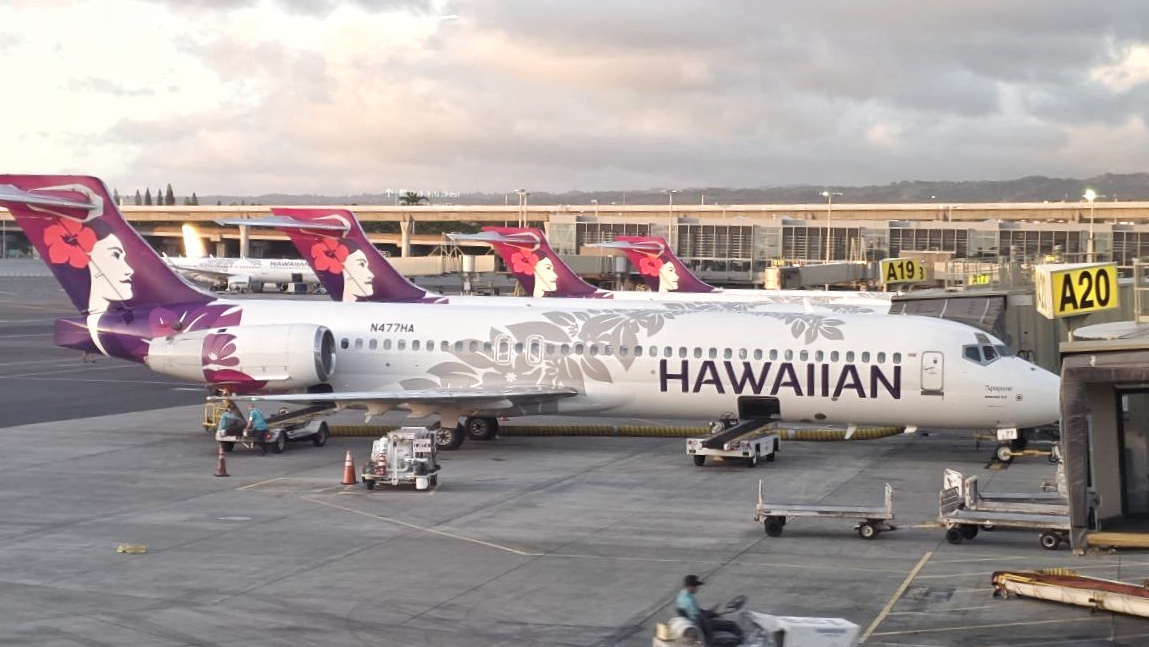
You may think you are booking a Hawaiian Airlines flight when you plan a Hawaii trip. The cabin may still feel like Hawaiian, and the aircraft may still carry the familiar livery. But when you go to book through a third-party site (like Expedia), something different already appears.
On multiple routes, the first thing travelers now see is Alaska Airlines branding, with Hawaiian reduced to a small operated by notation beneath it. That is not an airline promise or a political reassurance. It is the real world outcome already showing up in the tools people actually use to buy tickets. It leaves the question of whether the internet sometimes reveals truths even before airlines do.

We have already written about the end of Hawaiian flight numbers and how long dual branding between Hawaiian and Alaska is likely to last. Those articles dealt with symbolism and corporate commitments. This one deals with evidence. What you see when you search is often the earliest and most honest sign of where a merger is heading. The transition from Hawaiian to Alaska is now visible before anyone has formally declared the brand’s fate.
What travelers are now seeing when they try to book Hawaiian.
In recent searches on major Hawaii routes, flights that once appeared under Hawaiian branding now show Alaska in the primary position, with Hawaiian in smaller type beneath it as the operating carrier. To an airline insider, this might feel like a routine systems update. To a traveler, it feels like a brand being eclipsed in real time.
This is not an isolated glitch. Many travelers have noticed similar changes on flights to the West Coast and to neighbor islands. Hawaiian is still operating the aircraft, but the booking environment is no longer treating the airline as a standalone brand. It is blending it into Alaska even while the public language still speaks of two identities.
For many people, the booking moment is the emotional moment. It is when they imagine their trip and choose the airline they trust. Seeing Hawaiian replaced by Alaska on that screen above (Expedia) is a shift that happens quietly but lands with more impact than a press release. It is the point at which the merger becomes personal to your Hawaii vacation.
As one longtime reader told us today, booking is all too confusing. “You book on Alaska but you have to go to the Hawaiian website to get your seat reservations.” It is another sign of how the two brands are already overlapping in ways travelers feel long before the airlines admit it. Nothing feels clear right now.
Why this shift shows more than branding, it shows alignment.
Booking systems do not themselves make any aesthetic judgments. They reflect how networks, codes, and revenue structures are being unified behind the scenes. When an acquisition reaches the point where one brand is prioritized in search and the other becomes a secondary identifier, the direction is clearly already well established. It means the company is already leaning into a single identity for how flights are sold and displayed, even if the physical aircraft and other branding have, at least not yet, changed.
Public protections tied to the merger require Alaska to maintain Hawaii service for six years starting in 2024. That commitment, with the Department of Transportation, was to ensure that essential routes and capacity would not disappear as the airlines combined. At the same time Alaska has said that guests will continue to enjoy our distinct Alaska and Hawaiian brand experiences. That wording came from the company, not from regulators, and it was never tied to the six year service window in any way.
That direction became even clearer today. Aviation reporter JonNYC confirmed that Hawaiian Airlines joins the OneWorld alliance on April 22, 2026. That is also when the HA flight code ends and all flights shift to Alaska’s AS code, a change we covered when the 95-year-old HA code was first announced to be retiring. The brand name survives, but what booking screens show today is where the systems are already heading.
Booking systems, revenue codes, and flight displays do not wait for press announcements or ceremonial dates. They shift as soon as the back-end integration occurs. In almost every airline merger, the technology that sells the tickets becomes the earliest signal of which brand will lead and which one will slip into the background. That appears to be happening now, even while the official promise of dual branding remains in place.
Why Alaska’s all-Boeing reality matters to Hawaiian’s long term identity.
There is another layer that has not received enough attention. Alaska is, to the extent possible, an all-Boeing airline. Hawaiian is primarily an Airbus operator. That difference becomes significant once fleet planning decisions begin to intersect with brand strategy.
Hawaiian’s A330s continue to serve long routes well, but they are not part of Alaska’s own existing narrow body or wide body strategy. Hawaiian’s A321neos have faced the same engine challenges seen elsewhere, and the 717s, while ideal for interisland flying, are aging quickly and will require replacement in the near future.
Recently, Alaska signaled publicly that the A321neo fleet Hawaiian brings is too small to maintain as a permanent sub-fleet. Airlines rarely speak in absolutes, and when they do, it is worth noting. Calling a fleet too small to keep is not speculation. It is a clue about the long term shape of the operation.
Over time, a unified brand becomes more efficient when paired with a unified fleet of planes. That does not mean the A330s will disappear quickly or that interisland flying will change overnight. But the broader direction is clear. The Alaska operation is built on Boeing, pure and simple. As Hawaiian’s aircraft come up for retirement or require expensive overhauls, the natural path is toward simplification. That supports a single brand if at all possible, not two.
Traveler booking screens reveal the future before airports do.
Airports change slowly. Paint changes even more slowly. But booking displays change fast because they reflect decisions that are already locked in, not ones waiting to be announced. When an airline chooses which brand appears first in search, it is signaling to partners, revenue systems, and travelers which identity will carry the combined airline forward.
This is why the recent shift feels so different from the administrative changes that came first. Travelers can see this one themselves. They do not need an explanation of codeshares or merged reservations systems. They only need to search for a flight and watch which airline shows up in bold and which shows up in small print. They can see which brand is leading and which one is receding.
Some passengers have described emotional final flights on routes that once defined Hawaiian’s identity, with crews acknowledging that change was underway. This sense of transition is now accompanied by visible changes in how the airline is presented when people book Hawaii travel.
What travelers should expect next.
Travelers should expect the booking environment to lean even more heavily toward Alaska as systems continue to integrate. The physical airline will take longer to reflect that, but most people make decisions long before they arrive at the airport. When the online experience shifts, the traveler experience shifts with it. That is why this moment matters.
People can still fly on aircraft that say Hawaiian. They can still hear the same greetings and see the same crew uniforms. But the identity that appears when they choose their flight is beginning to tell a different story. It is the story of a brand that is already blending into another, long before any official sunset date is announced.
Have you noticed Hawaiian disappearing from your booking results and being replaced by Alaska, and how does that change your feelings about planning a trip to Hawaii?
Get Breaking Hawaii Travel News




Well Hawaiian management ran the airline into the ground, had technology from Soviet Russia era, treated their elites the worst of any US carrier (top status still didnt get Extra Comfort at booking for free), and outsourced its call center to the Philippines in a betrayal of the Hawaiian People. HA was functionally insolvent due to a feckless leadership team. AS saved them from liquidation.
Matthew, I was formulating a response in my mind before I read your comments. Now I don’t need to. You brought to light exactly the reality of what happened. When a business is run as poorly and customers are as frustrated by such a company as Hawaiian, the takeover should bring about many changes. Our flight to Maui in First Class on Hawaiian in October, has me happily booking with Alaska going forward.
Wouldn’t a simple name change like Alaska International , Alaska
world, Alaska Global or such release them from all promises and obligations?
New name different tax structure and contract liabilities. Just like a new business not accepting coupons from an older name establishment.
Who’s kidding who? Nothing and I repeat nothing is promised in life. Just like job security. The only thing guaranteed in life is death and taxes. Other than that expect squat.
Original trip confirmed Hawaiian from PDX to RAR with plane change in HNL. Now small Alaska plane from PDX to HNL and 2 different confirmation codes that I need to access for my Feb trip one to HNL and then one to RAR. Still waiting for my Hawaiian Miles to transfer to Atmos, after 2 phone calls.
I recently took my 4th trip to Hawaii’s 9th Island (had 3 already confirmed prior to Atmost implementation) when I made arrangements for my 4th roundtrip, I had no issues, I used my HM Barclays card as I normally did to pay. When I checked in, I had an unwanted surprise – a $40 bag fee. I used my HM Barclays card and informed the friendly staff at the bag drop area who apologized but could not assist. Gave me the number to call. Long story short, no refund to date, no qualification confirmed (as this was my 4th roundtrip) Atmost only showed my recent flight. I will be escalating (again)
This is just like United Airlines promise when they merged with Continental Airlines. The same thing happened with Delta & Nortwest, American & US Airways, along with Southwest & AirTran. All of them lost their identity, (How long will Hawaiian’s truly last?) their loyalty programs, and frequent miles or hubs.
Individualism is bain
and too costly for these mega airlines. The employees of the company that was taken over and their customers be damned.
I hear what you are saying. I normally book by available seats. Good luck with that. Whether on HA or AS website it wants you to book before showing seats. Who does that? The Atmos integration has been bad and only going to get worse.
Ticket prices seem to be up as well as FF awards. $8500 business to SYD from KOA really? I have 500k miles to use up and $3100 in gift cards.
Once these are used up I will be done with HA/AS.
Good article gentleman.
I prefer flights on Hawaiian. The few I’ve taken on Alaska used shabby, worn-looking aircraft. I will automatically choose Hawaiian first, but that may not be possible for much longer.
Hawaiian currently offers the most nonstops to places I visit from Maui. If I have to change planes in Honolulu, then I will utilize the most convenient airline, including United, American, etc.
Sorry to see the Hawaiian brand dissolve, but I understand the economics of it.
We have the same situation where I live in Spokane WA. Horizon Airlines is the regional carrier, and it too is owned by Alaska Airlines (like Hawaiian now is). For the past 25 years, we have the same dynamic when booking and when boarding. It’s usually “Alaska Airlines, operated by Horizon Air”. For you it’s now “Alaska Airlines operated by Hawaiian Airlines.”. I think it may have to do with the flight numbers registered with the FAA. Not sure this will be true for you, but I still see Horizon Airlines when I book and when I board, and it’s been 25+ years of that…even if Alaska owns that business. PS: I did love the former Hawaiian Airlines. Haven’t flown to Hawaii yet since the merger.
This makes me so incredibly sad. We’ve always flown Hawaiian on our three yearly trips to the islands to see family. We did make one direct flight to Kona on Alaska, but discovered that there is a very different feeling between the two airlines. Hawaiian is more welcoming, and we prefer their aircraft to the 737s. We also feel the service was better and more welcoming on the Hawaiian flights. Wish we could turn back time.
I agree with you Lee, but if we could turn back time, I would travel back and forth on a Continental 747, like I did in the 1970s! Best flights ever with a pub in coach class. (Plus, I would be a teenager again, lol.)