
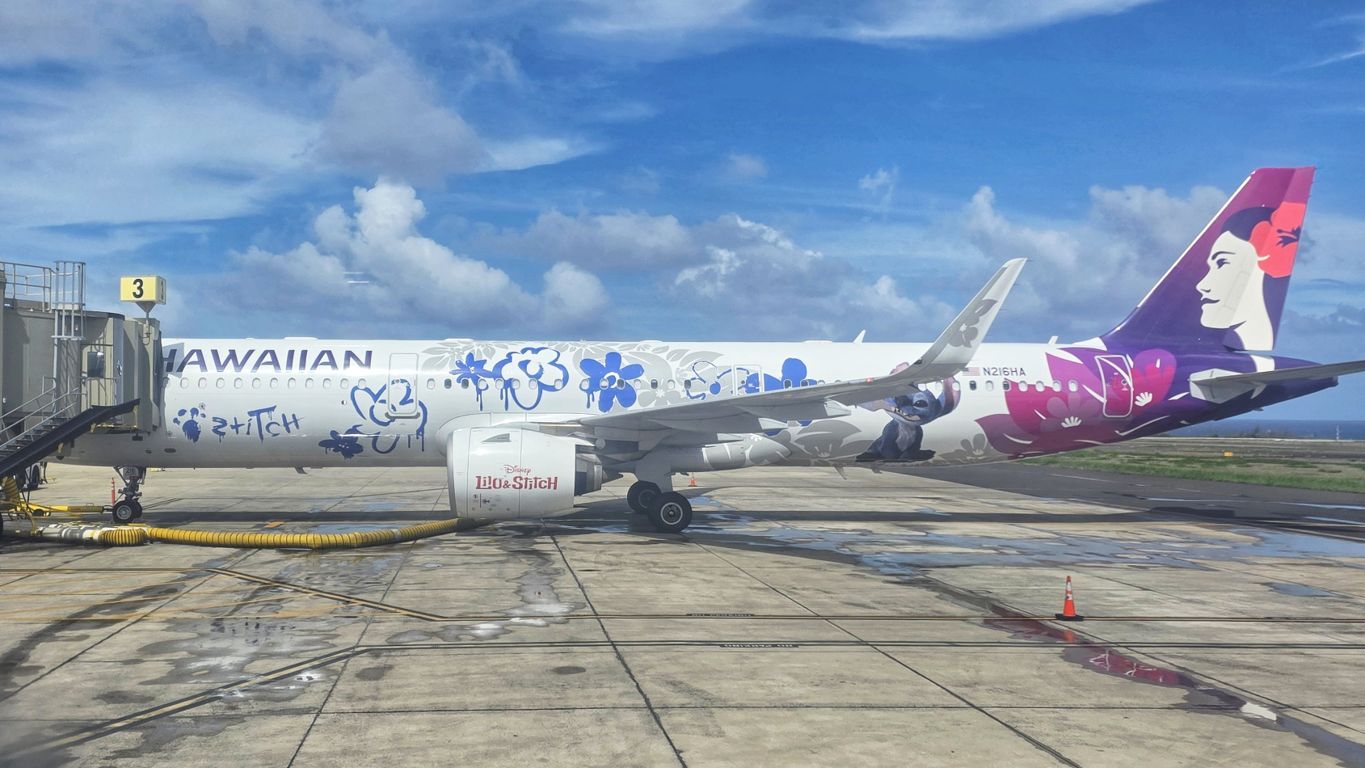
Hawaiian Airlines just posted another year of losses, even as its Seattle-based owner celebrated beating Wall Street expectations, placing the largest aircraft order in its history, and more. The contrast clear, and the timing is telltale for anyone hoping that the Hawaii side of this story is already settled.
For 2025, the Hawaiian Airlines unit lost $189 million before income taxes during its first full year under Alaska Air Group ownership. That is an improvement over the airline’s final years before being acquired, when losses ran about double, close to $1 million per day. But improved does not mean fully healthy, and the Hawaiian segment remains firmly unprofitable.
Alaska disclosed the results Thursday alongside its broader earnings report. While the parent company posted adjusted earnings of 43 cents per share, well above analyst expectations, Hawaiian Airlines continued to weigh down the combined operation. The Hawaiian segment alone lost $60 million before income taxes in the fourth quarter.
For Hawaii travelers watching this acquisition play out in real time, this is the first full set of numbers that shows what the process of saving Hawaiian Airlines actually looks like on the bottom line.
The numbers behind the headline.
Hawaiian Airlines generated $3.3 billion in revenue in 2025, yet still failed to turn a profit. The $189 million loss represents the segment’s income loss before income taxes as reported by Alaska itself.
Losses were cut roughly in half compared to the airline’s pre-acquisition collapse, bringing the daily burn rate down to about $518,000. That improvement is real, and Alaska deserves credit for stopping the prior bankruptcy-headed free fall, even as the absolute numbers remain deeply negative.
Hawaiian Airlines is no longer in crisis mode.
However, Hawaiian is also nowhere near self-sustaining as of today. Losing half a million dollars a day is still significant.
Alaska acknowledged that reality indirectly in its 2026 guidance. The company projected earnings between $3.50 and $6.50 per share, a wide range that signals significant uncertainty as much as confidence. The $5 earnings mid point was short of analyst expectations, sending shares down about 2% initially in late night, after-hours trading. It then rose nearly 7% so far today.
CEO Ben Minicucci highlighted what he called “the most significant integration milestone to date,” pointing to the issuance of a single FAA operating certificate for Hawaiian and Alaska. Operationally, that’s important because it will greatly simplify how the airline runs. Financially, it does not erase Hawaiian’s ongoing losses or likely change the near-term path.
Big Hawaii promises meet financial reality.
The earnings report landed just weeks after Alaska unveiled its Hawaiʻi Investment Plan, a $600 million, five-year promise to refresh Hawaiian aircraft interiors, modernize airport spaces, and upgrade technology across the islands.
Those commitments sound reassuring to some travelers and employees. They also raise obvious questions about their timing and prioritization, given that the Hawaiian segment continues to operate at such a substantial loss.
Alaska pointed to several bright spots across the broader company, including strong bookings in January and the new international routes from Seattle to Europe that are now on sale. That mentioned momentum, however, isn’t centered on Hawaii travel or driven by Hawaiian Airlines.
While Alaska admirably continues to grow its mainland and international footprint, Hawaiian Airlines remains largely a domestic and interisland operation with high costs, aging aircraft fleets, and intense competition. The gap between Alaska’s growth initiatives and Hawaiian’s still losing money remains.
The fleet tells a story.
Alaska’s fleet strategy tells a lot. This month, the airline announced orders for 105 Boeing 737-10 aircraft and five additional Boeing 787 Dreamliners, along with options for 35 more 737-10s. By 2035, the combined fleet is expected to exceed 550 aircraft.
Those Dreamliners will all wear a new global livery and operate long-haul international routes from Seattle. Hawaiian Airlines’ aircraft, to the degree revealed by Alaska, will not be part of that growth. Yet the question remains whether Hawaiian could become a mostly Boeing 737 airline, given Alaska’s own Hawaii history, and the huge new plane order.
Hawaiian’s core fleet still consists of aging A330 widebodies and even older 717 aircraft flying interisland that are expensive to operate and increasingly challenging. A330 interior refreshes are promised under the Hawaii plan, but little is known in terms of details, and the long-term strategy is plainly centered on Boeing standardization and Seattle-based growth.
For Hawaii travelers, fleet decisions will shape seating comfort, route networks, reliability, and ultimately whether Hawaiian Airlines remains a distinct and separate operation or, as some believe, slowly fades into a supporting role.
Loyalty changes, and whose program it really is.
Hawaiian Airlines will join the oneworld alliance this spring, giving prior HawaiianMiles members access to a global network of partners. That represents a significant expansion beyond prior Hawaiian Miles’ historically limited partnerships.
At the same time, the press release reinforces what travelers are already sensing. Atmos Rewards is repeatedly positioned as Alaska’s loyalty engine, while Hawaiian appears more of an add-on than an equal pillar of the new program. Even when Hawaiian is mentioned, it is within Alaska’s broader loyalty strategy framework.
Travelers are becoming savvy to the fact that airline loyalty programs are no longer side benefits. They represent huge airline profit centers, brand anchors, as well as decision drivers for at least the most frequent flyers. If Atmos Rewards serves Alaska’s greater network and growth goals primarily, Hawaiian’s role could be less strategic than symbolic.
Alaska’s best case 2026 scenario.
To achieve its top 2026 earnings guidance, Alaska said it will need sustained macroeconomic recovery at or above its early-January trends, alongside stable fuel prices. That is, of course, unknown in an industry that is vulnerable to shockwaves.
The airline also projected a first-quarter loss of $1.50 to $0.50 per share, stating that early in the year, losses are typical industry-wide. Hawaiian’s specific contribution to that seasonal loss was not detailed.
For Hawaii travelers and residents alike, the takeaway offers at least some clarity. Hawaiian Airlines is no longer collapsing towards bankruptcy, but is not yet thriving. Alaska has stopped the huge financial bleed, while much more work remains.
As you watch Hawaiian Airlines under Alaska’s new ownership, do these results feel appropriate during the rebuilding phase and do you think Hawaiian remains the priority that it once was?
Get Breaking Hawaii Travel News





Uh, methinks you don’t even know what an A220 is.
With the geared turbofan, high-bypass ratio, narrower fuselage and much lower To Weight? In the sub-150 seat capacity? It trounces anything B737 adjacent with much lower fuel costs, landing fees and operating expenses.
A220 is Absolutely the winner in specific fuel consumption. A quick gander at equivalent air hops like LCY in London– those are ALL fast, short hops to Amsterdam, Orly, BRU-Brussels, Dublin and the like. 100-500 miles, lower seat capacity, far lower per seat operating expenses– especially at the lower FLs the inter-island flights occupy.
1. There’s no such thing as Hawaiian Airlines as an entity anymore. The brand is being kept, but the company doesn’t exist – it’s Alaska now.
2. SOC didn’t happen until October, meaning for most of 2025, the Hawaiian side was largely stuck with the unprofitable operation they’d been running before the merger. Only during the last couple months of the year was Alaska able to really run the airline as one combined airline, which is where the efficiencies lie. So 2026 performance will be much more telling.
Probably drop the whole inter-island flight business model would be helpful to their bottom line. Let the State worry about interstate commerce.
What is going to happen is the 717s are going to start being retired. Alaska will simply take it’s 737s flying from the mainland and run them on a continuing interisland flight or two. Really like the Southwest model.
Slowly retire and repurpose the staff to other routes.
Uh, no. That’s a model that’s cost WN hundreds of millions per year.
Not to mention that AAG-HA will not have enough aluminum on the ground on all the islands combined to make that work.
Unless they simply down-scale Hawaii operations? They need something smaller and more fuel efficient. RJs, ERJs, EMBs or the A220s that have been floated as a solution.
Actually, Hawaiian Airlines situation is worse that it appears. The $189 million they lost includes the A330 freighter operation for Amazon, which was profitable. Without it, their loss would have been even worse.
Industry experts familiar with both companies say Alaska Airlines’ dissatisfaction with the Amazon (NASDAQ: AMZN) business likely stems from difficulties aligning passenger and cargo pilot schedules for better efficiency, and contract terms with razor-thin profit margins.
Alaska Airlines wants to renegotiate the cargo flying contract with Amazon it inherited after acquiring Hawaiian Airlines 16 months ago because the venture isn’t very economical, a top executive strongly suggested last month.
When booking a future flight on HA, you cannot chose your seat until after you purchase the ticket. An agent did say I can call the reservation line and verify if the preferred seat is available. Hope that it is true.
Another topic: Recently was scheduled to go to HNL and there was a time change and I was not notified about it. Luckily, I saw the change the night before and luckily was able to rearrange my rides in HNL and in ITO. No text message or email of changes!
This is all corrected in April when the flight reservation system is fully implemented to Alaska’s.
So yes – for the next 3 months it is a problem
Elaine, I’m not certain if this is your situation but if you purchase airline tickets using a third party vendor (i.e., Travelocity, Expedia, Cheapo Air, etc.) instead of the airline’s official website, you are now a client of an Online Travel Agency (OTA). Any changes, delays, cancelations of flights is communicated to your OTA who is supposed to notify you however, that rarely occurs. It is always prudent to purchase your airline tickets directly with the airline to avoid no communication.
Hawaiian airlines was about to go under. It posted major losses year after year. Yet people still complain about Alaska like it was the big bad wolf. Honestly, I don’t get why Alaska even wanted it. For the planes? Nope, the whole fleet is aging. If Alaska hadn’t bailed it out it would’ve been gone soon so it’s time to move on. Life is all about change. It was great while it lasted but it was unsustainable.
Deborah, regarding aircraft age, Hawaiian is one of the leaders, if you remove the 717, which was well known is going to happen,
Across the entire airline, Hawaiian’s average age is 13.5 years, but this is weighted down substantially by the 717 aircraft. 19 aircraft are 24 years old. Pull this out and the average age is much, much less.
A321 Avg Age 7 years (18 planes)
A330 Avg Age 12 years (34 planes)
717 Avg Age 24 years (19 planes)
787 Avg Age 2 years (4 planes)
Plus Hawaiian has rights to many more 787 orders
Once the 717s are removed from service this is going to be a very low avg age of aircraft.
Compare:
Alaska 10 yrs avg
American 14 yrs avg
Delta 15 yrs avg
JetBlue 12 yrs avg
Southwest 11 yrs avg
United 15.4 yrs avg
It’s hard to say. It got them the 787’s quickly, and the orders HA already had. They could consolidate business from the West Coast to Hawaii and not compete against each other in a low-yield market.
They probably will be able to do well with cargo when they ultimately can carry it from Rome all the way to Sydney.
The 787’s allowing the international business out of Seattle will bolster them against Delta which will be willing to lose money there because it is their transpacific gateway.
I’ll be interested to see of they sell off South Pacific not-Australia and New Zealand business to United so it can add to its old Air Micronesia routes.
They have way more A330’s than they need so something will happen to them.
They have the Amazon contract which AAG just said is profitable.
I think the basic answer is that AAG bought Hawaiian Airlines not for what they are, but for what they can become.
My wife, daughter and I recently flew flew HA to Hawaii. Round trip flight delayed 3-4 hrs each way. Took 3 days of calling to get seat assignments. Service was poor !
I will not fly HA again.
We come to the islands 2 or 3 times a year from Salt Lake City and were thrilled to hear of the new direct flights with Hawaiian Airlines to Hawaii. The news of old planes with deferred maintenance issues does cause concern however; so I hope the next news is of aircraft upgrades and maintenance or else we will be forced to use other airlines
Hawaiian has always been our airline of choice for 20+ years with many trips all islands of Hawaii. The 2 year plan and now the take over by Alaska with basically few flights and reasonable flight times offered by Hawaiian have soured our desire to accept Alaska’s takeover. After reading this story all I can say is.
Coming soon: Alaska writes off Hawaiian and takes it as a tax loss.
Now let’s talk about the State of Hawaii’s money grab in added and higher fees to visit the islands……….😬
That’s exactly my thought. They are going to gut HA and write it off. All while paying their c-suite hundreds of millions in salaries and bonuses.
The takeover has left us with fewer choices, less information, more add-ons. Seatguru is now dead too, so figuring out which ‘comfort class’ seats are little more than 3″ of legroom for an additional $100 is all the more challenging
Well, either way then, Hawaiian would be toast. They haven’t made a profit since 2019, 2025 being their 6th year of losses. Nobody was interested in buying them because they are a losing proposition.
So the alternative was they would go bankrupt and liquidate because other than the 787’s, they had nothing anyone wanted, and Southwest would be providing the only interisland service.
Would you have preferred that alternative?
Here’s the reality of operating to, from and within the islands: the majority of traffic is tourism driven, aside from interisland where the CASM is astronomical, so it’s difficult to make a profit on seat revenue. Most of the bookings are point redemptions, which are seen as a liability on the balance sheet. Furthermore, Hawaii is a loss leading segment for most company’s, but it’s a requirement to sell credit cards. Expect further fleet consolidation, the wide body aircraft to fly elsewhere, and for Alaska to make it as profitable as it can be.
Most airlines with A330, hv filed for bankruptcy. Why. Huge maintenance costs that no one talks about..this is a fact with no solutions other than bankruptcy. The only way out is to maintain A330 your own engineers and get rid of A330 soon.
I can help Hawaiian airlines get to make $$$$$
But they wont call me.
Alaska’s management went in with absolutely no plan. Just because you own wide-bodies doesn’t mean you’re on par with United or Delta. Even Alaska’s new routes don’t make sense. Why on Earth would I fly Alaska to Seoul when Korean has Far superior service. All in all I think the Alaska Air Group is going to be a poor performer over the next few years. They flew too close to the sun.
You think they came in with no plan, eh?
They just spent a couple billion dollars and said, “Eh, I dunno. Let’s take a look.”
Good grief, Kyle S, good grief. If you want to take Korean Air, so be it. But most Americans would prefer a US carrier. And connections via Seattle allow for about 100 different connections vs. the 12 from Honolulu. This alone, makes sense.
Alaska was the ONLY suitor for Hawaiian. It was either Alaska or liquidation. Alaska welcome the opportunity because it could strip the 787s and the infastructure and move it to Seattle, where it was better positioned.
Alaska always had a plan for Hawaiian and it was to make better utilitization of aircraft and staff. It’s doing that now, but still has some work to do. Whether this is enough to make the Hawaiian segments profitable remains to be seen.
In the end Alaska is a better airline for absorbing Hawaiian.
Seriously, though, HA was already standing on a guava skin next to a grave Before Southwest came in and messed up the economics for everybody.
I see all those WN planes flying empty between islands and just wonder what they could possibly by thinking. It’s a Zero Sum Game that Southwest (fighting their own internal battles) wanted to turn into “Everybody Loses”.
Oh, make no mistake about it. There is plenty of “urgency” in making Hawaiian Airlines profitable. AAG’s stock has held up reasonably well because investors had faith in its management that they would execute the merger and integration in a timely manner.
When AAG is saying they need better “macroeconomic conditions” and UA says “everything’s coming up roses”, there is a great deal of urgency.
Hey! At least we can fly Aloha…
Ohhhh. Too soon?
Maybe it’s because they keep raising prices and continue to put loyalty rewards out of reach and earning such, not worth the difference in savings by flying other, lower cost airlines
Take away the 10% interisland family discount for locals and the free carry on charges that Hawaiian’s get and maybe Hawaiian Airlines might be profitable.
That 180 million loss now comes closer to zero. How many flights are half empty serving interisland flights? IMO there’s your loss.
Unfortunately for the Hawaiian Airlines side………the “Aloha Spirit” does not pay the bills. Change must happen for it to be profitable or “Hawaiian Airlines” will disappear and the eskimo will be flying inter island and Pualani will be long gone.
That pretty well sums it up.
In the past year I’ve never encountered anyone in a conversation about the Alaska acquisition of Hawaiian who was in favor of it. Nor am I, but the sad truth is Hawaiian would have ceased to exist, but for the bail out. As with most businesses the party bailed out, endures dramatic changes. The become the poor cousin with diminished identity.
re: Hawaiian losses.
That big loss just posted for Hawaiian may be the excuse Alaska needed to fully integrate the two airlines, just like they did very quickly with Virgin America. My predictions: First, the refurb job on the A330 fleet will strip away all Hawaiian cultural accents on the interiors plus repaint the exteriors into the new Alaska 787 colors and branding. Second, look for the A321 fleet to go away sooner rather than later. Third, fully integrate airport operations with new uniforms, integrated ramp services, single set of ticket counters, etc. Everything in Alaska colors and branding except maybe for small signage with Hawaiian branding. And if the current Alaska management team is too slow or cautious to stem the Hawaiian losses, look for a hostile takeover, just like what happened at Southwest. Wall Street doesn’t like to see money left on the table.
AAG doesn’t need “excuses.” They will make whatever business decision they think will be in the best interest of the stockholders, which is the sole reason a publicly traded corporation exists.
Try real question is how will Alaska Air plan to replace the interisland 717 planes. I liked the SWA model where they fly in from the mainland and then shuttled between the islands and then returned back to the mainland. I can see this happening when the A330s are removed from service and probably replaced by an all B737 fleet for interisland and west coast travel and the B787 serves international.
I’m not sure. Southwest’s model was based on not being able to have overnight flights, so an aircraft couldn’t leave the West Coast any later than mid-morning to be able to get to Hawaii, turn around, and get back to the mainland before midnight.
The point of the interisland service was to be able to leave the West Coast later in the day, get to Hawaii later in the day, and then fly interisland for the rest of the day.
Southwest has said they are losing money on their inter-island service, but I haven’t heard anything about they mainland service.
Seeing as how they announced they are building a lounge in HNL, but that’s all they’ve said, I have a feeling Southwest is going to go like United where all the flights to Hawaii are turnarounds with no inter-island service. If inter-island service were profitable, UA would have done it ages ago when Aloha folded.
I’m Maui-resident, but on the Mainland half the time.
United has started leaving some MAX planes (notably from LAX and SFO) on the ground overnight at OGG, which they had traditionally never done. It’s nice to have morning departures back to CA gateway airports. Even with the time change you can get to connections in LA or SF for onward travel– which was never possible in the old days.
HA’s bread-and-butter was always inter-island, since Aloha’s demise years ago. The cheap fares were gone and biz travelers going to HNL for the day for meetings (and vice-versa) were paying a lot more for the pleasure. Those higher fares had given HA some breathing room since The Big Crash and Since The Big Bug. With Southwest offering a pile of low-price seats just to keep aluminum flying from KOA to HNL to OGG and Lihue? That was it for HA’s cash cow.
AAG probably overpaid. Nobody else was standing in line to buy it or re-structure it.
They have telegraphed, quite strongly, that A220 is about the only modern airframe that suits the density and Short Hop nature of the routes. I don’t see how the New Alaska stays All Proudly Boeing, even if they let the 330s and 321s go back.
They have a uniquely high cost structure on the jet fuel on the inter-island routes, so they’ll go for the most fuel efficient A/C short of backsliding to the remaining Dash-8s or Fokkers or Italian turboprops.
Ain’t gonna happen. The A220 is not at all optimized for short hops. No current airliner is. The plane is too expensive to buy. The short stage lengths don’t give it a chance to do what it does best-good seat/mile costs.
But most importantly, AAG is never going to have a 20-odd plane sub-fleet based in the most expensive place to do business in the US.
I’m betting they will ultimately ditch the A321’s, get 737’s, and cycle them through to the mainland as Southwest does.
Think about this: the 717’s are presumably paid for and depreciated out. Whatever AAG does, inter-island service is going to get a lot more expense to operate, whatever new plane is selected, so changes will have to be made from the way it’s done now,
The problem with all these scenarios is that none of them are good. AAG is looking for the least bad choice.
What is the latest on the future of the Barclay card?
Hate that Alaska Airlines took over Hawaiian Air..As someone on the east coast who likes to visit Hawaii was disappointed when flights were stopped from Boston.
Do not want to travel long distance on small aircraft. Do not want to travel to Seattle. Took non-stop from Boston and upon stepping on the plane I felt the Aloha spirit. So sad will not be able to experience that again.
Flew Honolulu to San Jose once and did not enjoy at all. Again Do not like flying on a 737 over water and for that distance. I look for comfort.🤨
It was Hawaiian’s decision to end the BOS-HNL
route. This was before the merger. It was not making enough profit. Expensive flight for HA.
Corporations/Businesses (airlines) needs to make money. If this route (BOS to Honolulu) was profitable, other airlines would have jumped in. As I said before, unfortunately the “Aloha Spirit” does not pay the bills.
The route was coming to an end anyway. Hawaiian was on the verge of liquidation.