
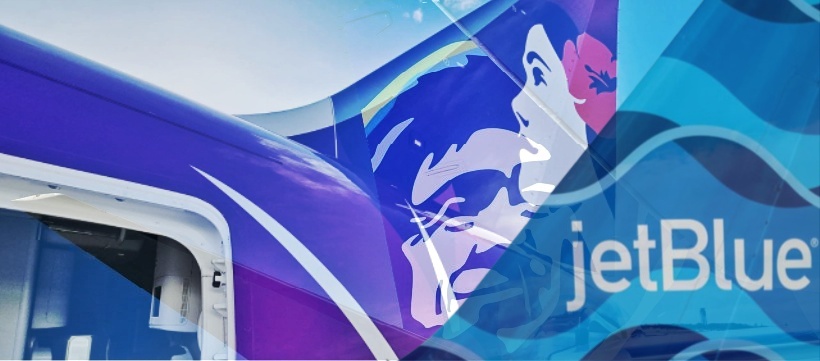
Fifteen months ago, we asked whether the Alaska-Hawaiian acquisition was connecting the dots between Alaska and JetBlue. This week, it was reported that JetBlue has hired advisers to explore a sale, and Alaska was specifically scenario-planned as one of three potential buyers. For Hawaii travelers, it’s a question about who controls your flights, your miles, and your access to the islands going forward.
Hawaii as Alaska and JetBlue connector.
Alaska is strong and growing on the West Coast and now in the Pacific too because of Hawaiian. JetBlue is strong in Boston and New York. There is little overlap, which is a key to why this keeps coming back into the conversation.
Alaska is also neck-deep in absorbing Hawaiian, and that changes this considerably. The operational merger date is April 22, 2026. That is not some minor back-office milestone. It is the point at which the two airlines cease operating separately and the reality of the acquisition becomes even more visible to customers, employees, and loyalty members.
Alaska makes sense on paper, but the timing and financial equation perhaps less so. Alaska isn’t sitting around looking for another project. It is trying to finish one of the biggest and most consequential airline acquisitions in Hawaii’s history without further breaking the product, labor relationships, operations, or the loyalty base.
Hawaiian was an easier version. When Alaska acquired Hawaiian, it was absorbing a small, niche Pacific carrier with 61 aircraft, 10 million passengers a year, and a regional island-focused network.
JetBlue, by contrast, carried nearly 40 million passengers last year, operates nearly 300 aircraft, and serves over 100 destinations, including transatlantic routes. It runs focus cities at JFK and Boston, two of the most operationally complex and expensive airports in the country. That is not just a bigger version of the same problem but a different category of challenge entirely.
Alaska is in its second year of visibly struggling through the Hawaiian integration. Loyalty chaos, booking system failures, and labor friction. It has not yet demonstrated that it can fully absorb what it has already bought. The idea that it could take on something three to four times the size simultaneously is a question nobody in today’s coverage is asking, but should be.
What a JetBlue deal would actually mean for Hawaii travelers.
JetBlue used to have a practical tie into Hawaii through Hawaiian, and that link is now gone. The booking and points side ended last September, the final travel cutoff is March 31, and JetBlue never built anything to replace it. For East Coast customers who liked JetBlue, Hawaiian was a useful bridge.
If Alaska buys JetBlue, that East Coast customer base folds into Mileage Plan, and more island-related loyalty power concentrates under one airline than has ever existed. If United buys JetBlue instead, Alaska loses the opportunity, and United strengthens its own Hawaii position.
Alaska has the cleanest regulatory path forward by far. Minimal overlap, no Big Three concentration issues, and a DOJ already letting deals through. United has the harder road.
Beat of Hawaii called this 15 months ago.
We looked at the Alaska-JetBlue connection back in December 2024 in Does The Hawaiian Merger Connect The Dots Between Alaska And JetBlue?. The argument then was that Alaska and Hawaiian together gave one airline group the West Coast and the Pacific side of the map, while JetBlue held a meaningful East Coast customer base that neither side had on its own.
United is the more financially logical buyer here. From here, the question is more direct: if JetBlue gets sold, which airline ends up with one more lever over how Hawaii travelers book, connect, earn miles, and stay loyal?
Would an Alaska-JetBlue deal change anything for you when booking Hawaii flights, or at this point, do you care less about the airline and more about price and schedule?
Get Breaking Hawaii Travel News