
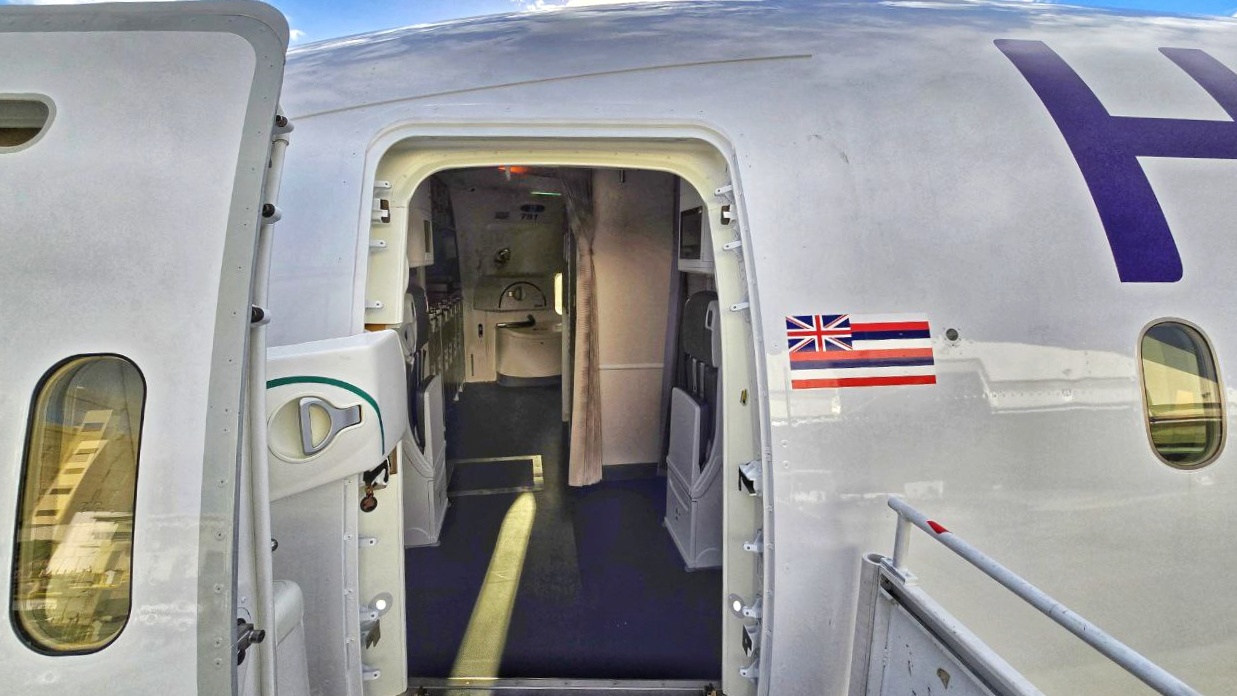
What Hawaiian built as the centerpiece of its long-haul future now wears Alaska’s Aurora-style global livery. The change and subsequent repaint are no longer theoretical. The company has also said the Alaska-painted 787s would be used from Seattle across Europe and Asia, which tells you exactly where management sees the near-term role for these planes. What is less clear, and still very much alive, is whether Hawaii has truly lost the Dreamliner for good or not.
Hawaiian’s short-lived Dreamliner identity is over.
When the first Hawaiian Dreamliner repaint surfaced, it still carried an element of disbelief. It felt fast, like one more integration step that could still be softened or slowed down. That did not happen. Beat of Hawaii’s January coverage of the first repaint was the opening act, not an exception. Now all four of the original Pualani-liveried 787-9s have been repainted, while the fifth aircraft arrived already in Alaska colors. Alaska separately says five 787s are already operating across the network and has showcased the new global livery as part of its international buildout from Seattle.
This was never just another aircraft type. The 787 was the premium product Hawaiian had awaited for years, the aircraft we flew and reviewed last October, and the one many readers saw as proof that Hawaiian still had a future at the high end of longer-haul travel.
Recent reporting indicates the cabins still largely reflect the original Hawaiian product, including the Leihoku Suites, while Alaska has not yet set a firm retrofit date to redo the interiors, including a true premium economy cabin. So for now, passengers can board a Dreamliner painted like Alaska while still sitting inside something that Hawaiian Airlines largely designed.
What the latest widebody filing actually says.
Alaska’s 2025 10-K is specific about what is coming. The fleet table shows A330-200 count staying at 24 through the end of 2027, then dropping by four aircraft to 20 in 2028. In the same table, Boeing 787-10 count goes from zero to four in 2028, while the 787-9 fleet rises from five at the end of 2025 to seven by the end of 2027. Read together, these point somewhere.
Alaska later told Beat of Hawaii that the A330 reduction shown for 2028 is not correct and that the fleet will not shrink as shown. That only sharpens the issue. If the table is wrong, it is fair to ask why the company has not corrected the filing. If the table is right, then the public fleet plan points directly toward a smaller Hawaii-widebody fleet just as more Dreamliners arrive for service outside of Hawaii.
It also lines up with Alaska’s January announcement that it had placed its largest aircraft order ever, including five additional 787s, bringing the future Dreamliner fleet to 17. Alaska said those extra-widebodies support its plan to serve at least 12 long-haul international destinations from Seattle by 2030, and that the intention is for the five added aircraft to be delivered as the 787-10 variant. There is no mention, nor does that prove Hawaii does or does not get any of them, but it absolutely proves the Alaska Dreamliner story is still expanding, with no ending in sight.
Why the number five still stands out.
Beat of Hawaii previously reported sources that put the potential future Honolulu Dreamliner base cap at five aircraft. At the time, that sounded like a ceiling. What exactly does that mean for the future of Dreamliners in Hawaii?
Could that still change later? Of course. Fleets change. Strategies change. Aircraft can be reassigned. But it is hard to miss how neatly the public outcome now matches that earlier number. Hawaii had five. Five is what’s left. Five is what Alaska says is already operating across the network.
Could the 787 come back to Hawaii routes?
If Alaska is sitting on 17 Dreamliners, and if its own filing still points to four fewer A330s in 2028, there will come a point where aircraft availability, route economics, and new product strategy intersect. Hawaii long-haul flying is not disappearing. The question is which aircraft the flight uses. Right now, the answer remains exclusively A330. But that answer may not hold indefinitely. The A330s are no longer young, and they aren’t part of an all-Boeing airline plan.
Alaska’s 10-K shows the A330-200 fleet averaging 12.5 years old at the end of 2025, while the 787-9 fleet averaged 1.0 year. That does not tell us where each future aircraft will fly, or whether, in fact, Alaska will keep any of its A330 planes, but it does show which fleet is aging and which one is just getting started. Once enough Dreamliners arrive, Hawaii moves from being excluded to at least being part of the obvious conversation.
The 717 endgame.
The deeper and more pressing fleet story may be happening closer to home. Alaska’s 10-K shows 19 Boeing 717-200s still in the fleet at the end of 2025, with an average age of 23.7 years, and it keeps that fleet flat through 2028. At the same time, Alaska has committed to 105 new 737-10s in its January order and says the deal extends deliveries through 2035. Officially, that order is framed around Alaska’s growth and aging 737 replacement, and there is nothing obvious about the announcement of the Hawaiian 717 replacement. But the silence around the 717 does not make the problem go away. It makes it louder.
Once Alaska finally deals with the 717, the logic of a simplified future gets harder to miss. A world where Seattle long-haul uses 787s, mainland and Hawaii interisland flying leans further on 737 MAX, and Hawaiian-specific fleet differences gradually shrink is no longer just a fringe theory. Pieces of it are already on paper. Other pieces will be revealed soon.
The Dreamliner may have left Hawaii for now, but the company’s own long-term documents still point toward more change, not less. If Alaska eventually decides it wants one cleaner fleet strategy with fewer Hawaii-specific exceptions, as has been its very nature for decades, the Dreamliner and the 717 questions stop being separate stories. They become part of the very same one.
Hawaii travelers are being asked to trust a fleet plan with major blanks still in it. Alaska points one direction in public messaging while its own filing points to another set of possibilities. The five Dreamliners that left Hawaii may be the clearest sign of where phase one ends. The next question is whether the same documents now start to point to phase two.
Do you think the Dreamliner will eventually return to Hawaii routes, or was this the moment it was gone for good?
Get Breaking Hawaii Travel News


I do trust Alaska more than I ever trusted Hawaiian management. Hawaiian had a beautiful brand and some nice onboard touches, but they also had years to figure out how to make all of this work and clearly did not and could not. Alaska is at least trying to build something bigger and more durable. That may not be fun for Hawaii aviation romantics, but it may be necessary if the airline is going to survive long term. It’s a very tough industry.
Honestly Alaska is finally thinking like an aspiring real global airline. The Dreamliner belongs where it can do the most work, and right now that is clearly Seattle. If Hawaii gets it back later, fine, but I don’t see why Alaska should leave its best long-haul aircraft tied to old assumptions just to make people feel better.
This is exactly why so many of us stopped believing the soothing language around the deal. Every few months we are told not to overreact, and then the next thing happens. The Dreamliners went from Hawaiian’s future to not faster than I could have imagined. The A330 filing says shrinkage, but then we hear that is not really their plan. At some point it becomes reasonable to conclude that Hawaii is being asked to accept a moving target while Seattle gets the clarity.
Agree that the 717 story is the bigger one pressing at the moment. Any word on what’s happening?
I flew one of the Dreamliners from JFK to HNL and it felt like Hawaiian had done something world-class. Not perfect, but darn good. For a lot of us, the plane represented more than a tool. It felt like Hawaiian finally had a future product that could stand next to anybody. Seeing all five now in Alaska colors is hard not to take personally if you’ve flown Hawaiian for decades like I have.
The paint job says Alaska, but the cabin still says Hawaiian? That tells me this whole thing is being done as they go along. It doesn’t seem like there is enough information coming out this far along in the process about specifically what the future plans are.
With the economy and rising fuel costs maybe Hawaii needs to rely on dream catchers not dream liners. Good luck with the cost of such luxury ride. People forget Airlines don’t cater to the tourist. The tourist’s cater to the airline because it you don’t like their offerings take a cruise ship to Hawaii. The only obligation for an airline is to fly or transport you from point A to B. Travel time from point A to B. Other than that quit complaining or just don’t purchase a ticket or book. Simple.