

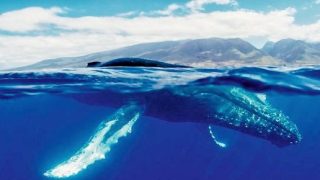
Standing on Kauai’s shoreline this winter, the change is obvious. Whales are showing up day after day in the same nearshore places, sometimes lingering long enough that you stop counting and just watch. It is not a single lucky breach or a one-off sighting. It is a steady presence that many residents have been noticing all season, well before the counts were released.
When the first January whale counts for 2026 came out, they confirmed our personal observation. Kauai not only posted strong numbers but also increased them year over year, while most of the rest of the state moved in the opposite direction.
What’s behind Hawaii’s changing whale numbers.
In January, Kauai recorded 467 whales through the Sanctuary Ocean Count, which covers Kauai, Oahu, Molokai, and the Big Island. Oahu fell from 399 whales last year to 337, and the Big Island dropped sharply from 493 to 337. Molokai declined as well.
Maui recorded a higher total of 694 whales through the separate Great Whale Count run by Pacific Whale Foundation. Even with Maui included, the combined statewide total still slipped by 158 whales compared with January last year. Kauai was the exception.
That is significant because this is about direction, not just totals. Kauai is not replacing Maui as the center of Hawaii’s whale population, but it is clearly playing a significantly larger role than it once did, particularly for whales that stay close to shore. Later counts reinforce the same pattern. By March last year, Kauai was still recording over 120 whales while totals elsewhere had fallen off much more sharply as the season tapered. What we are seeing this winter fits that as well.
Kauai is moving against the trend.
The point is not the size of Kauai’s count. It’s the direction. While statewide totals slipped and islands saw sharp drops, Kauai kept seeing whales in the same nearshore places repeatedly.
That contrast shows up quickly once you look at Kauai. The Big Island lost more than 150 whales year over year in January. Oahu dropped by more than 60. Molokai declined as well. Kauai did not.
This was also not a one-month blip. As last year’s whale season played out, Kauai continued recording the behemoths later into the winter while totals elsewhere fell off faster. That staying power suggests Kauai is doing more than catching pass-through traffic, especially close to shore.
Kauai is not replacing Maui as the center of Hawaii’s whale population. It is picking up more of the overflow as the population spreads beyond its historic locations.
Why Kauai is seeing more whales.
Starting with the obvious, Hawaii now hosts an estimated 12,000 or more humpback whales each winter, a dramatic recovery from the near-collapse of the population during the commercial whaling era. The population has rebounded, and every winter, whales move through Hawaiian waters. Maui Nui is still the center of that activity, and nothing about this season in any way changes that. What has changed is how far that activity spreads.
It now appears that, as the population grew, whales did not remain confined to the same few places they had always used. Over time, sightings became more common around Kauai, Oahu, and the Big Island, not just Maui, Molokai, and Lanai. Kauai’s numbers are not a surprise. They are part of a slow redistribution that has been building for years and is now easier to see.
Kauai’s geography helps explain why. Large stretches of the island sit over a shallow coastal shelf, broken up by reef systems and protected pockets close to shore. The Kaulakahi Channel between Kauai and Niihau functions as a natural pathway, with whales moving through deeper water before peeling off into calmer nearshore areas. For mothers with newborn calves, those quieter pockets are intentional.
Equally important is what Kauai does not have. Compared with Maui, there is far less commercial boat traffic and fewer whale-watching operations working the same areas day after day. That does not push whales away from Maui, but it does leave Kauai with long stretches of water that stay relatively undisturbed. When mothers and calves find a place that works, like Kauai, they tend to stay there.
The January count helped confirm that pattern. Kauai had strong volunteer coverage and near-ideal conditions, which made it easier to see what was already happening offshore. Calm seas do not create whales, but they remove the excuses associated with not seeing them.
What this means for visitors right now.
For visitors, the peak whale season on Kauai is now, and some of the best viewing costs nothing. Shore-based watching from places like Poipu, Spouting Horn, Kilauea Point, and Kealia has been consistently productive this winter, especially in the morning.
The January count identified the strongest statewide viewing window between 9 and 9:15 a.m., when more than 260 whales were spotted across the islands. That lines up with long-standing local experience. Earlier mornings tend to bring calmer seas and better visibility, and Kauai’s shores often deliver the best results during that time.
Boat tours remain an option, with most winter departures running out of Port Allen and occasional north shore trips when conditions allow, as part of Na Pali Coast itineraries. These offer a different and up-close perspective, but they are not required for a strong whale season on Kauai. Many people see multiple whales from land.
One reminder: federal law requires staying at least 100 yards away from humpback whales, whether you are on a boat, a paddleboard, or in the water. Kauai’s strong shore-based viewing makes it easier to follow that and remain comfortable without sacrificing the experience.
This is the 30th anniversary of the Sanctuary Ocean Count.
What began in 1996 on Oahu with about 150 volunteers has grown into one of Hawaii’s longest-running community science efforts, now spanning dozens of locations across multiple islands with hundreds of participants on each whale count day.
The next counts are scheduled for February 28 and March 28, 2026, with registration for the February count closing soon. Participation does not require special training; only patience and attention are required. Families, repeat visitors, and residents can sign up directly through the Sanctuary Ocean Count to witness what is happening offshore.
This is not a radar blip.
Nothing here suggests Maui is losing whales, or that Kauai has suddenly replaced it. Maui remains the center of Hawaii’s humpback activity. What stands out this season is how consistently Kauai is being used, especially close to shore.
From the beach, whale sightings no longer feel rare. Whales are appearing in the same places, lingering longer, and doing so day after day.
Are you seeing more whales from shore on Kauai this season than in past years, and where have you noticed the biggest change?
Get Breaking Hawaii Travel News





We stayed in a condo not far from Koloa Landing last month and saw whales almost daily from our second floor lanai, some seemed fairly close in. It was also the area where some of the whale watching boats came to from Port Allen. While most were respectful of the whales, one company with zodiacs consistently rushed toward the whales and appeared to not respect the distance. Ironically, they were always “rewarded” with the whales sounding before they could reach them.
Aloha Kathleen!
You are right about the whale- watch boats chasing the whales. The whales must be protected now!
End whale-watch tours, let these majestic creatures live!