
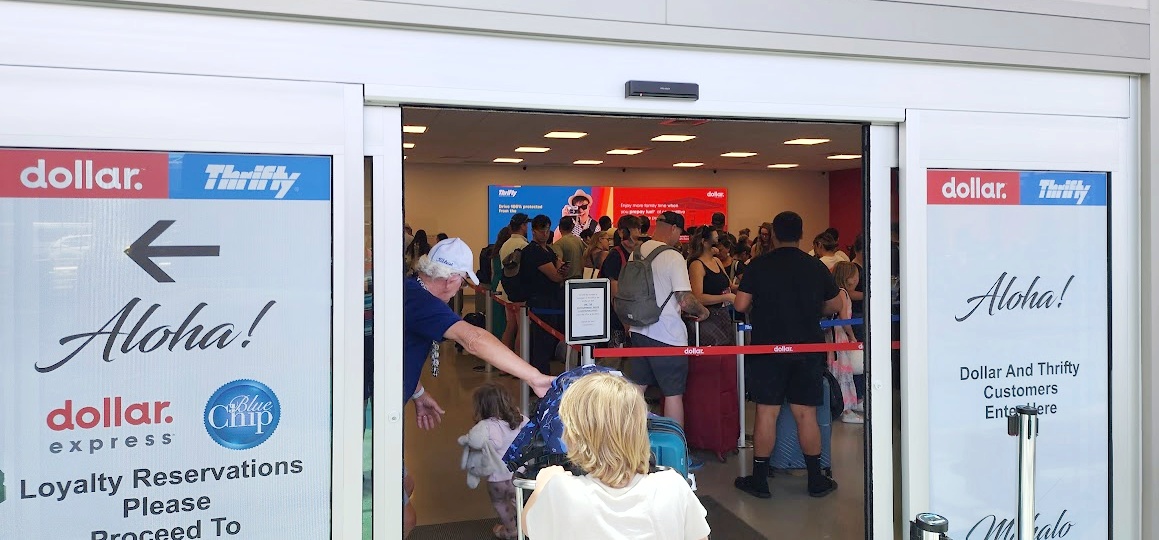
When we recently returned a rental car to Avis, we were stunned. It was the second time this had happened, and they were so fast that we didn’t manage to snap a photo.
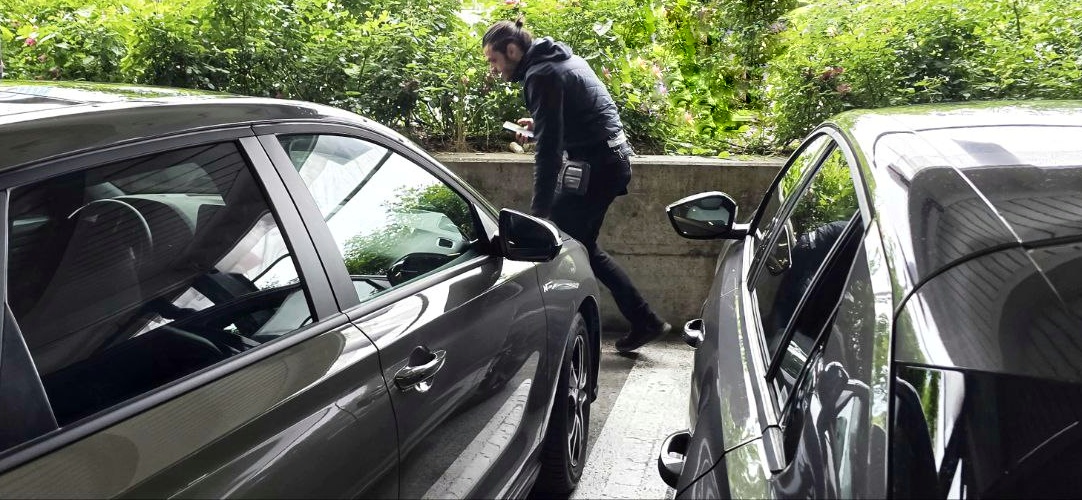
However, we did snap a photo the first time this happened, away from Hawaii, as it had caught us off guard. An Avis staffer, with a flashlight, was crawling beneath every returned vehicle, inspecting the inside of wheel wells, undercarriages, and more. It was something we’d never seen before. The inspection wasn’t fully automated – yet. And it felt personal. And these seem now like a preview of what’s coming next in Hawaii’s rental car experience.
Across the U.S. and worldwide, the major car rental companies are reportedly installing high-resolution AI damage detection systems that scan every car at return, often after a human agent has already cleared it. This is a step beyond what we just experienced.
Hertz is using a system by UVeye that photographs your vehicle from multiple angles and compares pickup to return images in milliseconds. If the software detects a new scratch or dent, you may be automatically billed before your flight even boards.
It wasn’t until we read about this new practice in a NYTimes article that we realized we had an early experience with what’s to come in the world of Hawaii car rentals. In that story, someone reported that after returning their car to Hertz and clearing a manual inspection, they received a notification stating that AI had detected a dent. The charge? $195. $80 for the “damage,” plus $115 in administrative fees. They were offered a one-day discount of $130 if they paid immediately. They allege Hertz stood by the charge.
Why this may matter more in Hawaii.
With Hawaii’s sometimes very rough roads, tight parking lots (think Honolulu), and frequent gravel approaches—especially on the neighbor islands- it doesn’t take much for a door ding or bumper scuff to appear. Some damage might not even be visible until the car is washed. But now, AI sees everything. And that, together with the manual inspection we witnessed, is raising questions for Hawaii visitors too, who are already grappling with high car rental prices, limited inventory, and changing policies.
When car rental companies say the technology “removes the need for manual walkarounds,” what they really mean is this: you may no longer have a human who can be between you and a new ancillary fee. The person returning the car next to us was told they had undercarriage damage. We didn’t stick around to see how that all turned out.
In Hawaii, many travelers arrive late, tired, and jet-lagged, pick up cars in dark, tight garages or under poor lighting, and may not notice existing micro-scratches or door dings. And many times, the rental vehicles already come with minor damage.
What happened to the (unofficial) rule of thumb about if the damage is less than the size of a quarter? If you don’t take detailed photos at pickup and drop-off, you’re flying blind. And even then, it might not be enough to fight an automated claim. Have you ever considered taking photos under your rental car? We could be headed there.
Hertz and others are already using detection at airports.
According to Hertz, their UVeye scanners are now in place at Atlanta, Newark, Charlotte, Tampa, Phoenix, and Houston airports, with plans to expand “to major airport locations” later this year. Hawaii hasn’t been officially named, but the system’s rollout is fast and quiet. And what we experienced at Avis instead – full-body car inspections under bright light – felt like a human prelude.
Sixt uses a similar system called Car Gate, and Avis Budget Group says its process remains “human-led,” but with AI playing a behind-the-scenes role. Enterprise, National, and Alamo state that they do not currently utilize AI for damage claims. However, “human-led” doesn’t necessarily mean human-protected, and we’ve heard from readers about mysterious charges appearing after cars are returned, especially during peak visitor periods when agents are rushed and documentation is sparse.
Damage claims are getting pricier and harder to dispute.
What’s especially frustrating for travelers is the fee structure. That $80 scratch may come with $115 in “processing” charges. These often include the cost of using the AI system itself — something the customer never asked for or agreed to. Unless you catch it early and challenge it fast, many travelers end up paying simply to make it go away.
What Hawaii visitors can do to protect themselves.
Take photos and lots of them. When you pick up your rental car, photograph every side, the roof, windshield, bumpers, and especially now the wheels and the undercarriage to the degree possible. Do the same at return, as they will be time-stamped on your phone.
If you notice something suspicious, such as scratches, dents, or curb rash, report it at pickup if possible and obtain a written acknowledgement from the agent. We’ve found that most times we’re now just waved off and told to take photos. Don’t assume a simple walkaround is still enough. You may not be billed until hours later, after the car rental company has done its complete pass.
At this point, it isn’t clear which rental locations are using automated scanning technology. We haven’t seen them ourselves. Have you? If your rental car insurance or credit card offers damage coverage, familiarize yourself with the claims process in advance so you’re not scrambling mid-vacation.
This could get worse before it gets better.
AI damage scanning is just getting started. The companies behind it say it detects five times more damage than human agents and increases billable incidents by up to 600 percent. In plain terms, it’s a serious moneymaker.
Some see that as smart fleet protection. Others see it as a trap. Hawaii visitors are already paying some of the highest rental car prices in the country, with peak season rates often topping $125 per day for even basic models. Now add surprise damage fees to the mix—sometimes for something as small as a light paint scuff—and the result is frustration, not trust.
We’ll be watching to see which Hawaii airports adopt the scanners next. In the meantime, have you been scanned, flagged, or charged after renting a car in Hawaii? Let us know.
There’s another angle too.
This might be the latest way rental companies encourage customers to purchase optional insurance on the spot, to avoid the risk of being flagged, charged later, and having to deal with their automobile insurance carrier. And honestly, it may just work.
What’s your take?
Get Breaking Hawaii Travel News




Anyone know if they are using these in Kaua’i yet? I assume they will start in O’ahu so I am hoping I am beating them to the punch when I visit mid-September.
Thank you for this informative article. And thanks to everyone who left a comment. I will be in Oahu, Hawaii in late September and staying outside of Waikiki and need the use of a car. I have a reservation with AVIS. But after reading this, I might consider renting from another company. This is absolutely ridiculous. Thanks again!
Enterprise charged me $800 for a dent I did not cause. It was in Tempe, AZ. I tried to get the agent to take a picture of some damage, he said it was too small. I hasseled with them for months. I ended up paying over $600. I will never use them again.
Enterprise tried to charge me for a paint chip on a car that I drove from one location to another without any stops – so I had no real chance to cause damage. I’d call it routine wear and tear from typical use. I told them I would post about the experience on all the social media I could, and that finally got them to change their mind. I wish we had a government to protect us from our wealthy and powerful overlords.
To address this scary article, just do one thing. Get a premium credit card that provides primary insurance coverage for any damage to a rental car. Let them handle it. And then you can forget about microscopically inspecting your rental car.
Dug-
While that is sage advice it ignores the bigger picture. This is a fight for things like Right to Repair and Right to Own.
Be it bricking devices via software updates so your previously working unit no longer works, discontinuing a product where you bought a lifetime subscription with updates…only to later relaunch a reskin “new” product, “selling” digital media that is not a permanent ownership but actually a rental until that company loses that right, or simply something like click to cancel dying because of corporate greed or now AI to charge you for “damage” to your rental.
So yeah, if you have no other choice then use a CC with rental insurance. But that money still goes to a company that doesn’t care about the consumer. Just like CC’s offer perks for free checked bag to counter those Checked baggage fee’s helped, look what happened there. Now nobody has free checked bags.
I will now only rent a car with my AMEX card because it literally does cover everything unlike the AA Citi Executive card which makes you deal with your own car insurance with its deductible and then use Citi’s insurance company. It literally took months to settle it. Fortunately I had lots of pictures from when someone hit me in the hotel’s parking lot.
This now appears to be a newfound income stream that they have complete control over and Hertz’s administration fee means that they are paying big bucks for the AI package they have bought in to!
I lived on Maui 6 years. Always check to see what kind of car is in the. In te rmediate and full size at each rental company of you need a larger car. When I lived on Maui Budget rents a particular model car a n d called it an intermediate car. The other companies called the exact same model car a full size car. I always went with the intermediate size from Budget if family was visiting. Same car but cheaper. I don’t think they do this anymore but rental companies in Hawaiinused to give you a c I upon booklet fir discounts with your rental. Budget gavecyou coupons that you could actually use a n d save money. Others not so much,
These companies are going to learn the hard way, if they continue to make traveling a hassle; people will just stop traveling….