

Two of Hawaii’s longest-running Hawaiian music series are back this winter, both in new venues and both offering something that has become increasingly hard to connect with as a visitor. These are not productions designed to justify a price point or be a tourist spectacle. They are community nights built around music first, where residents still come because they always have, and visitors are welcomed warmly simply by showing up.
At a moment when so much of Hawaii culture is filtered through high cost, reservations, packages, and expectations, these evenings remain refreshingly direct. Music on a lawn. Music in an excellent college theater.
Lahaina’s Hawaiian Music Series returns on familiar ground.
Lahaina’s Hawaiian Music Series opened its 2026 season on January 29 at a new location that holds real meaning for the town. This year, the free weekly concerts move to the lawn of Waiola Church, which is deeply rooted in Lahaina and is a natural gathering place as the community continues to rebuild itself after the fires.
This marks the 18th season for the Lahaina Hawaiian Music Series. The series previously took place at another Lahaina location, and its move to Waiola Church reflects the ongoing reshaping of Lahaina. The return is meant to be a celebration or a statement. It is simply long-awaited music happening again in Lahaina.
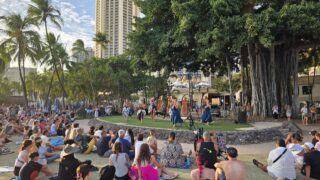
The concerts run on the last Thursday of every month in 2026, from 6 to 7:30 p.m. Guests are encouraged to bring blankets or low-back beach chairs and settle in. There is no reserved seating and no preferred section. Parking is available on site, and the evening unfolds without any sense of being managed or rushed. It’s the real deal.
Maui musician Joshua Kahula was among the performers featured on this season’s opening night. A vocalist and songwriter with more than three decades performing with local bands including Hoʻomau, Nuff Sedd, Pono, and Kahalawai, his work blends traditional Hawaiian mele with contemporary island sounds. Following the 2023 Lahaina wildfires, Kahula co-wrote “E Ola Maui,” a song that became part of the community’s shared recovery.
Theo Morrison, executive director of the Lahaina Restoration Foundation, described the return of the series as a meaningful milestone for the community, with the hope that the music will bring people together and help restore a sense of normalcy. For anyone who has spent time in Lahaina over the years, that sentiment needs no explanation.
The series continues weekly through Thursday, February 26, with Kepa Revelle-Aikala. More information can be found on the Lahaina Restoration Facebook page.
E Kanikapila Kakou brings Kauai’s longest running series indoors.
On Kauai, E Kanikapila Kakou (EKK) returns for its 43rd season, which began on Monday, February 2, also in a new venue. This year, the series moved to the Kauai Community College Performing Arts Center in Lihue, Kauai’s largest and arguably best indoor setting, which keeps the event intact while giving it a different kind of feeling than at the prior Kauai Beach Resort.
E Kanikapila Kakou has never felt like a formal concert series, and that remains true at KCC. Doors open at 5 p.m., followed by a ukulele circle at 5:15. Performances run from 6 to 8:30 p.m., and the pace of the evening feels casual. People arrive as they can, settle in, and stay as long as they’d like.
Update: Due to the weather, this week’s performance will be held on Tuesday, February 10.
General admission tickets are $20, and Kamaaina tickets are $10. Children are admitted free. In the context of Hawaii entertainment pricing, those numbers stand out for what they are not.
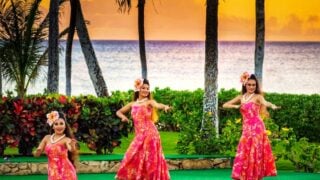
The eight-week season brings performers from across the islands, blending familiar names with long-awaited returns. Opening night was a community hula night with four kumu hula sharing the stage.
One of the most anticipated nights pairs Hookena with the Makaha Sons of Niihau, bringing together two of the most widely recognized names in Hawaiian music for a single evening. The season also includes the return of ManoaDNA to Kauai after more than 15 years, along with a closing-night performance by Makana and Friends.
E Kanikapila Kakou is presented by the Garden Island Arts Council, with funding support from the Hawaii Tourism Authority. Despite that connection, the event itself feels largely untouched by any tourism framing. It continues because residents and visitors still value it. You can also find more information on the EKK Facebook page, including photos of the performances.
Why these nights feel different once you’re there.
What connects these two series is how little they resemble most visitor-facing experiences today. There are no set pieces built for photos, and no effort to explain the culture as it happens. Nobody is selling add-ons at the door or steering people toward an exit once the performance ends.
Residents and visitors sit together without ceremony. The performers play full sets without trimming or translating themselves. The evenings belong to the music.
For visitors who feel worn down by reservations, fixed itineraries, and prices that demand justification, these nights offer something simpler and arguably far more wonderful. You do not need to plan weeks ahead. You do not need to wonder if it was worth it afterward. You show up, listen, and go home.
What visitors should know before going.
Both series operate on a first-come, first-served basis, and arriving early makes seating for the evening easier. Bringing your own seating is expected for the Lahaina concerts. These are early evenings meant to be shared. So bring a friend! Before each EKK performance, food is available for purchase.
Information for the Lahaina Hawaiian Music Series is available through the Lahaina Restoration Foundation. Details for E Kanikapila Kakou are on the Garden Arts Council website, including weekly lineups and ticketing.
In a Hawaii travel landscape that increasingly pushes visitors toward managed, high-priced experiences, events like these pose a harder question. Why does sitting on a lawn or in a college theater listening to real Hawaiian music now feel like the exception rather than the norm?
Lead Photo: taken by Beat of Hawaii, featuring Lihau Paik of Kupaoa at E Kanikapila Kakou.
Get Breaking Hawaii Travel News

The line-up for E Kanikapila Kakou 2026 leaves me wishing I was back there, yet thrilled I am returning next year at a time that I can look forward to attending a performance or two plus the Ho’ike Hula Concert. Out of curiosity I checked the ticket prices and was gobsmacked by how affordable they were.
One ongoing Hawaiian music event not mentioned is the Slack Key Masters series long held weekday at Napili Kai Resort pavilion midweeks. Granted, there are usually a good deal more visitors than locals, but the Hawaiian master musicians I have heard over the years is stellar, many Na Hoku award winners. George Kahumoku Jr was the host until just the last couple of years as he & his wife relocated to CA due to family illness. Heard Dennis Kamakahi not long before he passed, and his version that night of O’pai E was truly magical, and that Hawaiian lullaby remains one of my favorites. Jeff Peterson, a Maui born and raised guy, and Led Kaapana, from the BI, are 2 of the most accomplished slack key guitarists on the planet. Many fabulous others. There’s LwYs. But if hula, usually by lovely Wainani. It’s a very casual, wonderful event!!
It is sad to see what Hawaii is becoming. Every park we wanted to visit was at least $20 per couple. We save and save to come see your beautiful state and feel the Aloha. It seems like nothing more than a money hungry atmosphere. Parking on the Big Island was outrageous. We stayed in Kona area 2 weeks and never went into the village of Kona once. We used to come and go there everyday and shop ,eat and enjoy just being there.
I have missed local music scene the last few years. I have memories of the parking lot of Longs Drugs, families sitting in truck beds, buying food to donate to the food banks at Longs, going to local theaters built in Art Deco style and a Kauai Christmas show in some auditorium all by local entertainment.
I haven’t found these performances the last few years, perhaps there are fewer, or simply the timing of my visits.
But I’m making note of these mentioned in the hope I’ll be able to hit one.
I’ll never forget our first stay at the Hana Maui in the 1970’s. The “performers” for the show were our waiters and waitresses, desk clerk, car parker and other employees and their families. It was so simply beautiful. All traditional. Magical. A few years later we traveled to the Merry Monarch Hula Festival in Hilo, and enjoyed three days of Hawaiian culture at its best.
I am saddened by what I read here about how things have changed since then.