
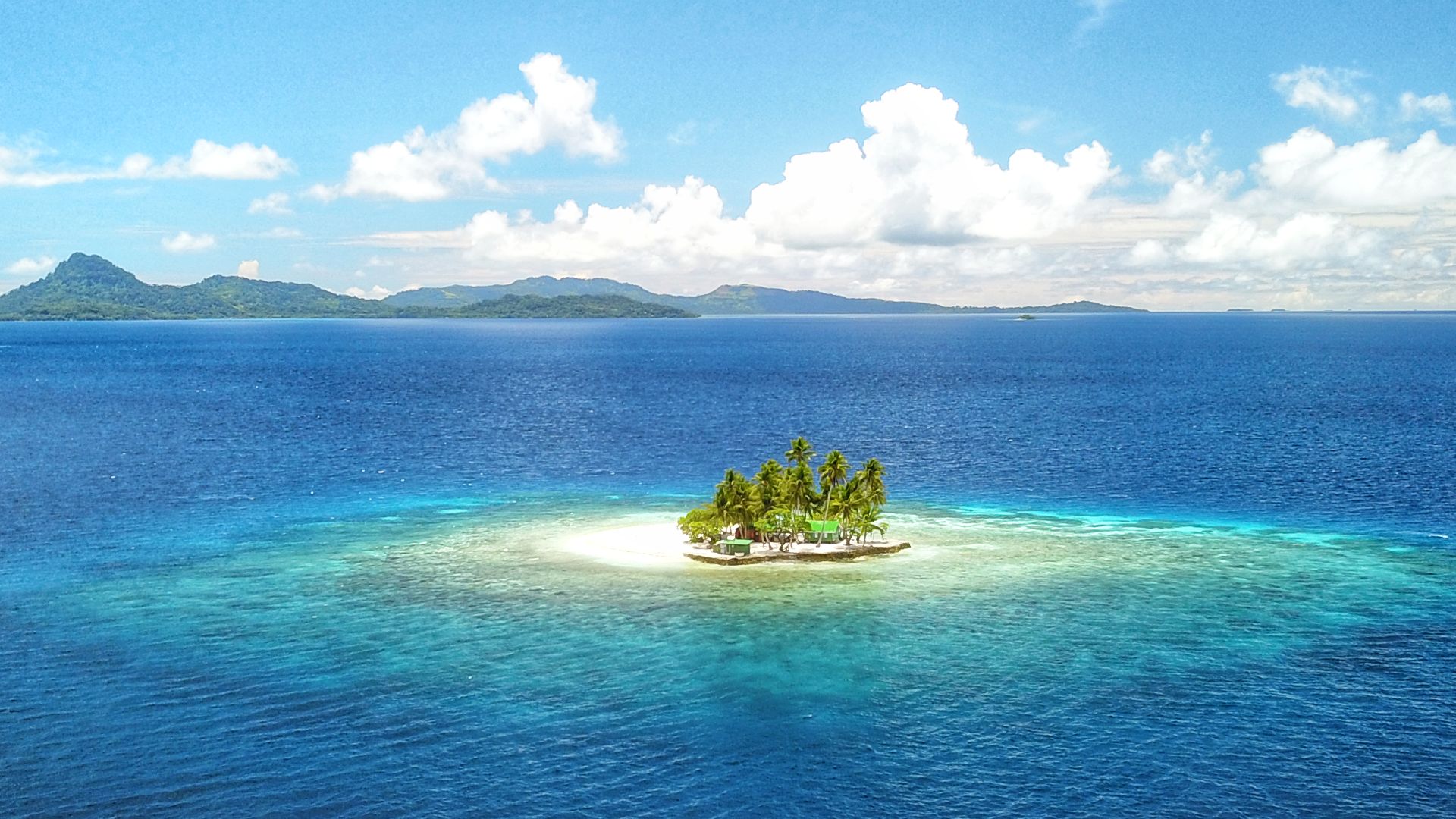
There is a storied United flight that departs from Honolulu and heads into a part of the Pacific that most Hawaii travelers barely think about. Before it reaches Guam, it stops on Majuro, Kwajalein, Kosrae, Pohnpei, and Chuuk, turning what looks on a route map like one long overwater line into one of the most unusual airline journeys anywhere in the world.
It has long been one of those routes aviation people talk about in near-mythic terms, but it is getting a fresh look now because United has begun upgrading the aircraft serving the Guam-based flight.
55 years of scheduled service from Honolulu.
Most flights out of Honolulu are going to get you to somewhere familiar. Los Angeles. Tokyo. Seattle. Maybe New York. This one leaves Hawaii and keeps going deeper into the Pacific, not to tourism-dense Tahiti or the Cook Islands, but to a chain of islands so scattered and remote that even travelers who know Hawaii well can go years without really noticing they are even there.
For travelers used to thinking of Hawaii as remote, the first leg alone runs more than 2,200 miles from Honolulu to Majuro in the Marshall Islands, before the plane continues farther west through places that feel less like normal airline stops and more like their own tiny worlds, connected because they have to be. United still operates this as part of its Micronesia network out of Guam, and even now, the route has the feel of something from another era that somehow survived.
It is easy to forget, from Hawaii, that the Pacific keeps going in a way that dwarfs nearly every map instinct most Americans have, until you board a plane that treats Honolulu like the starting point.
The route dates back to 1968, when Continental Airlines CEO Robert Six backed a way to connect these scattered Pacific islands by air under a new carrier called Air Micronesia, which became known as Air Mike. The early flights used Boeing 727s with Teflon-coated undersides built for coral runways, alongside prop aircraft and even amphibious planes on legs where jet-capable airstrips didn’t yet exist.
Continental eventually took full ownership and rebranded it as Continental Micronesia, and by 2008, the Island Hopper alone accounted for 30 percent of that subsidiary’s business. When Continental and United merged in 2010, the route was transferred along with everything else, and United has kept it running ever since. That is more than 55 years of scheduled service across some of the most remote inhabited places on Earth, with much of the same basic mission still intact.
The route that turns an airline seat into a front-row Pacific tour.
The all-stops westbound version, United flight 154, leaves Honolulu and continues through Majuro, Kwajalein, Kosrae, Pohnpei, and Chuuk before reaching Guam. The flight runs three times weekly westbound, with the all-stops return operating twice weekly eastbound. There are also different stops on some days that skip Kwajalein and Kosrae, which means anyone booking this for the whole experience needs to look at the exact date and routing instead of assuming every Island Hopper flight works the same.
Majuro is the first real shock. After hours of open water, the atoll appears as a sliver of land and lagoon that can look almost too narrow for its runway. One of the most vivid details is the sight of fire trucks positioned near the runway because the brakes can heat up from the repeated short hops and quick turnarounds, and cooling them is part of the routine.
Kwajalein is next, and it changes the mood. It is a U.S. military installation, and unless you have authorization, you stay on board. That stop alone separates this trip from any normal tropical island fantasy. This route is not a breezy leisure circuit offering the same experience. One stop may let you step briefly into civilian island life. The next may remind you that the Pacific is full of places with very different histories, rules, and even current uses.
Kosrae, Pohnpei, and Chuuk are the stops where the Pacific starts to feel like the place where the route earns its reputation. Pohnpei is home to Nan Madol, one of the Pacific’s most remarkable archaeological sites, as well as waterfalls and a vivid, green interior that feels a world apart. Chuuk is famous for wreck diving and draws divers from all over the world. Kosrae still feels almost absent from mainstream travel culture, which is part of the draw for the small number of people who do know about it.
Published reports on the route describe an onboard mechanic seated up front in economy who gets off at every stop to inspect the aircraft and address issues on the ground. Those same reports describe four pilots onboard for parts of the trip, with one crew flying the Honolulu segment and another taking over later in the day.
Then there is the old travel lore around the stops themselves. Travelers have long talked about getting off the plane at civilian airports, walking around on the tarmac or inside tiny terminals, and, in some cases (albeit perhaps no longer), collecting passport stamps along the way. Practices can vary, and you can’t assume every stop will work exactly the same way every time, but that is part of what gives the route its reputation, because you are not just crossing the Pacific but moving through a chain of inhabited islands that most travelers will never see at all.
The cabin finally catches up.
For years, one of the strangest parts of this flight was the mismatch between the route and the onboard experience. The journey itself had all the ingredients of a once-in-a-lifetime trip, but the cabin was another story. United’s older Guam-based 737-800s handled the job, but nobody was pretending they turned a long multi-stop day through Micronesia into a polished modern experience.
United said last year that it would begin replacing those Guam-based 737-800s with 737 MAX 8 aircraft in 2026, adding seatback screens at every seat, Bluetooth connectivity, larger overhead bins, USB charging, and Wi-Fi capability. The airline also said the aircraft would retain the ability to accommodate medical stretcher transport, a reminder that this route is not just a curiosity for travelers but a lifeline, and AeroRoutes reported the first Island Hopper MAX 8 debut on March 16, 2026.
The Wi-Fi piece is a bigger deal here than it might be on some routine mainland route. On a flight like this, the lack of connectivity has never just meant a few disconnected hours. It has meant a long day of flying and stopping across some of the most isolated inhabited islands on earth. United has said Wi-Fi is coming on these Guam-based MAX 8s, with free Starlink expected across the fleet by the end of 2027.
This is still the kind of flight people talk about with equal parts excitement and warning. Bring patience. Bring snacks. Know that you are flying a route built around real island community needs, not a themed experience created for airline romantics or travel aficionados.
Who this is for, and how to actually book it.
This flight is for people who care about unusual route maps and who still get excited by the idea that commercial aviation can occasionally feel strange and off the map. Divers, Aviation geeks, Pacific history readers, geography obsessives, and travelers looking for something beyond the usual Hawaii, Cook Islands, or French Polynesia conversation will all understand the appeal.
Booking it is simple in one sense and yet trickier in another. You can book it on United as a through flight between Honolulu and Guam, or target individual islands such as Majuro, Pohnpei, Kosrae, or Chuuk, depending on what you want to do.
The tricky part is making sure you are booking the routing you think you are. If you want the full all-stops Island Hopper experience, then the exact dates matter. Some flights operate the shorter pattern. Some do the entire chain. Anyone serious about doing this should verify the stops before buying the ticket. And this one might even be worth a call to the airline. United also allows multi-city bookings that let you stop on individual islands for days or weeks before catching the next departure, though the fare increases with each stopover added.
The Pacific beyond Hawaii.
Hawaii still feels remote to most Americans, and that remoteness is part of its pull, too. But this flight reminds you that Hawaii, Tahiti, and Rarotonga are not the last outposts in the Pacific. These are points in a much bigger ocean, and most of that ocean barely registers in the way Americans imagine travel.
From Honolulu, the Island Hopper pushes west into a Pacific that is larger, quieter, and far less familiar than the Hawaii travel conversation usually includes. One of the most famous island destinations on earth, Hawaii, turns out not to be the edge of the map at all.
Have you ever heard of the Island Hopper before today? Have you flown it, or would you?
Lead Photo is Chuuk, Micronesia.
Get Breaking Hawaii Travel News



I’ve been looking at this on and off for years. It used to be very inexpensive if you used miles but now that I am in a position to actual make the trip that no longer seems to be the case if you’d like to do the hop. Might have to save up and bite the bullet!
The Island Hopper is a bucket-list trip for sure!
Regarding Kwajalein, I’ve read that not only can non-authorized passengers not deplane, but window blinds have to be lowered so no one can even see the island and its military installations.
Yes, so many fun memories on this route. We took many trips from Kwajalein via Guam to Australia, Indonesia, Japan, Palau during the oughts. The Chuuk landing is not for the faint of a heart – a very fun/harrowing approach circling around terrain onto a very short runway. Many of the stops feature runways squeezed between ocean on either end. Very hard full stops. And travelers often brought coolers full of fish stowed in the overhead – sometimes the coolers leaked…
I traveled that route in 1990 or 1991 as the new deputy regional Director of FEMA region nine. It was in the aftermath of typhoons that had done extensive damage throughout the region. We also stopped at other places in Micronesia, like Yap. Guam and Palau and Saipan were also included. We ultimately even went to American Samoa. But it was that hop from Honolulu to Guam (we touched down on Midway too) and everything in between that ignited my love of the Pacific (I now live on Maui). The best snorkeling I ever did was in Yap, and I have tried on several occasions, unsuccessfully, to learn if the reefs there are bleached now. I was in my early 30s at the time and it was an amazing adventure. I have always dreamed about returning. Now that they’re upgrading the planes, maybe I will!
Aloha Lorri! I was just asking how safe it would be to travel there alone, but it sounds like you went 30 years ago, so I assume a lot has changed. since then. I live on Maui also and I wonder if BOH would allow us to connect to talk travel!
I’ve flown this route quite a few times for work and vacation. Flight attendants remind you, “no chewing beetle nuts”. The condition of the planes fell like they were already sent out to pasture. There are amazing adventures to be had in the Marshall Islands and the Federated States of Micronesia. Not many places so remote that one can fly to with such ease.
As a Univ of HI graduate student in the early 1980s, I flew this route twice as part of my thesis field work. Carrier was Continental back then. Once in Guam, route continued to Yap and Palau. You did not mention these 2 locations in your article. Does United not fly to these locations? Mahalo for this article and a “trip down memory lane”
My wife and I have taken the Island hopper several times. Once to Chuuk for wreck diving and this last October to Kosrae to dive the untouched coral reefs. For those that want to experience the South Pacific with no crowds and warm island hospitality I highly recommend the trip. We will no doubt go again and look forward to the newer 737;s.
All of these stops are in the North Pacific, not South Pacific. Micronesia is geographically off almost everyone’s radar, including mine until I went there.
I used to work with people who went to Kwajalein in the 70’s – I tried to sign up back then but they didn’t want single women. Many went as couples. + co-workers. They saved a ton of money + traveled to AUS on their vacations. Most took up diving on arrival. I never heard them talk about the logistics of getting there + elsewhere. Except they did have a ‘commute’ to work site back then.
I wonder who safe it’s now as a single woman ….would love to hear if a single women travelled there recently, as this is a trip I might be interested in.
My dad was in the Navy and was stationed at Pearl Harbor in the early 70s. His job there required him to periodically visit Guam and Kwajalein (along with various other posts around the Pacific). He took this flight several times. I remember he came home once with a large glass fishing float (which I still have) that he had bought in one of the airports.
Great article. This is definitely something I would want to do whenever I can afford to disconnect from everything for a week! Will check into the routes you mentioned. Had not idea those flights existed and would need to research each island first ….(ha, ha!)