
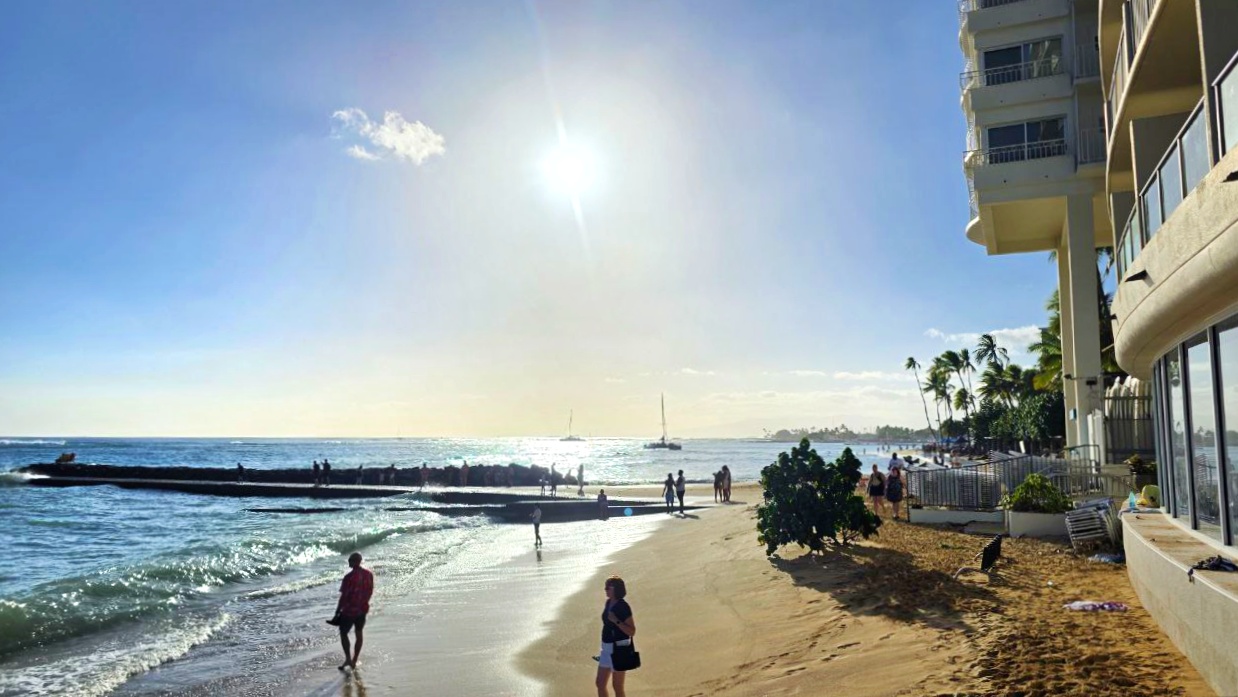
For visitors who have watched Waikiki Beach narrow, lose sand, and give way to seawalls year after year, visitor money is finally being used to rebuild it. The state has earmarked the first investment in restoration work for the Halekulani sector, marking the first time controversial Green Fee dollars have been formally directed toward rebuilding Hawaii’s most engineered shoreline.
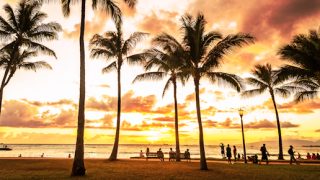
We were in that area recently, as shown in our lead photo at the Outrigger Reef Waikiki Beach. Waves were crashing against the seawall, with the restaurant windows just above.
The initial work targets one of Waikiki’s most clearly worn stretches, where usable sand has largely disappeared, and walking the shoreline often means navigating exposed rock and hard edges. The plan calls for adding sand and installing new stabilizing structures designed to hold it in place. It’s an attempt to reclaim beach width and restore continuous access in an area that has been steadily unravelling.
The Waikiki beach restoration efforts come with a familiar financial reality. Estimates for fully restoring it range from $30 million to $60 million, which may even be conservative, yet are far beyond what this first allocation will cover. The current funding sets the project in motion, but it addresses only a small piece of a shoreline that has been rebuilt, replenished, and reshaped repeatedly for more than a century, even as results have faded far faster than visitors or residents expect.
Waikiki’s engineered reality.
Waikiki Beach is not a natural beach as most visitors imagine. We have written before about how Waikiki’s shoreline is already on a path toward something very different than what many visitors remember. See Waikiki May Soon Look Nothing Like You Remember.
It is a constructed shoreline, shaped and reshaped over decades to accommodate hotels, seawalls, walkways, and nearshore structures that have long ago altered natural sand movement. It’s a reality we have been tracking as the beach increasingly looks nothing like what many visitors either remember or expect.
When sand is placed on Waikiki today, it does not stay put.
It migrates offshore, shifts laterally, or disappears entirely, forcing the cycle to keep repeating. Major beach nourishment projects were completed in 2012 and again in 2021. Each was temporarily restored to its original beach width before erosion resumed. That only reinforces how quickly sand disappears once it is returned to an engineered beach like Waikiki. The Halekulani sector remains especially vulnerable due to its nearshore configuration and the surrounding structures, leaving the sand dependent on constant engineering support to remain in place.
The recommended initial $7 million spend covers only one segment of Waikiki and only the initial phases of a much larger project. Even if this work performs exactly as intended, it does not change the underlying reality that makes Waikiki a perpetual and expensive maintenance project rather than a one-time repair.
$2 billion in requests and $129 million available.
The money behind these decisions is coming directly from Hawaii visitors. The 0.75% increase to the Transient Accommodations Tax that took effect January 1 created a new pool of $129 million for its first year, drawn from hotel stays and other visitor accommodations statewide.
Once that money was available, the scale of the need became clear. More than 600 project proposals were submitted, totaling over $2 billion in requests competing for just that initial $129 million.
That 16-to-1 gap shaped nearly every decision the council made. Members repeatedly acknowledged that the funding level falls far short of what Hawaii needs to address climate risk, environmental degradation, and visitor impacts that have accumulated over decades.
The council consists of ten unpaid volunteers appointed by Governor Green in August of last year. Its role is advisory only. Green fee revenue flows directly into the state general fund, and the legislature decides how and whether to appropriate it through the budget process now underway.
Under Act 96, the money must be split evenly across three categories: environmental stewardship, climate and hazard resilience, and sustainable tourism. Seventy-five projects were recommended across those, many of them grouped from multiple proposals to stretch limited dollars as far as possible.
Where visitor-facing money lands.
The sustainable tourism bucket totals about $42 million and is the category most visible to visitors. Waikiki’s $7 million allocation sits within this financial pool, alongside other projects that illustrate how broadly the money is to be distributed.
The Ala Moana Beach Park restoration, already underway, is on the list to receive up to $7 million to help finish work that has been slowed by rising costs and funding gaps. Another approx. $8 million would go toward community-led visitor education programs at heavily used sites statewide, emphasizing responsible behavior and on-the-ground care rather than physical rebuilding.
Popular destinations, including Kiholo Bay on the Big Island, Hoopii Falls on Kauai, and Waimea Valley on Oahu’s North Shore, are slated to share more than $4 million for improvements tied to safety, access, and environmental protection.
West Maui coastal repair work at Kahana Bay and Kapalua Bay received a combined $2 million for sand nourishment, shoreline stabilization, reef-related efforts, and flood mitigation. An additional $4 million would fund an adaptation pathways planning program that includes long-term options for Kaanapali, an area many readers have already watched retreat significantly.
Together, these allocations show an effort to touch many sites rather than concentrate funding on only a few. The tradeoff is visible in Waikiki, where the price tag for any meaningful restoration dwarfs what the Green Fee can support in its first year.
Climate resilience takes the largest share.
The climate and hazard resilience bucket reflects lessons that became unavoidable after the Lahaina fire. Wildfire risk reduction alone received a recommended $21 million, the largest single allocation in the entire group.
That funding would support Firewise community programs, invasive vegetation removal around public schools, and a new climate resilience workforce focused on fuel reduction and defensible space maintenance. A $5 million home retrofit program will target hurricane and high-wind protection, modeled after successful efforts in other coastal states, and aims to complete 1,500 home audits and 750 upgrades in this first phase.
Additional recommendations include funding for emergency preparedness, hospitals, flood mitigation, coral restoration, cesspool conversion pilots, and improved climate and hazard data systems.
None of the recommended projects is guaranteed.
The legislature will decide final appropriations through the budget bills now moving through the session. Amendments, substitutions, and funding shifts remain possible before the budget is finalized later this spring. Agencies could begin deploying funds when the new fiscal year starts on July 1, assuming the allocations are approved.
An unresolved legal challenge remains affecting the size of the funding pool. Cruise lines are contesting the application of the Transient Accommodations Tax to cruise ships. The Ninth Circuit has temporarily blocked collection as of January 1. If cruise lines prevail, the Green Fee’s annual revenue could shrink available money by about $29 million.
Council members emphasized that the Green Fee is intended as a permanent funding source rather than a one-year experiment. They also warned that if visitors and residents do not see tangible outcomes in the first few years, political support for the Green fee could erode quickly.
For visitors now paying a total accommodation tax burden of nearly 19%, layered with the Green Fee on top of existing state and county charges, Waikiki Beach has become the most visible test. What remains unresolved is whether the Green Fee money can ever keep pace with an engineered shoreline that has been slipping away for generations.
How do you feel about where your tourism dollars are being spent?
Photo Credits: Beat of Hawaii at Outrigger Reef Waikiki Beach.
Get Breaking Hawaii Travel News

The greed that has ruined Hawaii continues. Why does a fire in Lahaina affect the shoreline in front of shorebirds?
Linda
Question.
Considering visiting Hawaii this spring, but with current Canadian/US exchange rate and Hawaii being more expensive to begin with makes it highly unaffordable. Is Hawaii offering any special incentives for Canadians like Las Vegas where they are now accepting Canadian money at par? Are any of the hotels or businesses offering this type of incentive?