
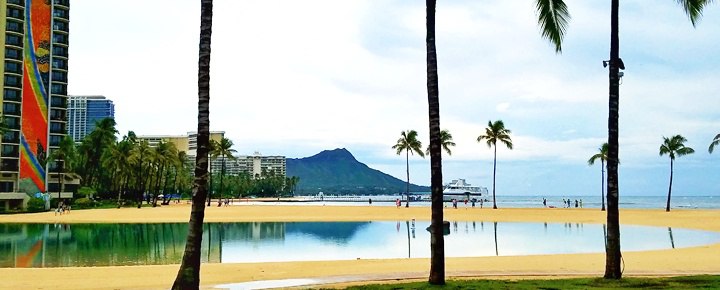
Waikiki Beach is quietly slipping away—and with it, a century of shoreline illusions. Engineered more than a hundred years ago and maintained ever since with imported sand and coastal structures, Hawaii’s most famous beach is now retreating faster than ever before. In some places, the sand is already gone. In others, walkways are simply crumbling underfoot.
Now, state lawmakers are being asked for $5 million to kickstart final plans for the latest $60 million beach rescue effort. But experts warn: if the funding stalls, so does Waikiki’s future.

A three-phase plan built on immediacy.
The Waikiki Beach Special Improvement District Association (WBSIDA), working with state and county partners, is spearheading an interim mitigation plan designed to hold back erosion and extend the beach’s lifespan. The phased strategy includes beach sand replenishment, stabilizing structures, and long-term engineering interventions that could cost up to $60 million or more. But the entire project hinges on political will.
Much of the updated strategy centers on findings and recommendations from Dolan Eversole, a coastal processes specialist at the University of Hawaiʻi at Mānoa’s School of Ocean and Earth Science and Technology. Eversole has been instrumental in multiple studies of Waikiki’s erosion risks and has emerged as a leading voice behind the current efforts.
He has previously emphasized that without a program of regular replenishment and structural protections, Waikiki’s beach would gradually disappear, leaving behind hardened shorelines, exposed infrastructure, and seawalls battered by waves.
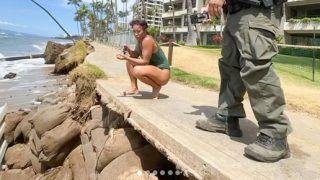
The Eversole team’s phased strategy encompasses immediate, midterm, and long-term interventions. The first step includes temporary closures of hazardous walkways—like the heavily eroded Halekulani Boardwalk—where exposed rebar and collapsed slabs now pose safety threats. From there, limited sand placement and small-scale stabilizing structures are planned to improve access and slow erosion over the next few years.
The most ambitious step involves installing T-head groins—perpendicular rock structures designed to trap and retain sand. The ultimate goal is to return parts of Waikiki to the condition they were in 40 to 50 years ago, even if, as Eversole has noted in public forums, the result is engineered rather than natural.
Will there still be a beach in front of your Waikiki hotel?
One of the most delicate issues is sand sourcing. Any new material must closely match Waikiki’s existing sand in both grain size and color. Current plans involve drawing from both onshore stockpiles and nearshore areas, such as the Hilton pier channel.
For now, around 5,000 cubic yards of sand are being used in a pilot project focused on three of Waikiki’s most heavily eroded areas—each fronting some of the most name-recognizable hotels in Hawaii.
At Gray’s Beach, situated between the Halekulani Hotel and Sheraton Waikiki, erosion has left virtually no usable sand. Seawalls and wave-exposed concrete now dominate the shoreline here. This area is slated for significant sand replenishment and the construction of T-head groins to reestablish a walkable beach.
The stretch fronting the Royal Hawaiian Hotel and Moana Surfrider is another high-priority zone. Anchored by the aging groin at Royal Hawaiian Hotel—originally built in 1927—this segment has seen repeated restoration efforts to stabilize the sand. It remains a focal point of current plans to improve long-term shoreline retention through structural updates and controlled sand placement.
Further west, the zone between Fort DeRussy Beach Park and Kuhio Beach, including the beachfront of the Hale Koa Hotel and adjacent to Hilton Hawaiian Village, is showing uneven sand distribution. Some areas have sand buildup; others have experienced measurable retreat. The plan here involves redistributing sand and evaluating structural changes to maintain beach continuity and access.
While modest in scale, this pilot effort will serve as a test of new dredging equipment and environmental protocols. Officials believe it could set the stage for similar maintenance efforts statewide if the project is successful.
A billion-dollar beach with no budget.
Waikiki Beach is more than just a postcard backdrop—it’s also one of the state’s economic powerhouses. Estimates place its direct tourism-related value at around $2 billion annually. For comparison, the entire restoration project’s price tag of $30 to $60 million, or even more, would represent a small fraction of that value.
Even so, funding has remained uncertain. Rick Egged, president of both WBSIDA and the Waikiki Improvement Association, said the scope of work and cost estimates are still being finalized. The drop in the bucket $5 million currently being requested is meant to fund the final design and permitting process, but there is no guarantee the Legislature will approve it.
Egged emphasized the importance of securing legislative support this session, noting that only with completed plans in hand can the broader funding requests move forward.
Beach infrastructure at risk.
Waikiki’s beach erosion is not just a cosmetic issue. As sand disappears, the shoreline draws closer to critical infrastructure—including seawalls, buried utilities, and oceanfront hotels. With no buffer zone, wave energy increases, and the likelihood of structural damage grows.
In some areas, such as in front of the Halekulani Hotel, the beach was already mostly gone even before the latest storm damage. Complete reconstruction is now being considered, with new sand and permanent groins proposed to create a functioning beach where none currently exists.
Waikiki as a test case.
The stakes go far beyond Honolulu. Waikiki is one of the most engineered beaches in the Pacific, and what happens here could influence how coastal cities worldwide respond to sea level rise and shoreline retreat. The pilot dredging system being tested as part of the current restoration effort may also be used for harbors and other beaches across Hawaii in the years ahead.
In that sense, Waikiki has become a test case: Can a tourism economy built on image, access, and shoreline stability find a way to mitigate accelerating erosion?
A beach built on maintenance.
Few visitors realize how synthetic Waikiki Beach truly is. Its shoreline has been regularly replenished with imported sand for more than a century. The last major project, in 2012, involved pumping nearly 24,000 cubic yards of sand from offshore onto the beach. In 2021, a $3.4 million state effort added another 20,000 cubic yards.
None of these fixes are permanent. Sand washes away naturally with waves and tides, and as extreme weather becomes more common, the intervals between replenishment may need to shorten.
Still, some question whether rebuilding Waikiki’s shoreline every decade—or even more often—is sustainable in the long run.
What happens next?
The most immediate question is whether the Hawaii Legislature will allocate the initial funding needed to finalize designs and permits. If that happens, full-scale restoration work could begin as early as 2026. If not, the timeline could stretch further, or the plan could stall entirely.
In the meantime, the beach will continue to change—subtly for now, more dramatically in the years ahead if nothing is done. And for travelers booking their next Hawaii vacation expecting Waikiki Beach, the island they remember may not be the one that remains.
Would you still book in Waikiki if the beach disappears—or would you go somewhere else in Hawaii instead? Let us know.
Get Breaking Hawaii Travel News
Hawaii needs to fund this. Almost all tourism going into Oahu is centred around Waikiki, so they need to make this a quick priority. I went two years apart, and I can see significant changes in just that small amount of time. Anyone in a position of power that denies funding should be arrested and removed.
I love Waikiki Beach. I first stayed there in 1974. Wow, what a difference. The beach is nearly gone. You reap what you sow. The greed there is sickening. The hotels have been ripping off the tourists for years. Now, there is even more taxes coming. I know I am right about this.
Just looking at a certified photo (don’t know how to post the photo here) of Waikiki Beach in 1934….beach width looks about the same as now….life and sand ebbs and flows I think.
Sooooo…
Over a century of continual beach maintenance…. But I thought climate change was the existential threat that would end humanity in 10yrs and we have to do something immediately …
Sacramento,CA broke a 100+ yr old heat record… how was it hot 100 yrs ago?
Thanks Al Gore
Boggles my mind….why aren’t the big luxury hotels volunteering the funds, after all, they benefit the most. Time for these big names to step up. Suck it up and do good for the people of Hawaii. Stop trying to pass on costs to the citizens and to the tourist. The greed is what will destroy them in the long run. Maybe, we the tourists, should visit other islands and spend our hard earned dollars on places more caring of their environment and their visitors.
Thank you for this article. I had no idea that sand was brought to Waikiki from other places and now that I know this, I would rather have more ocean than sand …maybe some sealife would come back!
Given that we almost never visit the island of Oahu (we typically spend our time (3-4 weeks a year) on Kauai) we really wouldn’t miss it if it disappeared. That said, if the beach needs intervention, and has received it over the years, go for it.
As a long term resident and tax payer in Honolulu I recognize the natural beauty and importance of Waikiki beach, however I am very resistant for us tax payers to fund such a project.
It is in the financial interest of the travel, industry and hotel business to carry this burden. Most certainly because they are responsible for Hawaii, not developing a diverse economic business model, and keeping businesses and career choices for young people from existing here. They benefit so they should pay.
The hotels, the tourists and legal STR owners Do pay huge taxes. Let the locals vote to not replentish the sand. Kona is beautiful with rocks. Then see who pays higher property taxes because tourism is down.
Aloha,
As a Hawaiian Born citizen for 40 years, I was just blown away by all the taxes and fees the State and lodging that is paid by visitors today. A 7 day stay in Waikiki and the Big Island cost over 10,000.00 to stay in 3 star hotels while home for a Wedding.
It’s Karma for how much money they have ripped from their loyal visitors and just now want to do something to help the issue of erosion in Waikiki.
Born and raised in Hawaii and not being able visit because of Greed of state representatives.
I have a travel blog and have passed this information on to my 320k subscribers and general population. I guarantee my articles have cost Hawaii tourism millions of dollars in revenue and I am just getting stated. No relief for Hawaiian Born visitors is plain disgusting at best.
Hawaii is far from the Aloha State I grew up in. I will always love my homeland, but will never return due to taxes on taxes and taxes on fees.
Aloha Hawaiian Islands
dws
Hate to say it but Hawaii’s Waikiki beach has always had sand barged in to fill eroding areas. Notice the sand is different colors in front of certain hotels. No mater what the tourist will be taxed or surcharged to fix the problem. Barging more sand in just is a temporary fix so IMO I think a sea wall will be constructed and hopefully a huge boardwalk-patio to safely view from. As always a fee to enter and stiff the tourists. Ya know Pay,Pay,Pay. That’s the Hawaii tourist way.
Every island has done multiple studies on beach errosion and spent millions of local tax payer money. They should stop wasting time and do what they did years ago and build more beach breaks, and quit thinking the politicians you keep electing are going to do anything to help save Hawaii.
I think beach breaks and also. Get these big hotels to move away from the water. That’s the whole issue we build too close. Let the beach be a beach.
Need to demolition of the Hiltons move them back or to koolina. You know the state will build them a train or something out there.
Can’t even enjoy the beach and ocean as a resident so many people. Wish there was a boardwalk path along the beach to exercise and enjoy the natural beauty. Not just feels like a big mall.
Aloha Kawika, removing the Hilto & other resorts from the ocean will probably not happen in our lifetime, so we will have to live with it …I just hope that they will not allow new resorts being built on the ocean …in fact, I was wondering why there were no demonstrations when those were built in the 1st place …
Less sand on beach, more in the ocean
Every trip, we can walk out further and further
The corps of engineers needs to look at Lido Beach in Sarasota FL. I think they could do the same thing in Waikiki. It saved the beach there.
The seaside concrete walkways at Kapi’olani Park headed towards the Natatorium are a disgrace (so is the Natatorium). Everytime I visit they’re in worse shape. how about “A little less talk and a lot more Action” I’m going to be there in week – not looking forward to seeing them in even worse shape.
Best Regards
I think the hotels, restaurants and shopping malls should share in the repairs to the beach. Although I know we the tourists will pay for that share with increased prices. They have to be careful with increasing the prices because the tourists will find other places to vacation.
this is a band aid (and a terrible idea long term). the state just can’t see to help itself from jumping from one boondoggle into another. how about a 12 step program for Tourism Addiction.
Island of Molokai wants their sand back. Papohakau was stripped of a massive amount of sand.
So what is going to happen. Is there not going to be a beach on Waikiki in the future. Is that what you are saying ? Well that just makes me want to return for vacation. Yikes
What return Waikiki beach to 40-50 years ago. You mean a swamp or let it erode to nothing. Waikiki will then be a bunch of hotels with high priced tourist trap shops. The lagoon next to the Hilton Hawaiian Village will be the only place to go other than the hotel swimming pool. With all the fee’s for non hotel guest in the $20-50 charge to use the pool, restaurant pertaining to the non guest resort fee no wonder hotels are starting to do this. Close Waikiki beach and where else is there to go? Next what attack car rental rates so a tourist is stuck in town not able to enjoy a beach. IMO I’m surprised Hawaii hasn’t made car rentals $500 a day just to control the amount of tourists and beach traffic. Wait until tourists just stop coming.
Many non-hotel guests use the Hilton pools for free, both locals and visitors. It’s not regulated at all. And The Bus will take you just about anywhere on Oahu for a few dollars —no need to rent a car.
ok …now you are giving away “secrets” …let’s just hope it doesn’t get out of hand, because when it does, we will all have to pay the price!
They aren’t closing the beach, the beach is running to is natural state. It was marsh land artificially filled in with sand on a regular basis. If you weren’t aware of this before you should have been if you read the article
it’s obvious that the area around the Hilton in Waikiki is an artificial lake, but I didn’t know that the rest of the beaches in Waikiki was ….grateful for the article. Always good to learn new things and it makes sense to me now.
Just an idea, but since erosion is continuous, would it be possible to have a much smaller and quieter dredging operation operation with a small crew work 5 nights a week and continuously replace smaller amounts of sand moving along the beach and back over a year?
Yep save Waikiki Beach along with the hotels, but home owners on the north shore, let them slip into the ocean. 🤷♂️
Sea levels will probably rise faster than predicted, then the whole island will eventually need sea walls.
One would think that a portion of all of the taxes and fees charged to tourists (occupancy taxes, resort fees, etc.) staying in the hotels in Waikiki could have been set aside to maintain the beach. It may not be the only reason tourists flock to Waikiki, but it is certainly one of the primary reasons.
First Lahaina, now Waikiki? Hawaii really needs a statewide master plan before it’s all just memories and old postcards.
We just stayed near Gray’s Beach last month and the sand was barely there compared with before. Sad but not surprising with everything going on.
It’s embarrassing that I had no idea Waikiki was this engineered. Makes you wonder how much longer we can keep pretending it’s natural and keep it going.
My thoughts exactly, Ernie. I didn’t know either ….although, personally, I don’t need a beach like the one in front of the Hilton in Waikiki or the Sheraton on Maui …as long as I can enter the ocean safely somewhere, I am fine. On top of that, many people don’t even like sand and prefer to sit on grass …
Waikiki sucks. Sure, save the beach but maybe make all those horrible businesses who have ruined the area pay for it. Or …. return it to what it was in the 50’s. Louie Vuitton, and stupid stores like that, need to Go. It’s now worse that what happened to La Joya in SoCal. Make all them pay for it instead instead of asking locals, who don’t ever go there, to pay for it. Or …. make the tourists pay for it.
60 mil on Waikiki beach is way better than even one dollar more on the rail that never ends.
If it proceeds, it means the pro tourism lobby won.
If it stalls, it means the anti tourism lobby won.
By their deeds you will know them.
$2 billion annual revenue per year with a $60 million restoration need? Why doesn’t the county put a property tax special assessment on all commerical properties in a half mile radius of the beach for the property owners to pay a percentage of the restoration? Have the businesses directly benefitting from the beach foot the bill. It is their property values occupancies that would go down if the beach errodes and become unsightly or unusable. Those directly on the beach or closer to it would be charged higher percentages.
Oh that just makes me want to buy property in Hawaii yipee Nanette
This is so sad that the beach is eroding. So what is going to happen. How about the lagoon by the ilikai. Will that be ok? Oh boy so many questions. Hawaii as i know will be know more i guess right. Nothing will be the same. So sad.