
When a Kauai-based company went to federal court last year to challenge the century-old shipping law many people blame for Hawaii’s high prices, it never claimed that the odds were good. It claimed the costs were unbearable, unsustainable, and shared by everyone who lives in or visits the islands.
That long-shot effort ended this week, and the outcome reinforces a reality that Hawaii travelers encounter on every trip. Prices are not coming down, and the courts are not going to be the place where that gets changed.
The lawsuit that tried to open the door.
The case was brought by the Koloa Rum Company, a Kauai-based business that has grown from a small island operation into an internationally distributed brand while keeping production rooted in Hawaii. Its CEO, Bob Gunter, is also a longtime friend of Beat of Hawaii, which is in part why we followed this case closely from the start rather than treating it as an abstract policy fight.
From the beginning, Gunter framed the lawsuit around day-to-day Koloa Rum economics rather than ideology. This was not about theory but rather about invoices, freight bills, and math that no longer works.
At the center of the case was the Jones Act, a federal shipping law that requires goods moved between U.S. ports to travel on vessels that are American-built, American-owned, and American-crewed. Hawaii, separated from the mainland by thousands of miles of ocean, feels that restriction more acutely than any other state.
Foreign-flag ships that move cargo cheaply across the Pacific cannot legally carry goods between Hawaii and the mainland, even when they are already cruising nearby. That restriction limits competition and drives up shipping costs for everything from raw materials to finished products.
Gunter argued that the burden falls on everyone. Hawaii businesses pay more for bottles, packaging, equipment, and spare parts. Families pay more for groceries and household goods. Exporters then get hit a second time when they try to ship Hawaii-made products to other parts of the United States. Visitors pay in everything from restaurants to grocery stores.
The company highlighted a comparison that effectively captured the imbalance. Shipping rum from Kauai to Los Angeles costs nearly three times more than shipping the very same product from Los Angeles to Australia. That kind of situation is not unique to rum and appears in food, construction materials, retail goods, and hotel supplies.
Why the court shut it down.
Chief Judge James Boasberg of the U.S. District Court for the District of Columbia dismissed the lawsuit on two grounds that leave little room for revival.
He ruled the case was time-barred. Under federal law, constitutional challenges generally face a six-year statute of limitations. The court concluded that the clock started when Koloa Rum began operating in 2009, not each time the company paid a shipping bill or watched costs rise further.
Second, the judge rejected the constitutional argument outright. The Jones Act, he wrote, does not discriminate against Hawaii specifically. Instead, it applies uniformly across the United States as part of what he described as a long-standing tradition of laws that reserve domestic shipping for domestic carriers.
That distinction is significant. If Hawaii is not singled out under the law, courts are unlikely to intervene simply because the law produces harsh economic outcomes when applied.
The federal government defended the statute, and Matson Navigation intervened in support of keeping the law intact. From the court’s perspective, this fight was over long before it began.
What this means for Hawaii travel costs.
For visitors, nothing changes operationally, but everything familiar stays very expensive. The Jones Act continues to sit beneath nearly every cost travelers encounter upon arrival.
Groceries cost more because they cost more to ship. Restaurants charge more because ingredients, packaging, and equipment all arrive at highly inflated rates. Rental cars are more expensive because parts and vehicles are subject to the same constraints. Hotels pay more for furniture, linens, maintenance supplies, and construction materials, and those costs eventually show up in nightly rates and resort fees.
Earlier this year, interisland freight rates jumped a whopping 26%, and businesses passed those increases straight through. The Jones Act is not the only factor behind Hawaii’s high prices, but it is a structural one that makes every other cost worse.
For travelers wondering why Hawaii feels increasingly out of reach, this ruling confirms that one of the most frequently cited causes that has been mentioned across hundreds of BOH comments is not going away.
A reader question that still hangs.
When we first covered the lawsuit, a reader named Susan from San Diego raised a skeptical but fair question. Even if the Jones Act were changed, she asked, would businesses actually lower prices, or would they simply keep the savings?
The court never reached that debate. The law did not change, so the question stays just a theory for now. What is no longer theoretical is that prices tied to shipping will continue to remain high.
For Hawaii travelers, that means airfare is only part of the cost equation. The prices of food, lodging, and everyday services will continue to reflect a supply chain designed around protection rather than competition.
Why Congress is the only remaining path.
With the courts closed off, the only avenue for any meaningful Jones Act reform runs through Congress. Bills like the Open America’s Water Act could repeal the domestic shipping restrictions outright, but they have gone nowhere for years.
The political forces behind the law are entrenched, backed by maritime unions, shipbuilders, and domestic carriers that benefit from keeping the status quo. Hawaii’s geographic reality gives it the most to gain from reform, but not enough leverage to force it to happen.
For now, the Jones Act stays in place, and so does the cost structure it creates. If relief ever comes for Hawaii’s high prices, it will not come from judges. It will come, if at all, from lawmakers willing to challenge a 105-year-old law that few visitors know by name but everyone pays for once they arrive.
When you look at Hawaii’s prices today, does this ruling change how you think about what is really driving the cost of a trip, or does it simply confirm what you already suspected?
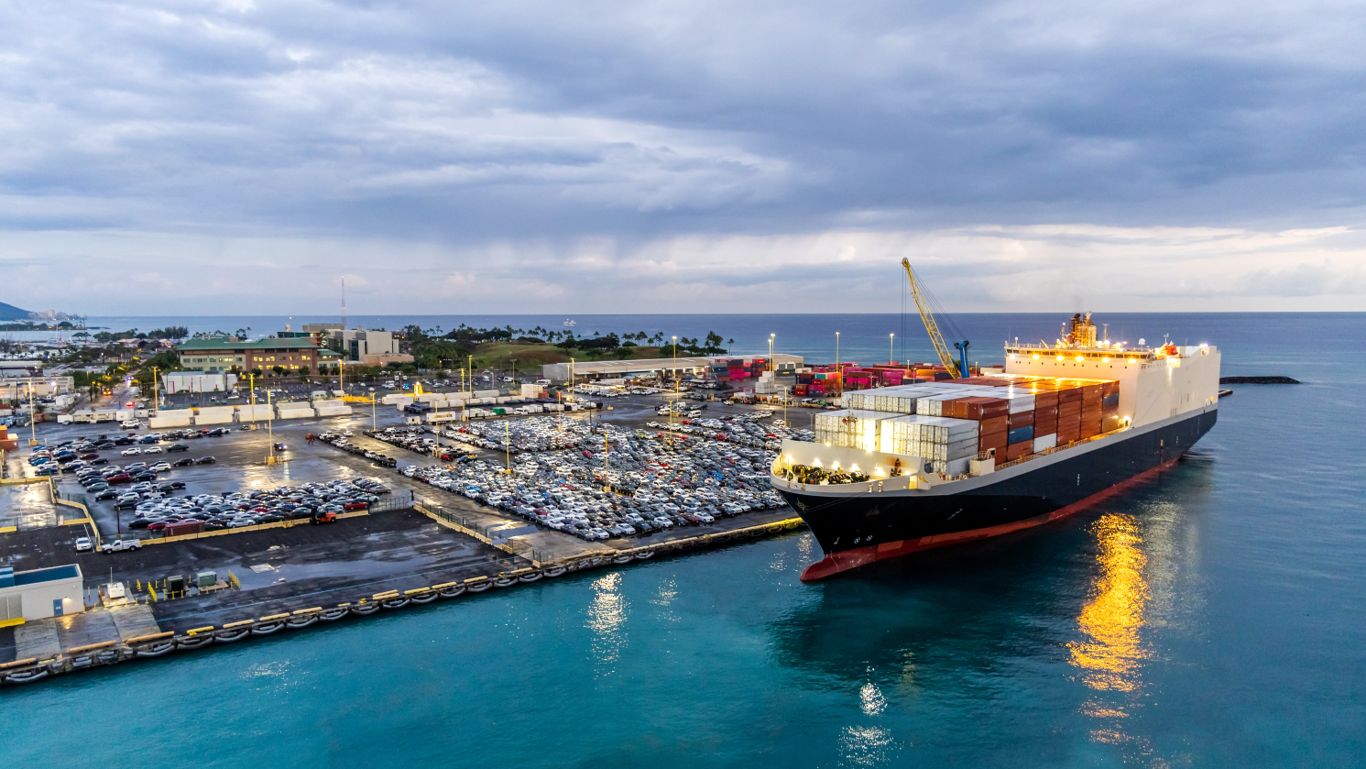
Lead Photo: Honolulu Harbor.
Get Breaking Hawaii Travel News





Sen. Hirono’s comments today make it a timely issue. But think it through: what would post-Jones sea transport look like ?
Ocean cargo as a whole is low margin: shippers only profit on short runs with smaller ships & operating costs (eg. Manila to Guam, who BTW are subject to the Jones Act) or at large scale (eg. China-Calif) on big ships. We’re a small market (more like Guam), further away than we think, with daily costs much higher. No easy “drop-off” en route (as folks who can read a maps know): costs will barely drop, but service will degrade.
The Sen. should explain this all better: her brief 20 sec. reply was a disservice. Detailed facts (what would trans-Pacific carriers charge ?) & options (can interisland be “split-off” ?) are needed in the debate; then address other info too:
• Insurance, safety, enviro, and contractual compliance ?
• can HNL serve the big ships they’ll use ? Or will we need DaRail-size money to retrofit ?
It almost seems like the Jones act has created a monopoly for the American shipping industry. And, if I remember correctly, wasn’t the old “AT&T” broken up because of that to become Lucent tech, a smaller AT&T, and other telecommunication companies? Or when Standard Oil had to become Standard of Ohio, of Texas, etc. Competition makes prices more affordable and products have to innovate to keep a competitive edge. Maybe governor Green should consider something to help the average islander afford to purchase products.
Congratulations to Bob Gunter and Koloa Rum for there efforts on shipping issue’s. Shipping is the 1st of a handful of lies that has been told for so long that the Hawaiian people now believe it as the truth. Others are:
There’s a shortage of land.
There’s a shortage of fuels
There’s a shortage of foods
There’s a shortage of freight
There’s a shortage of shipping from mainlands
There’s a shortage of housing.
Amoung others. Its a big lie.
I can dive into each subject and make a compelling case, but as Koloa Rum just learned no one is interested in actually fixing the problems. Everyone at the higher levels of business and government is well aware of what’s going on but no one is going to “rock the boat” and change a fixed system at the highest levels. Anytime something goes wrong in the above mentioned area’s the company’s involved go to the media with a sob story of how they need more monies and its agreed to.
There’s more but my 1000 characters is up.
Terry
Lose the Act, and what do we get ? Not regular shipping schedules, despite fervent wishing. Hawaii is a small market, and not worth the expense of a layover, much as we can sympathize with small local exporters. Vessels don’t actually sail that close, and the several days’ deviation (transit, off-load, minimal on-load, etc) won’t even pay daily operating costs of large, modern cargo ships. At best we’d get foreign tramp steamers with irregular schedules or accountability (for mishandled/lost/spoiled cargo, accidents & pollution, etc) We can’t even hold PRC fishing boats accountable through their shifting webs of owners, charterers, etc. It’s a reality of living in a remote archipelago: akin (or worse) than folks in Laie expecting a stop on DaRail.
This is the greatest hinderance from Hawaii, Alaska and Puerto Rico from ever getting away from high prices. The article mentions that shipping might be a 1/3 less. The correct amount is about 9/10 less. The US shipping back to China is almost completely empty. How do you think that we used to ship recyclable’s back to China? Newspaper, cardboard at least bring in some revenue for these shippers. The shipping rate is a fraction of China-US. A container before COVID would run about $1800 from China to US. A container from US to Hawaii runs about $9,000. New Car’s from Japan could stop in Hawaii on the way over. No Senator from the two states or PR support getting rid of the Jones Act because of the money the two carriers give to them. It would be better to pay the US crew to sit at home than continue the current situation. Prices would fall dramatically. Costco would create these savings and others would have to follow.
Sone Toyotas and Subarus are built and shipped directly to Hawaii.
Full containers from the far east can be shipped from other countries. Besides petroleum, sand, cement and cars, most items can’t ship from other countries as Hawaii to small to absorb such amounts of other products
Too bad Hawaii residents have to live in the past. The Jones Act was enacted in response to World War I to address problems back in 1920. It worked back then but that was a long time ago. Fast forward to 2026. We need our Hawaii congressional delegation to stand up for all the people of Hawaii to address the Jones Act. Until that happens, we’re stuck in a time warp and a blast from the past! Sad!
The problem is treating one of the most isolated island chains in the world—Hawaii—as if it were part of the continental U.S. under an ancient law. The result is that American citizens in Hawaii are penalized. Then policymakers wonder why people in Hawaii buy overseas via Asia instead of the mainland U.S.
Even with air shipping, it’s absurd: shipping from California to Hawaii via FedEx often costs far more than shipping from California to New York, despite both being flown by air. That difference isn’t logistics—it’s mindset.
Barge shipping is even worse. Hawaii businesses and residents have every right to be upset. Allowing the monopolization of barge shipping by two local companies is outrageous. Residents are effectively punished to protect an outdated mainland-focused Jones Act. The law was never designed for Hawaii—it wasn’t even a U.S. state when the law was written. The situation is simply ridiculous.
Absolutely agree! On another level, this unfair and antiquated law could be seen as a form of economic colonialism impoverishing the U.S. citizens inhabiting a U.S. state for the benefit of private U.S. shipping companies and their shareholders! As another commenter stated in another post, this law was enacted before Hawaii statehood, so it definitely has remnants of American imperialism and trade protectionism designed to protect the economic interests of shipping companies. Nevertheless, Hawaiian residents should not have to pay a regressive and unnecessary tax to increase the wealth of shipping companies and corrupt officials.
Aloha everyone, I sincerely appreciate this article because of how The Jones Act negatively impacts Hawaii residents and visitors. As a recent and repeat visitor of Oahu, and Maui, it boggles my mind how this law makes life unaffordable for both residents and tourists, while at the same time it significantly limits Hawaii’s economic development and competitiveness. For instance, when I go to a grocery store on mainland USA and look for Hawaiian products I can rarely find them, however, I can find thousands of international products from countries thousands of miles farther than Hawaii. By limiting access to Hawaiian products on mainland USA, through higher shipping costs from the Jones Act, it puts Hawaii at an extreme economic disadvantage and, it contradicts the popular “Made in America” policy that many bipartisan congressional leaders claim to promote!
This has been ridiculous for too many years. The 1920 Jones Act is antiquated and only serves to support Matsons and Young Brothers in keeping prices high. The US builds very few commercial cargo ships. Hawaii’s economy is also entirely dependent on imports. So, the law that was intended to solve a 100-year-old problem is causing real-time pain to Hawaii, resulting in higher costs on literally everything. It is up to our senators and representatives to make this a priority to end the Jones act and allow free competition among shipping lines. We should be asking ourselves Why thislaw remains???? Look in the right direction to solve the problems of Hawaii’s cost of living!!!!!
I am curious if you have comparative impact for other US Territories like Guam or Puerto Rico? The same shipping restrictions would surely apply, however I have heard (nor have I looked very hard) if the Territories have similar sky high pricing. If not, why not?
As my parents always taught, it’s expensive keeping up with the Joneses.
This law actually discourages Hawaiian businesses from buying American products. If I were subject to this as a local business, I’d be choosing Asian imports mostly and I am sure that many already do – they can get shipped in by non-US carriers. Penny wise pound foolish law from 105 years ago, like a lot of politicians that should have retired already!
why does the Hawaii government not pass a new law that overrides the Jones Act of 1920 (wow).
Because federal law overrides state law every single time and twice on Monday.
Do companies like Costco run their own freight to keep costs low?
Judge Boasberg… That dude is working to get everyone in the US to detest him.