
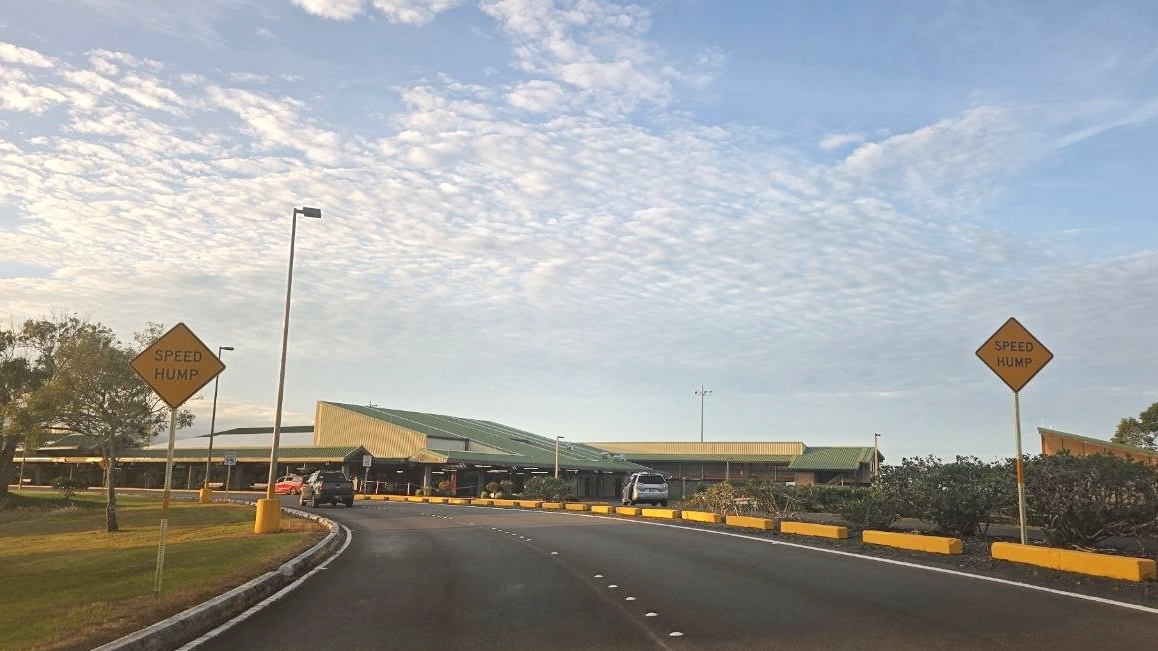
We fly through Hawaii airports all the time, and not in any aspirational kind of way. Living on Kauai and writing about Hawaii travel news means interisland flights are part of normal life, sometimes stacked close together, sometimes done tired and late, and always for reasons that have nothing to do with vacation.
After a while, Hawaii’s airports stop being interesting places. Things like architecture, branding, or whatever language gets used by others to describe them, and you start paying attention to friction instead, things like noise, heat, crowding, and how quickly a place wears on you.
Moving through all five “major” Hawaii airports in rapid succession in December, those differences became hard to ignore. One of them, however, broke the airport pattern in ways that still feel extraordinary.
Hilo Airport feels different the moment you walk in.
Walking into Hilo Airport does not feel like entering a system designed to process you quickly. In fact, it feels like a step back in time, and in a very good way. Flights are arriving and departing, security is operating, and Hawaii visitors and residents are moving around, but the building itself does not feel tense, even at the holidays.
The noise level is lower, and the pace feels slower, even though nothing is actually stopping. You are not immediately scanning for where to sit or stand, which line you might be blocking, and that reaction happens at Hilo even before you consciously register why.

Waiting here does not feel like something you are supposed to endure.
The seating is the detail people notice first, not because the chairs are trendy or new. They are large, wood with generous Hawaiian floral cushioning, and forgiving, the kind you can lean back into instead of perching on the edge and waiting for discomfort to push you up again. The airport floor is beautifully kept, with its original wood. It isn’t funky fluorescent green carpeting like Honolulu Airport.
Most airports feel designed to make waiting just uncomfortable enough that you do not linger. Hilo does not do that, and you can sit there for a good while without constantly shifting or clock-watching. That alone changes how delays feel. It’s actually a fun place to hang out, and we can barely believe we are saying that about a Hawaii airport. It is unique in that way, too.
The bathrooms underline the same priorities.
The bathrooms at Hilo are the detail that really makes you stop. And even photograph them. Granite counters, marble finishes, and materials that feel original, high-quality, and permanent stand out immediately.
That contrast is sharper if you fly through Lihue regularly. LIH has seen years of upgrades and plenty of money, yet the bathrooms there feel tired, oddly cheap, and worn out, even though they technically function. They are an embarrassment every time.
At Hilo, the bathrooms clearly send a different signal. Someone chose durability over minimum standards, and even if no one can fully explain how that happened there and not elsewhere at any other Hawaii airport.
Security and baggage stay out of the way.
Security at Hilo is usually small and uneventful, which is exactly the point. Typical waits are short enough that you do not build your day around them or start running timing scenarios in your head. We didn’t even bother with the MyTSA app to check wait times. It was worth noting that the security staff seemed less stressed, friendlier, and more helpful than at other Hawaii airports.
Baggage claim works the same way. Bags come out quickly, people do not stack up shoulder to shoulder, and you are outside before irritation has time to ever set in, which is becoming increasingly rare.
The other airports contrast with Hilo.
Honolulu works, but it works loudly and relentlessly. It is built haphazardly, yet for volume, and you feel that pressure everywhere, even on days when everything technically runs smoothly.
Maui feels compressed. Lines stack, waiting areas shrink, and the experience often feels like it is operating outside its comfort zone, especially during busy times. It is functional yet never a place to linger.
Kona divides people. Some love the open-air arrival and departure and the nostalgia of walking across the tarmac, and we mostly feel the same way, except when it is very hot, and the air isn’t moving. Others just want to cool down and sit after a long flight, and do not really get that option, except for two new gates.
Hilo does not ask you to trade comfort for character. It simply lets you arrive in a Hawaii style that is both elegant and understated.
Lihue is small like Hilo, but feels dark and gloomy after security.
The downside is real.
Hilo’s biggest weakness has long been getting there in the first place. For years, mainland nonstops disappeared as United pulled out, and most service funneled through Honolulu or another island, making even short trips more complicated than they needed to be.
That has started to change in a meaningful way. Southwest is launching mainland nonstop flights to Hilo beginning this year, restoring direct service that many travelers assumed was gone for good. We covered the implications of that shift in Hilo finally gets mainland nonstops amid airline shakeup, because this is not just a schedule tweak but a real change in how Hilo fits into the Hawaii airline landscape.
At the same time, nothing here is guaranteed. With Alaska Airlines acquiring Hawaiian, the longer-term shape of mainland service to Hilo remains unsettled, and history still suggests caution rather than optimism about Hilo’s future role.
For now, flying into Hilo will still mostly mean weighing a nonstop against a connection, except for one flight that is going to be popular. Whether that tradeoff is worth it depends on how much value you place on what happens after you land on the Big Island.
For some travelers, the math still works.
Hilo makes total sense for Volcano trips, Hilo stays, and for travelers who care about how a trip starts as much as how quickly it gets going. Rental cars are sometimes cheaper here than in Kona, which can offset some of the inconvenience of a connection.
Getting out of the airport is easy, getting on the road is straightforward, and you are immediately right in Hilo, and not dropped into congestion. That alone changes how a Hawaii airport arrival feels.
Ken’s House of Pancakes, a personal favorite, is just minutes from the airport and has long felt like part of the Hilo arrival ritual, whether you planned it or not. It is the kind of place you can hit immediately after landing, before you even get fully out of the airport mode. We also like stopping at nearby Big Island Coffee Roasters.
This difference is not accidental.
Hilo is not better because it is older or quieter. It is better because it feels like it was built with the assumption that people arrive tired and leave distracted, and that the space should work with visitors in mind, instead of against it.
That assumption shows up everywhere once you start noticing it. After flying through all of Hawaii’s major airports again, it becomes harder to ignore how uncommon that feels anywhere else.
If you use Hilo Airport, what has been your experience? We invite your comments.
Photo Credits: © Beat of Hawaii at Hilo Airport.
Get Breaking Hawaii Travel News




Bruce,
There are no direct flights to or from Hilo … yet … as Beat of Hawaii has reported, that’s changing this August with Southwest Airlines nonstops to Las Vegas, & back, three (3) times per week. Southwest has also added a couple of these flights this April around Merrie Monarch time.
East side Big Island residents agree with you: there should be more direct flights in & out of Hilo. Unfortunately, United Airlines stopped their nonstop Hilo service to & from LAX, January, 2023, which had started in 2011.
Important to note that Hilo’s runways are far longer than those on Maui or Kauai, and can easily accommodate jumbo jets. Perhaps if the new Southwest Airlines direct flights to the mainland get heavily booked, then other airlines might restart direct service as well. We can only hope.
Everything you said is true for Hilo Airport. But that’s because it does not do direct flights except now Southwest from Vegas to Hilo is starting up.
But it still never gets the huge crowds which ofcourse change the atmosphere. And ability to keep that original Hawaii simplicity.
It is like going back in time. But to get there you have to connect from a larger airport therefore you lose that old Hawaii feel.
People fly from mainland to Hawaii voa Honolulu and Maui as main hubs..
Kona and Lihie, Kaui do some too.
But the more people who fly to an Island, the less the Airports can keep that amazing Hawaii feeling at same level.
Hilo is an experience and worth flying interisland too unless your staying in Kona and driving across Island to see Volcano etc.
Just thoughts from a local Hawaiian dude….. Aloha
Two points on ITO –
1. It is indeed comfortable.. I sat there one time immersed in reading, like sitting on my couch at home – completely lost track of time, and missed my flight. 😆
2. The TSA folks there are the best! One time I was removing food items and the TSA guy saw my Big Island Candies bag of omiyage. He says; “have you tried their pies? They are awesome!”..
Food recommendations from TSA officers. Only in Hilo!
Love my ITO!!
The only bad thing about Hilo is that there are NO direct flights from Oakland International to Hilo. If there was, I believe it would be better than just having Kona take all the flights.
Hilo is my favorite airport too, and I’m happy to see it get the recognition it deserves. Thank you for doing this piece. As someone else commented, the live music there was awesome.
A colleague of mine once compared the vibe of the Kona airport to a Honolulu municipal district park, and I totally agree.
TSA at Hilo is so kind and helpful.
ITO is beautiful! I love the rain chains that trickle water to the many tropical gardens. They have a serene Peace garden that I have to stroll through to get my luggage. Stop and read the peace pole in Hawaiian. Admire the orchids on the hapuu. By the time you reach your bags, you’re relaxed. The security even helps me with my bags, instead of yelling like on Oahu. The only junk thing is the “lounge” which Alaska needs to fix up a bit. I ♡ Hilo!
Great thing about the staff at ITO is they know us local people. They go out of their way to help. I have been embarrassed at TSA in HNL, because with my 5 joint replacements, I set off metal detectors. I tell them ahead of time & have been ordered, rudely, to “go back & come through again.” I have frequently told the ITO supervisor to go teach HNL some manners.
Assuming you are PreCheck since you’re still going through the WTMD.
Suggestion- request to go through the image scanner that the regular people go through. Your internal joint replacements won’t make any difference to it. Source- me and my plate and screws I had in my broken arm while I mended.
Telling TSA you have a pacemaker will also push you into the full body scanner.
Hilo airport has long been my favorite airport anywhere, for all the reasons in your article. Even the TSA people are friendly, or at least relaxed. I hope it can stay this way.
Even TSA seems more courteous and helpful.
Hilo in 1966, It was real Hawaii, very different, you walked down steps! Baggage? You could see them coming off the plane! They were fast to us! The Big Island was in my mind always! We saw everything! No problem, the best was Kalapana village! I played with Uncle Robert as boys on the beach! I saw a huge Bay with Whales in it, A Black Sand Beach going from Kaimu too Kapoho! Yes miles of Coconut tree’s by 1970s this all changed as the coast sank 16 inches and the beaches all go + tree’s gone, I moved back to Hilo from Oahu in 1978, flew on Hawaiian Air a great flight! The Hilo Airport was unchanged! still quite and full of Aloha, Hilo? great! + Pancakes at Ken’s were still the best I had ever eaten!. We rented a car and off we to Volcano National Park! My family member driving, later became the Park CEO 1980 years. So we had a unforgettable experience! Flying in the now? Honolulu is not live Aloha! Hilo? Is! Slow quiet and TSA kind!
Pre-covid, the Friday afternoons at Hilo Airport were even better: live Hawaiian music with guitar & ukulele players & Hula dancers. It was awesome & authentic Hawaiian culture at it’s very best. I hope that can return one day. If the Hawaii State Tourism Authority can get this message: to help reverse declining tourism, if they funded live Hawaiian music at every airport in Hawaii, every day for a few hours, can you imagine the joy returning, as well as supporting our local musicians ?!
Travel to Hawaii, 1963 just a few years after Hawaii became a State! We got greeted by a full on Hula Halau! The Band was spot on! The Hula Dancers were awesome, the Girl that gave me a kiss! On my mouth was so beautiful I still remember Her with leis stacked around her neck and a smile that wasn’t faked! The Garden was next it was the first thing we saw of Hawaii after a seemingly endless flight! Talk about noisy.. Lol!
Any way this has all changed Oh ya free Pineapple juice or Guava juice all you wanted!
So then the ride too Waikiki! In a open air slow moving bus painted Pink and white stripes!
Only 12 Hotel’s yes it’s not that anymore.
The Beach was wide and Duke was there and kind to children and powerful reminder that he is a Olympic athlete with Gold medals and they were hanging by his Surf board rental booth no fear that any one would take them!
See my next email for Hilo in 1966.
I just flew out of Hilo recently for my First time (to Honolulu to catch my flight back to the mainland). I agree…it’s a nice little airport. Except…my 9:55 a.m. flight was changed to 10:15 a.m., but it was after 10 when boarding started. Then we sat at the gate until about 10:40 a.m. waiting for the ground crew for pushback!
Sounds like an airline issue- unless the delay was actually caused by an issue at ITO.
Could be the greatest airport in the world. Doesn’t mean airlines won’t have delays.
Great article and agree completely about ITO!
Over the years it has always been a pleasure to fly in and out of Hilo.
Love the old Hawaiian vibe and especially the big comfy chairs. Wish either UA or AA would put on a mainland nonstop from either LAX, PHX, DEN, or SFO.
Also, your comments about LIH are spot on. LIH is an embarrassment and made more so because it is located on such a spectacularly beautiful island.
Aloha to all.
Agree!! The staff are terrific
Love you ITO just the way you are. Don’t ever change.
“Elegant and understated…” You got it right.
The upgrades to the bathrooms and the food service were welcome; but I truly hope the main lounge area never changes. Those unique, classic Hawaiian lounge chairs are an old-school delight. Pause to take in the collection of Hawaiian seashells; look up to view the “Eyes of I’iwi” murals that celebrate Hawaii. Welcome to Hilo!
A clarification: Hawaiian’s acquisition by Alaska shouldn’t affect mainland service, as Hawaiian only flies interisland from Hilo
ITO is awesome for all of the reasons stated.
The only drawback is the traffic enforcement at the curb at the baggage area. Unlike KOA, if you park for a minute or two traffic enforcement will be yelling at you to go.
Love Big Island Coffee Growers! It’s our favorite bean for a special treat cup. They have many local micro growers to choose from. Our day to day is Kauai Coffee as it’s more affordable, but we would drink Big Island Coffee Growers every day if we could.