

A Massachusetts family canceled their Hawaii vacation in March, during a statewide emergency, and did everything a traveler is supposed to do. Their airline refunded them as a credit. Their vacation rental kept roughly $12,000.
They had booked through Vrbo, which advertises an emergency protection policy for exactly this situation. Vrbo refunded the roughly $800 booking fee it had collected, and nothing more.
Vrbo and Airbnb decide whether you are covered.
Most travelers never read the Extenuating Circumstances Policy until they need it, and by then they have already canceled and are trying to work out why the money disappeared.
The policy is a switch, and Airbnb and Vrbo decide when to flip it. Until that happens, the reservation is governed by the property’s cancellation terms, meaning the host decides what happens to your money.
The protection a traveler thinks they bought does not exist until the platform says it does. No rainfall total, no wind speed, and no number of closed roads force that decision.
That is what happened to Steve Cavagnaro and his family. After Hawaii Governor Green’s March 9 emergency declaration warned of heavy rain, thunderstorms, flooding, road closures, and damaging winds statewide, they decided the winter trip to Hawaii was no longer worth the risk.
They canceled because the state told them conditions were becoming dangerous. They were not trying to game some cancellation window, and nobody has suggested they were doing anything wrong.
When this happened, Vrbo told CBS Boston that because it had not activated its Extenuating Circumstances Policy, the reservation remained subject to the host’s cancellation terms. The host declined to refund the rental payment, while Vrbo returned only the booking fee it had collected.
The second family’s $3,497 contract proved even tougher.
Jennifer Peranteau’s family from Pennsylvania booked a two-bedroom oceanfront condominium in Kihei, on South Maui, for spring break. After another round of flooding and high winds was forecast, the family decided it was safer to cancel than risk becoming stranded.
Peranteau asked the rental agency for flexibility and noted that other hosts in Hawaii were allowing guests to cancel for a refund. The agency refused and directed her back to the contract governing the reservation.
The answer was already in the agreement, as the contract stated there would be no refunds for weather-related cancellations. It also said there would be no refund if road conditions or power outages made the property unreachable, meaning guests would still pay even when they’re physically unable to reach it.
Peranteau estimated the loss at $3,497. After Consumer Rescue intervened, the family received a partial goodwill payment, which she described as neither a refund nor a repayment of the full amount they had lost.
Her case reached the same destination by a different route. Vrbo’s activation decision controlled the Massachusetts family’s outcome, while the South Maui contract had already answered the question before the storm ever arrived.
We saw yet another version of a similar trap in April, when a Hawaii visitor lost $316 because a Hawaii transportation company decided a storm was her financial problem rather than theirs. Different circumstances, same result, with someone else deciding whether any money came back.
A Hawaii emergency is not one of the triggers.
The governor’s declaration did not create a right to cancel the rental for a refund, which may have come as a surprise. A state or county emergency order is not automatically considered grounds for Vrbo or Airbnb to activate their policies.
Flooding is listed among the event types the policies can cover. The March storms brought flooding, road closures, and power outages, yet Vrbo still did not activate the policy for this family’s reservation.
There are two questions here, not one. Whether the weather qualifies under the policy is the first, and whether Vrbo activates it is the second; only the second determines whether there was any protection for this family.
Once Vrbo stayed out of the dispute, the host’s cancellation terms became the only agreement governing the reservation. That is where the family’s claim ended, and the roughly $12,000 loss began.
A Kona low is not what these Hawaii visitors expected.
The March storms were not hurricanes. They were Kona lows, cool-season systems that reverse Hawaii’s normal pattern by pulling moisture in from the south and west. That puts the heaviest rain over the leeward sides, where visitors pay extra to book.
Maui received between 27 and nearly 40 inches of rain in some spots over roughly three days, breaking rainfall records dating back to 1951; more than 100,000 customers lost power, and Kauai’s only north shore highway closed, with visitors stranded on both sides.
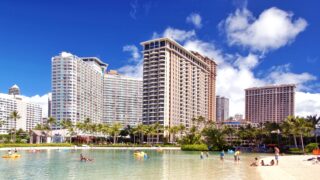
On Kauai’s sunny south shore, Brennecke Beach (lead photo) lost so much sand that regulars said they barely recognized it. It was a reminder that the parts of Hawaii visitors pay extra to enjoy in winter can become the hardest hit during a Kona low.
Hawaii is named on their exclusion list. Both of them.
Vrbo publishes a table of foreseeable seasonal weather events that it generally does not cover. Hawaii is in it by name for tropical storms, typhoons, cyclones, and hurricanes from May through November.
The Vrbo table lists three places: Mexico, Guatemala, and Hawaii. For anyone with a late-summer or fall rental already booked, that sentence is worth reading twice.
Vrbo says a foreseeable seasonal storm may still qualify when it causes another event the policy names, such as prolonged utility outages affecting most homes across a major area. When that additional event does not occur, the property’s own cancellation terms remain in force.
That table is within Vrbo’s help center. The main policy page a traveler is most likely to read does not carry it, which means a guest can read Vrbo’s Extenuating Circumstances Policy from top to bottom and never see Hawaii named.
The help center version also includes a critical detail that the main page omits. It says the policy activates automatically for a hurricane classified Category 3 or above, at least 24 hours before expected landfall, with the window running 48 hours, 24 before and 24 after.
NOAA has put this hurricane season at a 70% chance of above normal, and August and September have not arrived yet. Nothing needs to form for any of this to be true, because the exclusion is already written into the contract for every Hawaii vacation rental booked for the rest of the season.
Booking through Airbnb instead does not solve the problem. Airbnb publishes its own list of foreseeable weather events that fall outside its Major Disruptive Events Policy, and the Eastern Pacific row names the same three places for the same months: Mexico, Guatemala, and Hawaii from May through November.
Airbnb rewrote that policy in early 2024, and Vrbo introduced its current version a few months later. Airbnb said at the time that its changes brought the policy into line with industry standards, and today the two policies read remarkably alike.
Airbnb may provide protection when a foreseeable storm leads to another covered event, such as a mandatory evacuation order. Vrbo does something similar when a storm causes another qualifying event, such as prolonged utility outages across most of a region.
Airbnb draws the line like this. Its policy covers mandatory travel restrictions and lists an evacuation order or a shelter-in-place order as examples. It says the policy does not cover non-binding travel advisories and similar government guidance. Governor Green’s declaration warned of dangerous conditions statewide, but it stopped there.
What actually protects a Hawaii visitor?
The property’s own cancellation terms are the first document worth reading because they govern situations in which the platform does not activate its emergency protections. Those terms can be far stricter than the broader emergency language displayed elsewhere on a booking site.
Any separately purchased travel insurance should get the same careful reading. Coverage terms, exclusions, purchase deadlines, and documentation requirements vary, and Consumer Rescue concluded that insurance might not have produced a different outcome in the South Maui case either.
A credit card dispute is a different question from a refund request. Whether one succeeds depends on the written agreement, the circumstances surrounding the cancellation, and whether the merchant failed to provide what was promised under the contract.
The hosts and agencies involved in these cases are also operating in a Hawaii vacation rental market already under pressure from changing regulations and enforcement, which we have covered extensively. That does not change the contracts, nor does it put the money back into a traveler’s pocket, but it is worth remembering before deciding that the owner is the villain.
Even the airline didn’t entirely refund the Massachusetts family. It issued a travel credit, which is a lower bar than a refund, albeit one that the vacation rental still could not clear.
The document that ultimately decides these cases is usually not the one on the booking platform’s homepage. It is the one attached to the individual listing, the one almost nobody reads, and it is the only one still standing after everything else falls away. Yours is probably still sitting in the confirmation email from the day that you booked.
Before reading this, did you assume a Hawaii state of emergency would automatically protect your vacation rental booking?
Lead Photo Credit: © Beat of Hawaii at Brennecke Beach on Kauai.
By Rob and Jeff, Beat of Hawaii.
Some of the most meaningful parts of Hawaii are the ones visitors walk right past without knowing they are there. We’ve spent nearly 20 years finding them firsthand for BOH as full-time Hawaii residents reporting on travel, culture, and island life, and telling you what they mean for your trip. Join us →
Get Breaking Hawaii Travel News





One thing this article does not address:
I believe it is a small %, but i know for a fact that some mgmt companies do this:
1. Let’s say you pay for a week at a vac rental. The total is $5,000. But, you have to cancel. The mgr refuses to refund – keeps all your $. On vrbo, airbnb, etc., you have to “cancel” to get the unused cleaning fee back.
2. After your reservation has been cancelled (& $ taken), the dates you booked are now available. The mgr then books the same dats at a lower “last min discount” rate. The mgr includes the cheaper reservation amount on the report to the owner. The $ for your booking is taken by the mgr – and never reported to the unit owner.
There is very little chance of a vac rental mgmt company being caught when they do this. Because it is so profitable, and there is very little chance of being caught it is very tempting.
Always try to know who you are doing business with.
I have a STR in Kona, on Hawaii Island. We had a cancellation because of the Kona low. We instructed our management to refund 100% all their money. The difference to me was the Governor declared an emergency. It wasn’t just “bad weather”. I felt refunding their money was the right thing to do.
All airlines, hotels, vacation and car rental companies and owners I’ve booked with in the past 10+ yrs around the world have had cancellation policies spelled out before payment – usually with an offer or strong rec to purchase trip insurance. We then make a financial decision whether or not to spend the money on TI or ‘risk it’.
It really comes down to honoring our agreements. This a shared responsibility that protects both parties from an infinite number of unforeseen reasons.
I have a condo on Maui listed with Vrbo for more than a decade. Covid cost nine month of cancellations at an 80+ occupancy rate. The Lahaina fire cost four weeks of cancellations and an untold loss of occupancy the next two years when my occupancy rate dropped to near 50% due to the Governor & Mayor’s ‘edicts’ to stay away from Maui. My canceling guests received full refunds, all handled without the need of protests. Yes! Hawaii is an entirely different market and the free market has it’s risks, but the ‘customer should be treated fairly, within or outside policy.
That’s why I use Costco Travel the cancelation time line is clearly stated at time of booking.
Looks like resort hotels have the better cancelation policies but fewer kitchens for longer stays. I use VRBO and other platforms and almost always buy the insurance, but that doesn’t mean you’ll get a refund. Luckily, I’ve never had to use it or deal with the issues. I visit Hawaii every year and take other trips, rule of thumb I use is ‘if I can’t afford to lose it I don’t book it’. Otherwise I do see both sides and believe a compromise would be in order here, partial refund or a partial credit for future stay.
When booking on Airbnb.com it asks you if you would like to take out travel insurance. Sounds like this is the prudent thing to do.
Can you please run a story on how many times hotels don’t refund guests who cancel?
Friends of mine had a $10k VRBO condo rental on Kauai when Covid hit. They had to cancel since the airlines quit flying, and they had no way to get there. The condo owner absolutely refused to give them a refund.
After much negotiation between the owner and VRBO, they grudgingly returned the $75 cleaning fee. My friends will never use VRBO again and now stay in hotels.
I appreciate you included the host perspective too. It’s easy to make this a villain story, but there are real people on both sides trying not to lose thousands of dollars that no one wants to afford. This is complex with a lot at stake and I’m going to take it a lot more seriously in terms of doing due diligence going forward.
I’ve rented dozens of vacation homes in Hawaii over the years. So far we’ve never had a problem. But the contracts have become longer every year, and I can’t honestly say I’ve read every word of every one.
It seems like there’s always so much pressure during rentals and during airfare purchases to buy insurance. But what are you buying exactly?
I understand why people say “buy insurance,” which includes for their own financial gain, and this article also points out that insurance isn’t automatically the panacea either.
As a vacation rental owner, I have to ask here: If the situation is one that insurance would not cover, then why is the owner expected to in effect insure the guest?
Fair question. But you may have received compensation for a service not provided. That’s the issue. Although the owner’s opportunity cost was lost with a (not the fault of a customer) problem preventing the customer from attending, it seems you’re suggesting the buyer needs to accept all the risk. I don’t think that’s reasonable.
I guess it comes down to what the “service provided” is. If the owner / manager provides a unit ready to stay in, and the guest reserves & pays for specific dates, is checking into the unit a factor?
If you pay to have a unit ready for your use, but don’t end up using it, is that the manager’s fault? Hotels & vac rentals are built quite differently in this area.
When i managed vac rentals, our refund policy often depended on the ujit owner: if refunding would reduce revenues to owner, and we knew that owner would fire us & hire a new mgr, our refund policy was strict. If the owner allowed, we were more generous with refunds.
It is a nuanced issue.
Great point.
I’ve always booked directly with small management companies instead of the big platforms. Reading this makes me think I should consider and ask about weather policies and insurance options before I ever send a deposit to anyone going forward.
This is one of those articles that caused me to go back and read the contract for our upcoming stay after I’d already booked and paid. Mine is as clear as mud and honestly I’d never paid much attention to what that actually meant until today.
The part that surprised me wasn’t just the $12,000 but learning that both Airbnb and Vrbo have very similar policies. I honestly thought switching platforms might solve the problem. I tried checking for rental insurance during storm events and so far that hasn’t come up very clear either.
I don’t think enough people realize the host can also be in a terrible position. If someone cancels two weeks before arrival, there may be no realistic chance of renting those dates again. So there has to be some middle ground here.
If a rental owner is going to be so put out by a very valid cancelation, they should probably reconsider whether they can afford to own a rental home. Thank you to the visitors who considered safety and their impact here when making their decisions to cancel. I hope the owners will reconsider your refunds.
This changed how I’ll book Hawaii stays from now on. I always assumed the platform’s emergency policy overrode everything else. Apparently the rental contract is still king unless the platform decides it should be otherwise.
I book with the knowledge that; 1) I’ll get a refund or 2) I won’t get a refund. That goes for airlines, places to stay, etc. I recently cancelled a trip for 7 people to Hawaii in May. I knew that I could cancel at the resort up to 5 days before my arrival date to get a refund. I knew there would be a credit on the airfare which never covers the cost. Five days before arrival I had to cancel (health reasons). I got a full refund from the resort. Surprisingly, because the airlines had made a change to the schedule (moved arrival time by 5 minutes), I could cancel the airfare for a full refund. We got lucky on the airfare. In the past, I have booked, cancelled and lost my total deposit/payment. I’ve adopted the attitude that if I am not willing to lose it all, then I don’t book. Things happen whether in our control or not. I truly feel for the people who lost their deposit. I’m booked with a VRBO next March for spring break – no Refund. Fingers crossed!
Reason #347 not to use Peer-to-Peer platforms.
As usual, this article strongly favors the tourist, and doesn’t support the people who live in Hawaii and own the vacation rentals. It’s important to know that unlike many vacation rental around the world, many Hawaiian VR are reserved many months or even more than a year in advance. If a guest cancels a month or so before their visit, it’s virtually impossible to fill those dates. I own a home in Captain Cook. When I’m off island, I rent it to help pay my mortgage and to cover the cost of cleaners, yard guys, and handyman. I wouldn’t be able to afford my home or pay 6 people their wages if a rental or two got canceled “last minute”. Yes, we got a lot of rain during the Kona Low. I still biked and swam all but one day. A few places had road closures for a day or 2, or the power was out. The chances that someone at a vacation rental would be in danger due to the big storm was close to zero. Buy additional insurance, or don’t cancel because the weather forecast isn’t great.
If you can’t afford your home without the vacation rental income, perhaps it’s time to look into a long term rental arrangement or downsizing? It’s not just that the forecast wasn’t great – the state had declared a weather emergency. We should be grateful for visitors who are paying attention and trying to prevent being an additional burden during a weather event.
This is what happens when travelers don’t realize that they should take travel insurance to cover weather related events if they want to have an option to cancel and be refunded in full. This covers the interests of the traveler as well as the host who has restricted anyone else from renting their property for the given dates..
The owner of the vacation rental does not have the option to take insurance for trip cancellation, the traveler does. The owner does not control anything except making sure their property is in suitable rental condition for their guests and if there is not an outright emergency that restricts access to the property, the host has performed their responsibility And they have very high cost of ownership.
I’ve used VRBO and AirBnB but theyve now become as profit focused as the big hotels. Due to their exploitive practices, I actually now attempt to go with a hotel first. Only when a kitchenette is not available will I consider VRBO or AirBnB.
As a vacation rental owner our complex pushes our guests to buy the insurance and if they don’t buy the insurance they have to check the box that they declined the insurance.
Hide behind legalese. Unilaterally interpret opaque contract language. Twist both to screw the individual good-faith purchaser. Do not provide service. Retain currency.
Welcome to travel’s current definition of “success.”
Or just buy trip insurance.
In over 100 past trips, domestic and international, we never buy insurance. To us its no more than extra fees for a potential compounded loss. We avoid VRBO and AirB&B. Hotels are more flexible in options. However twice, AAA refunded a stay loss, and fully covered lodging and meals when stranded with a flat tire in the middle of “nowhere.”
We buy trip insurance for international trips only, because the odds of being able to make alternative arrangements on the fly or get a refund are much worse there. And on one international trip, we collected every penny that we lost on bookings and airfare when one of us came down with a bad flu and we needed to get back to the US as soon as possible.
The deal is: either buy trip insurance or don’t complain when you lose the money you put down.
There’s a lot to unpack here.
1. vrbo/AirBnB don’t always deal with Hawaii well because of the diversity of islands, and travelers often don’t either. I’ve seen them put extenuating circumstances on the whole state when an issue is just on one island. I’ve seen travelers want to cancel when an issue doesn’t affect the island they’re staying on at all.
2. I’ve seen more and more younger people saying they never read the fine print when they sign up for things. It’s nuts. Nobody should be putting out this kind of money without reading every word of the contract and knowing what they are getting.
3. If people want protection beyond what is contractually obligated, they should buy travel insurance. Nobody wants to pay for that anymore, but they want the benefits.
4. That said, my contract says that if my house is uninhabitable I will refund. And I don’t know, but I suspect that might be required by law. It seems wrong to charge for something when it is unavailable.
A resident of Hawaii, I was in San Diego with my 16 year old daughter, when Covid hit. We rented an Air BnB for a week. Upon arrival at our rental we were shocked to find junked cars along the side of the entry and a rocky dirt driveway that I couldn’t take the chance driving down. Still we ventured with suitcases on rollers that tipped over as we manuvered over rocks to the house. There was a wasp nest on the porch with wasps buzzing around, and childrens play toys strewn about dirt and weedy yard. Nothing like the photos looked. I called the owner and said this was not what the ad looked like and we could not stay there. Dust covered the counter tops and floors. Like it had been deserted for some time. He said it was too late to cancel. We left and found a hotel for the night. When we got home we followed up with the owner and requested our $4,000.00 deposit back. No way. Called BBB and they told me they would follow up. Nothing came of that. Sad.
I own 2 Air B and B units on Maui and as far as the cancellations for the storms I would have demanded my host refund every penny to the effected clients no questions
Mahalo for printing this very important article ~ I am very aware now. I am an Airbnb host (strict cancellation policy on my listing). I used to travel to Hawaii every year. If I was hosting any of those reservations I would have issued a “credit” to let the guests return at another time as I good will gesture. For my personal trips I book hotels direct because the vacation rental platform fees are ridiculous $$$$$. I quit traveling to Hawaii because the taxes and fees are unreasonable.
I had a similar experience with VRBO during the start of Covid. I and friends had booked an apartment (not in Hawaii) through VRBO and after weeks of negotiating received a partial refund of around 50%. In the process I learned the renter was not the one woman listed as the host as I had presumed; she was an agent with a large real estate company that owned dozens of rentals. After that I quit booking with VRBO. Their fees are ridiculous anyway, and paying 100% well in advance for something that could unexpectedly go sideways was a cautionary tale for me.
I think most would agree that the traveler shoulders some portion of risk when they spend a sizeable amount without a travel insurance policy. Perhaps all is not lost yet. Maybe a partial refund or credit for a future stay could be negotiated and agreed upon by the two parties. I had an instance where I needed to back out of a condo booking in Kona. The owner wasn’t willing to give a refund, but he gave us full credit at the condo for a future stay which we used the following year. It would seem reasonable for the two parties to split the loss in a case like this. After all, the lessor stands to lose a lot of money from many lessees in a case like this. Conversely, the lessee shouldn’t expect total satisfaction either. In my case, I agreed to a longer stay the following year so at least the owner was able to consider my entire stay as a discounted rate rather than a freebie.
We spent 7 weeks on 4 Hawaiian island at various military vacation housing during the “Kona lows.” Travel was somewhat disruptive, and we experienced some short time power outages, but we were in beautiful lodging and greatfully the military never forced an evacuation. We also have a rental cottage pn Cape Cod. Our cancellation policy is very strict, only allowing for “Named” hurricanes!