

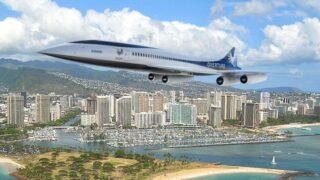
Boom Supersonic made headlines this week with $300M in new funding. On the surface, it sounded like momentum toward the long-promised jet that would cut Los Angeles to Honolulu travel time in half. But the details tell a very different story.
The money is not going toward the Overture aircraft that Boom says could have one day flown passengers to Hawaii. It is aimed at natural gas turbines for AI data centers instead. That even as the CEO says that this won’t change its plans for upcoming supersonic flights. Yet, that pivot raises the question Hawaii travelers keep asking. Is Boom building a passenger jet, or is the dream quietly slipping away?
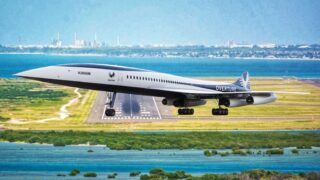
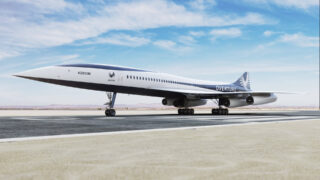
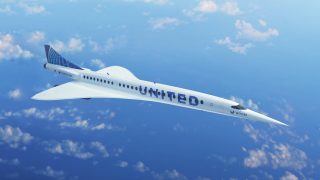
Overture has been scheduled to begin flying passengers in 2029. United was the first airline to come on board with an agreement to buy 15 aircraft. The total order book claimed by Boom: 130 aircraft (a mix of orders, deposits, options, and non-binding pre-orders)
| Airline / Investor | Firm Orders / Pre-Orders | Conditions / Timeline / Caveats |
|---|---|---|
| United Airlines | 15 Overtures firm order | Order is conditional on Boom meeting safety, operating, and sustainability requirements. No delivery before 2029–2030 based on Boom’s projections. |
| American Airlines | 20 Overtures deposit placed | Fully conditional. American requires performance and certification milestones before deliveries. Earliest timeline late 2020s to early 2030s. No route announcements. |
| American Airlines (options) | 40 additional options | Options are not firm orders and can be cancelled if requirements are not met. |
| Japan Airlines (JAL) | Pre-order option for up to 20 | Investment and pre-order option, not a purchase. No delivery timeline and no route indication. |
Our readers have been skeptical for years.
One pointed out that the last test flight saved barely an hour compared with a traditional widebody on a Hawaii route and asked why anyone would pay a massive upcharge for such a small gain. Another said the XB-1 demonstrator proves nothing until Boom builds a full scale aircraft. Others note they have seen big promises like this before.
The plane Hawaii was promised is still theoretical.
Boom still has not built a flyable Overture prototype. The Symphony engine remains untested, FAA certification is a long way off, and this latest announcement offers no timeline, no aircraft news, and no visible progress.
Readers with aviation backgrounds have been blunt about this in their comments. One noted that Concorde failed despite major government backing and enormous resources, and questioned how a smaller company would clear the same hurdles. Others said the economics do not work for Hawaii routes and that hard reality will win again.
Hawaii has vanished from the conversation.
Early Boom communications often highlighted Hawaii-range missions as examples of what supersonic travel could do. That created the impression that Hawaii might be an early showcase route. Those references are gone. This new funding round contains no mention of Overture, airlines, or Hawaii.
The reason seems clear. Hawaii is overwhelmingly leisure focused, while supersonic travel, if and when it does arrive, will target business heavy premium markets. New York to London carries more high paying passengers in a single month than Los Angeles to Honolulu sees in a year, making Hawaii an unlikely early candidate.
Investors appear to be hedging.
Boom’s new funding round totals more than $1.2B and includes 29 natural gas turbines for Crusoe’s AI data centers, scheduled for delivery beginning in 2027, with factory scaling through 2030. That is where Boom’s engineering and manufacturing focus is now pointed. None of this funding supports the Overture jet or the Symphony engine that would need to power it.
Boom’s chief executive compared this strategy to how Starlink helped fund SpaceX. But the comparison does not hold. SpaceX had proven it could fly rockets before Starlink existed. Boom has no flyable Overture prototype, no certifiable engine, and no realistic certification path.
Seen through that lens, the $300M looks less like a bet on supersonic travel and more like a hedge into a market that can generate revenue and financial sustainability long before any passenger jet reaches Hawaii or anywhere for that matter.
Readers saw this immediately. One said the fact that Boom is raising money for anything other than its aircraft program tells you everything. Others viewed it as a company trying to stay alive rather than one approaching an aviation breakthrough.
What this means for Hawaii.
For years, the hope was that Hawaii could be part of the next aviation leap: faster flights, shorter travel days, and a new place in the Pacific network. But none of that appears closer after this announcement. If anything, it seems farther away.
A few readers still hope supersonic travel will return and say they would try it at least once. Others argue that Hawaii needs higher spending visitors and that this could fit that direction. But most see a different picture. Supersonic flights, if they ever exist, will be for the ultra wealthy. Everyone else will continue flying on the same aircraft and the same flight times Hawaii has always had.
Until Boom builds a full scale prototype and shows certifiable progress, Hawaii’s dream of three hour flights remains a marketing concept we will largely all forget, not an approaching reality.
What do you think?
Does this new funding make you more skeptical that Hawaii will ever see a supersonic flight? Or do you still believe Boom will eventually deliver the jet it has been promising for years?
Get Breaking Hawaii Travel News


I guess I was always struggling to see how this could work for HI travel, even while hoping for the sake of the islands that it would.
In the not-so-distant past, I took an HI vacation that started when my Hawaiian Airlines flight departed MN. Why rush the flight to go faster if HI came to me in the form of airline staff, lei greetings, HI-inspired food, and ukulele music during boarding? The travel itself was part of the experience.
The only reason I could see to rush the travel to supersonic speeds was because the quality of airline travel had been reduced to sardine-canned passengers, marginal food at best, and little to no service. The less expensive (and potentially less flashy) option to sell more HI travel was simply to enhance the existing travel offerings to bring HI to the passenger well before arrival.
Boom did HI badly. Super bummed, but frankly not surprised.
Whether Hawaii is served by supersonic aircraft will be up to Hawaii residents and visitors. The ticket prices will be high and passengers will have to be able and willing to pay expensive prices. The kicker I guess is the folks with no issues with the fares already fly direct to their island of choice in private jets. The delays at airports and having to make a connection in HNL will destroy most if the speed benefit. Maybe one or two will buy supersonic private jets
At a certain level of affluence these folks fly private instead. Five hours in your Gulfstream passes quickly enough.
Maybe it wasn’t about the time saving issue. If you could afford the expensive boom ride then what’s the big deal about the expensive hotel bookings, added taxes and fees plus all the restaurant reservation fees. Not to mention all the ammentity charges and every attraction fee. Money. It’s all about fleasing the tourist’s wallet. Attract the rich and shoe away the rest.
This company entering the Hawaii market has been nothing more than wishful thinking. No different than when Zuckerberg bought land on Kauai people envisioned Facebook jobs coming to Kauai. It’s not even worth writing an article about it and continuing the speculation.
Folks, get ready to book your BOOM flight to Hawaii in the year 2099
I honestly don’t understand how Hawai’i was ever part of the conversation to begin with. Leisure markets don’t generate the yields to operate such aircraft. They never have. This was purely wishful thinking and nothing more.
Exactly. I don’t know why there was some impression made about Hawaii being an early adopted route. Just saying the name “Hawaii” shouldn’t create this illusion. Gotta make money on this venture first, and that ain’t the leisure market.