
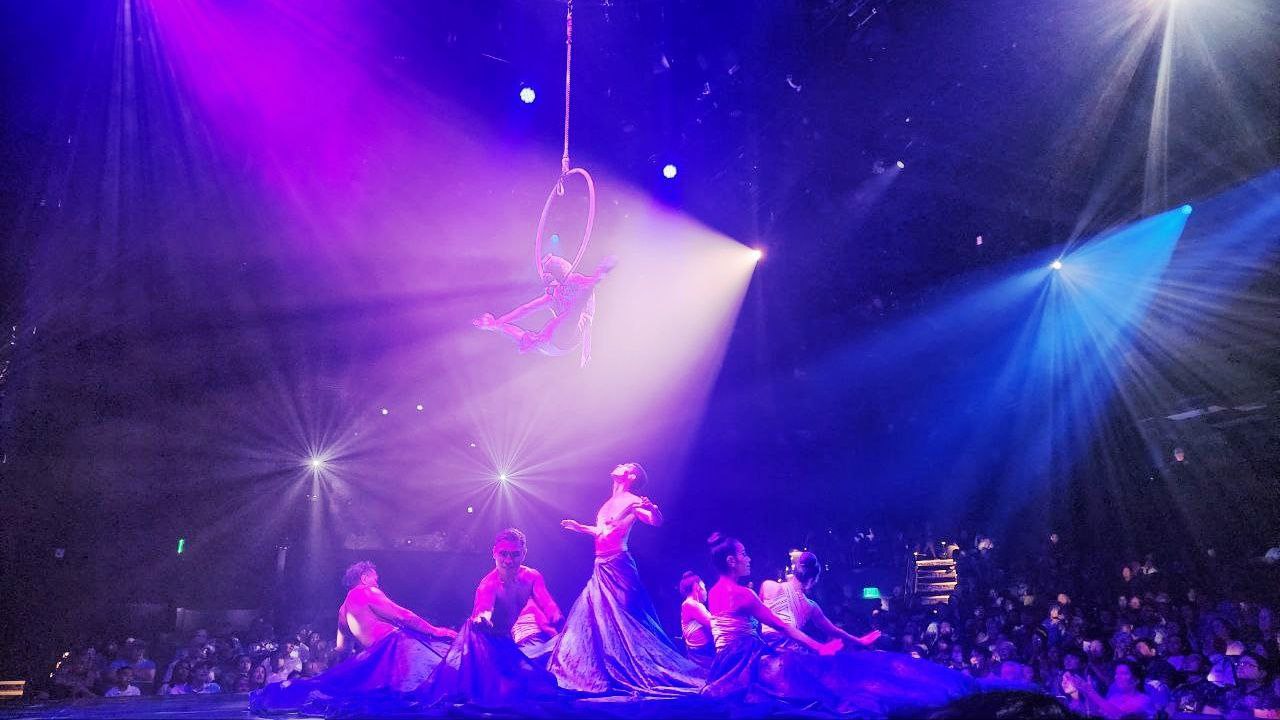
Cirque du Soleil built its first place-and-language show around Hawaii, and just released music entirely in Hawaiian. We saw the show, changed our minds about it once, and are looking at it differently once again.
The question with Cirque du Soleil’s ‘Auana is no longer just whether visitors should spend $86 or more on an 80-minute Waikiki show. It can look like a global entertainment company turning Hawaiian culture into a polished visitor product. It can also look like one of the most ambitious celebrations of Hawaii now playing anywhere in the islands.
The reason we’re looking again is not the show itself. It’s the music. Earlier this month, Cirque du Soleil Entertainment Group and BMG released “Kele ka Moana,” a song performed entirely in Hawaiian, with a full soundtrack scheduled to follow in July. That is enough to revisit a question we thought we had already answered.
What we saw on opening night.
We attended opening night of Auana in December 2024, paid for our own tickets, and came away impressed. In our review, “Is Waikiki’s New Cirque Du Soleil Show ‘Auana Worth The Splurge?“, we called it a great celebration of Hawaii.
Part of that reaction stemmed from the project’s ambition. Auana was not another traveling Cirque production dropping into Waikiki for a limited run. It became the first resident Cirque show in Hawaii and the first production in the company’s 42-year history built around a specific place and its language.
The roughly 80-minute show unfolds through eight chapters that blend Cirque acrobatics with hula and Hawaiian stories connected to Maui, Hina, Mamala, Naupaka, voyaging traditions, and other elements of Hawaii’s cultural landscape. These become the framework for the performance, all inside the 784-seat theater at the OUTRIGGER Waikiki Beachcomber Hotel, where it continues to play Wednesday through Sunday.
Why we looked at it differently later.
A few months later, while comparing luaus and other visitor-facing cultural productions, we found ourselves putting Auana in a different category. It was clearly the better production, but we were less sure it belonged in the same conversation as island experiences rooted in community, place, and practice.
That wasn’t meant as a dismissal. It reflected the tension many residents recognize when Native Hawaiian culture is presented in a visitor setting. A production can be skillful, respectful, and emotionally effective while still being designed for a Waikiki audience.
We were asking whether such a highly polished stage production could carry Hawaiian stories in a meaningful way. The new soundtrack gives us a better reason to revisit that question.
What the album changes.
The new soundtrack forces a more complicated conversation. “Kele ka Moana” is performed entirely in Hawaiian. Composer Evan Duffy worked with Native Hawaiian linguist Dr. Keao NeSmith, who consulted on the music. A full soundtrack is expected to be released in July.
“Creating a soundtrack entirely in ʻŌlelo Hawaiʻi was especially meaningful because the language itself holds such depth, emotion, and connection to place.” (Evan Duffy).
At the same time, the show’s creative foundation was never simply imported from outside Hawaii. Aaron J. Sala is the show’s cultural creative producer, Manaola Yap is costume designer, and Kumu Hula Hiwa Vaughan is choreographer. Neil Dorward is co-creator and director, working with a Native Hawaiian creative team that helped shape how Hawaiian stories, language, hula, and design appear on stage.
A global entertainment company with a worldwide audience is putting Hawaiian-language music on streaming platforms and in the theater night after night, and Native Hawaiian creative leaders helped build the project from the beginning. The language, stories, hula, and design are not extras added for atmosphere; they are part of the show’s core.
That is also what makes Auana different from many visitor productions in Waikiki. Yes, it is polished, commercial, and clearly built for premium ticket buyers, but it is not just empty packaging. It carries real Hawaiian language and stories through a stage production designed to reach a wide audience.
What visitors get for the money.
For most visitors, yes, this is worth it, but not for the reasons a brochure would probably imply. What Cirque does exceptionally well is create emotional scale. Sure, the acrobatics are world-class, and the production values are extraordinary. But it is the Hawaiian storytelling that gives the show a sense of place that many visitor experiences never achieve.
That is also how many other Hawaii residents who saw the show at launch seemed to read it. The reaction was not that Auana reinvented Cirque acrobatics, but that the cultural dimension, the Hawaiian setting, and the intimate Waikiki theater made it feel more worthwhile than a standard Cirque touring spectacle.
At the same time, nobody should mistake it for an evening at a halau or a rich community cultural gathering. Tickets start at $86 and climb to about $232 for front-row seats, with a 30% Kamaaina discount for Hawaii residents. There is also a 20% discount on Aloha Friday for the 8:00 pm performance. The theater sits in the middle of Waikiki. The audience is largely visitors. The entire enterprise exists because tourists buy tickets.
Pretending otherwise would be as misleading as dismissing everything the production does accomplish. What has changed for us is that we no longer think authenticity is necessarily the most useful test. A more interesting question is whether something can be commercial and culturally meaningful at the same time, and Auana comes closer to that unusual middle than we first realized.
The bigger question.
That leaves the traveler with something more useful than deciding whether Auana is “real” or not. Hawaiian language, Hawaiian stories, and Native Hawaiian creative leadership are reaching visitors who might otherwise never encounter them through a show designed to fill seats in Waikiki.
That may be the most honest way to look at it. Auana is a tourist show, a cultural project, and a business all at once. The reason it stays interesting is that none of those fully cancel out the others. Have you seen Auana?
Lead Photo: © Beat of Hawaii at ‘Auana in 2024.
Get Breaking Hawaii Travel News


This story seems all wrong.
Cirque Aruana is owned by a foreign private equity company.
What happened to the buy and support local lip service?
Twenty shows a week, 52 weeks, 784 seats per show, average $150 ticket.
Do the math! 20 x 52 x 784 x $150= $122,304,000.00 Millions gone!
Why not encourage people to spend money at a local luau, hula group, or with Hawaiian musicians?
Then the money stays in Hawaii and helps all Hawaiians.
Years ago we saw a beautiful show in Lahaina with Hawaiian music, language and hula telling the history of the island. We loved it. Is this similar?
I haven’t seen the show and probably wouldn’t (if I ever return to Hawaii). If you really want Local hawaiian entertainment, the Maui Cultural Center often has performances by halaus to raise money; the ukele festival; sometimes performances from local musical artists – we saw Kalani Pea there twice. George’s show at Napli, I think it is still running, is another place to see up and coming hawaiian musicians. We saw Makana there. Then there’s always local festivals that provide music and hula that advertise in the newspapers.
Hana had such an event and we saw Reichel and his halau there amoung
other recognized groups. All for $5! Having said that, I can understand that the Auana-Cirque du Soleil may be the best to give visitors some experience with Hawaiian music. They certainly aren’t going to go amongst the locals to find the real thing.
I attended the performance 2 months after it opened and was amazed at the beauty and cultural foundation of the show. I had been to ‘ulalana on Maui at least 15 times and found similar qualities. I have also seen 5 other Cirque shows in Vegas and Orlando. Yes it has many of the the Cirque acts that make them good. But Auana brings one of the finest blends of the soul of Hawaii and the acrobatics of Cirque together on stage. It is definitely worth the money for an in depth subversive view into Hawaiian culture and Aloha spirit.
Interesting. You mentioned $86 dollars. Then a comment which mentioned premium ticket buyers. What is meant by a premium ticket buyer anyway? I’m not rich so maybe this crowd is out of my league. What does culture have to do with affordability anyway?
I am so impressed with this write up! You guys are always right on. As the producer of The Magical Mystery Show! at the Hilton, I am deeply aware of the delicate blend of Hawai’ian cultural integrity and commercial tourist value for a theatrical production. Cirque has blazed a trail allowing us smaller productions to thrive as visitors and locals alike are given more evening choices. The Magical Mystery Show! follows King Kalakaua’s 1881 global circumnavigation which included entertainment in Victorian England. We’ve been here in Waikiki nightly since 2 years before Cirque opened and guests to our show constantly comment about the soul and heart of both Cirque and our production. Cirque has opened a category that allows legitimate stage productions validity in Honolulu. We’ve made it to the TripAdvisor #1 rating for nightlife entertainment in Waikiki and much of our thousands of 5-star reviews are a factor of Cirque opening the category for us all. There is room for much more!
Yes, we did last summer and thoroughly enjoyed it. It was so much more than a “typical” Cirque show. And we’re going back and bringing friends in a couple of weeks.