
We boarded Alaska 224 from Lihue to San Diego, expecting nothing out of the usual. After all, we’ve crossed the Pacific from and to Hawaii with Alaska many times. The plane we flew on was so new that the flight attendants said it was their first time, and even they were just getting used to the changes. What followed was both fascinating and a distinct improvement.
To start, we expected either the usual $8 Wi-Fi that worked half the time or none at all. That was the first surprise. On this brand new Boeing 737 Max 8 that had just been delivered, we found ultra-fast Starlink already running at the departure gate. The rest of the flight was different, too, in a Hawaii cabin where every inch now has a price tag, and the strange part is how well it all works.
On the WiFi note, Rob noticed the Starlink Wi-Fi at the gate before pushback and long before Alaska announced it. When we connected, Starlink routed us through an unavoidable long video ad for Alaska’s new Atmos credit card before we could get online. Past that, a speed test clocked at up to 300 Mbps down. Set against a prior system that worked half the time, it was an entirely different product. So was the flight.
The WiFi was the first, and the lack of entertainment was the second. As the flight went on, the overall pattern was hard to ignore. Every piece of the Hawaii flight has been monetized, repackaged, branded, or tied to Alaska’s loyalty system. On older flights, that would have landed as one more complaint about what air travel has become. On this one, the cabin was good enough that the monetization was easy to ignore unless you stopped to count it up.

The free entertainment has gone missing.
Free Starlink was great. But when the inflight brochure mentioned movies and other entertainment we went looking. Much to our surprise, and that of the Alaska flight attendants, there is no entertainment provided. Instead, the airline promotes passengers using whatever services they already license/subscribe to as an alternative for all entertainment. That was a first for us.
None of that makes the digital products bad. And that is what makes this different from the usual airline complaint. The speed is real, the connection works, and access to YouTube, Netflix, Prime, Apple videos, and more is real and top quality. So, while entirely different in many ways, it was significantly better than the old systems Hawaii travelers have been familiar with for years.
The rest of the cabin tells the same story.
The aircraft made the point too. This was a 737 MAX delivered in December 2025, and it looked like it. New Recaro seats in both first class and economy were decidedly more comfortable than the predecessors. Rob has an inflatable seat cushion, but never needed to use it with the new seats. Other notables: 60-watt USB-C chargers and power, taller adjustable headrests, and a quality fit and finish that made the cabin feel better than the older Hawaii flights regular travelers are used to. Nothing felt patched together. It had been well thought through.
Alaska is no longer just selling Hawaii flights.
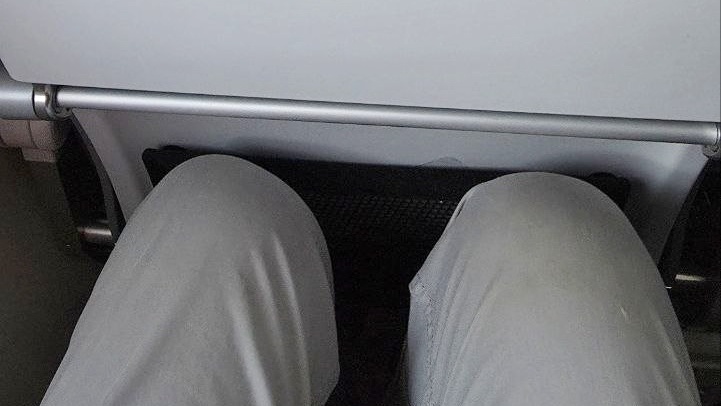
It is selling layers of experiences inside the cabin. Extra-legroom “Premium Class” seats through row 10 were priced $120 to $130 more per person on our Lihue-to-San Diego flight. And we skipped them. We purchased three regular economy seats in row 11 that included an extra seat for comfort. The legroom was extremely tight, but with the extra seat shared by two passengers, it still worked, albeit claustrophobic.
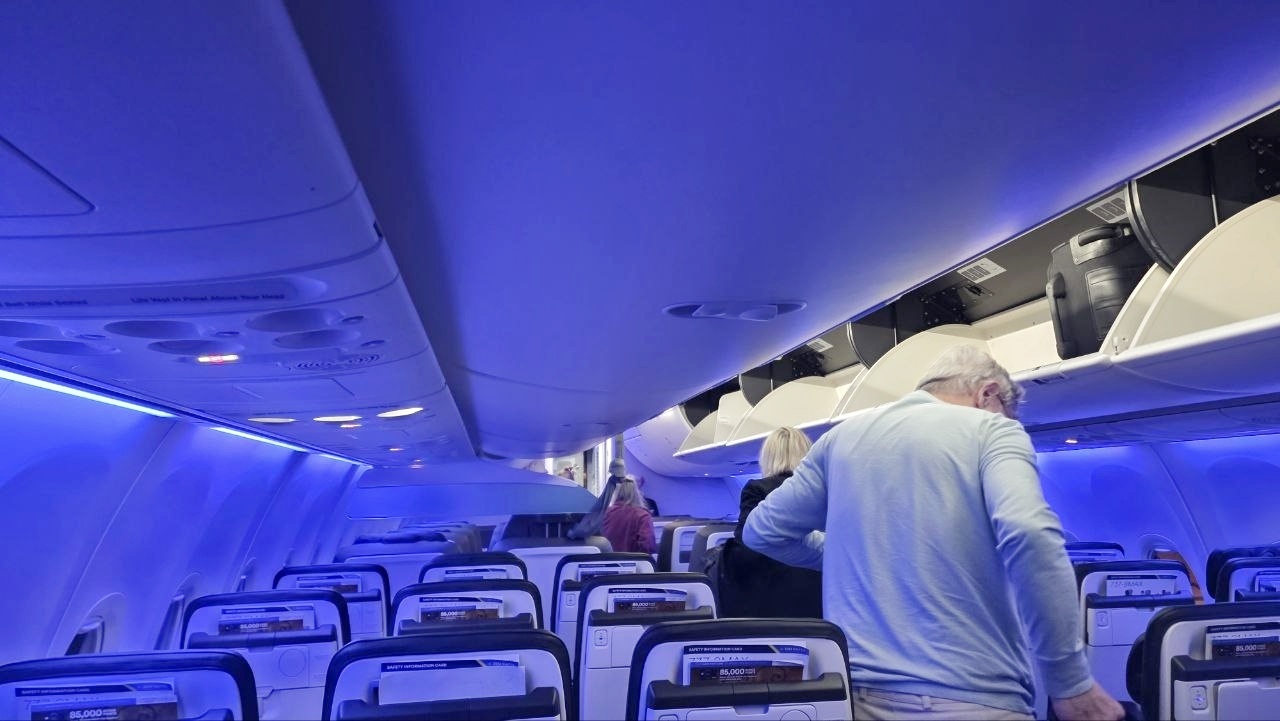
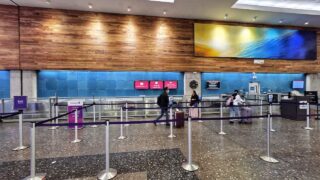
As a side note, the luggage bins are enormous. That works great except during boarding and deplaning, when it virtually extends the low overhead height across nearly the entire cabin width. As seen in the image above. If you are short, that will not be a problem. If you are tall, it definitely will be.
To improve that with far more inches of legroom, there is a real up-charge on what used to be a simpler purchase, especially on a Hawaii flight where the base ticket already carries enough pain. We paid $220 for each of the three economy seats for the one-way flight.
It’s worth noting that those in extra legroom “Premium” also received other perks. One was another round of beverages that regular economy passengers did not have. Instead, water was offered to the others. The other perk was that flight attendants offered a choice of chips or cookies for the extra $120 paid. In addition, the new, very spacious overhead bins over those rows say that they are “reserved” for Premium passengers.
The snack program has been rebuilt the same way.
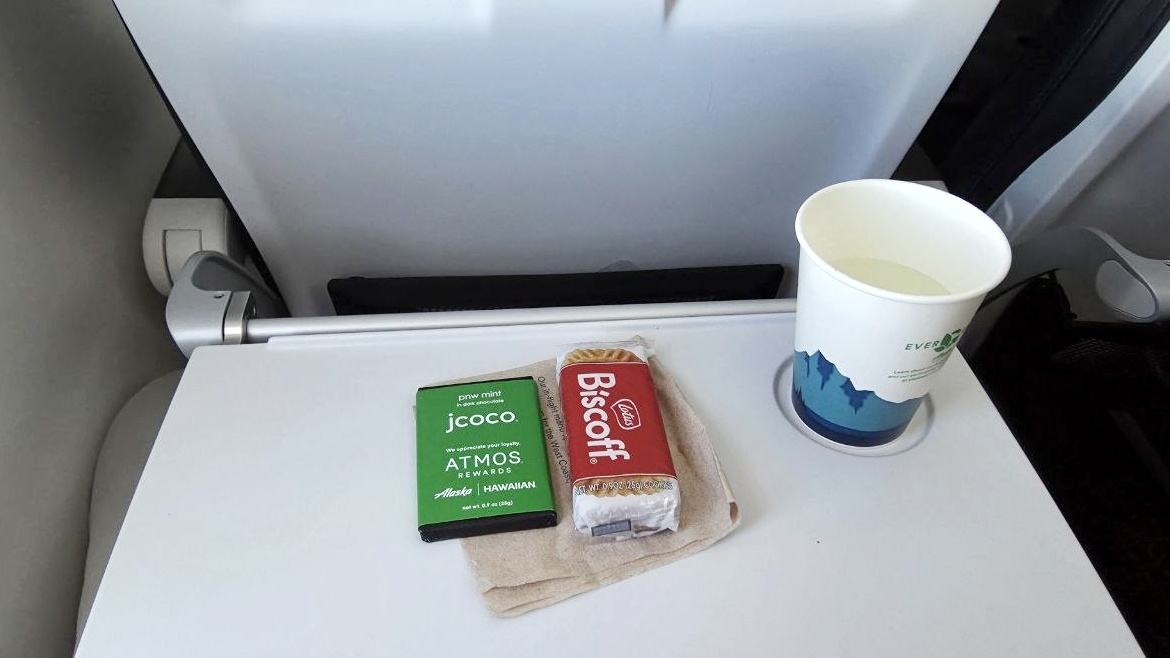
Everyone in the economy received a full-size Biscoff cookie, which used to be a first-class touch on Hawaiian, more than a main cabin standard that we remember on Alaska. We also received a generous Atmos-branded jcoco PNW mint dark chocolate bar with “we appreciate your loyalty” printed on the wrapper. We weren’t sure whether every passenger received those or whether they were discretionary. A nicer snack is not a complaint, and neither was the chocolate. But even the free items now carry a new branding and a distinct loyalty message.
Preorder meals, paid seat selection, the Premium up charge, branded snacks, and the strong credit card play are noticeable but still work. Each is small on its own. Taken together on a single Hawaii flight, the pattern was obvious. Every inch of the experience has been turned into a surface that either charges the traveler, sells them something, or pushes them deeper into Alaska’s loyalty ecosystem.
The strange part is how well it all works.
Hawaii travelers have spent years watching airlines cut meals, dramatically shrink seats, add myriad fees, and charge more without improving anything. This flight stood out because the product was actually better. The Wi-Fi was far faster and more reliable, the cabin was brand new, the service was very pleasant, and the snacks were nicer. There is real food offered if you pre-purchase it, and several options even if you do not. Even the loyalty branding, which could have felt heavy-handed, was done with enough subtlety that most travelers would not think twice about it.
Alaska has monetized the Hawaii flight down to the inch, and the execution is good enough that you miss it until you sit down, look around, and add up what is being sold between ticket purchase and landing. This was not another stripped-down domestic flight with a fresh coat of paint. It was a cabin well thought through and redesigned to make money while giving travelers something better than before.
Airlines have spent years pushing travelers deeper into their profit-making credit card and loyalty systems, seat bundles, branded partnerships, and various upsells. Passengers usually see it as an annoyance because the product does not improve enough to justify the extra pressure and price. On this flight, the cabin improvements made the sales pressure easier to accept.
What Hawaii travelers can expect now.
The issue for readers is not whether this new setup exists. It is that travelers booking Hawaii flights on Alaska will no longer know in advance whether they are getting the new version or the older one. Same route, airline, fare, but a very different onboard experience, depending, for now, on which aircraft flies.
A traveler booking a mainland to Hawaii trip on Alaska can choose departure time, price, or convenience and have no idea whether the plane will have Starlink, the newest refreshed MAX cabin, and the Atmos branding that comes with it. The onboard difference is real on a long Pacific flight (this was 5.5 hours), where Wi-Fi, power, seat comfort, and cabin feel shape the trip.
The service gap should narrow over time and across Alaska as more MAX aircraft are retrofitted and more of the fleet gets Starlink. For now, Hawaii flying is in an in-between phase. Some passengers are boarding a better product while others are still getting the version they have known and complained about for years. That split is going to produce the kind of comments that follow when two travelers pay the same fare and walk away with very different flight experiences..
What is still coming, and what is not.
Hawaii travelers have been trained to expect that when an airline adds branding, loyalty pressure, or upselling, the passenger loses. On this flight, the passenger still got sold to, nudged, and packaged from multiple directions. They also got a better Wi-Fi product, a nicer cabin, better power, and a more polished experience than they were expecting.
Every inch of these Hawaii flights now has a price, a pitch, or a loyalty hook. The surprise is that, at least on this flight, Alaska delivered enough on the product side to keep it from feeling like a bad deal for Hawaii visitors.
Have you flown to or from Hawaii on one of these new flights? What stood out, and what did you pay for that used to be included? Tell us the route and aircraft in the comments.
Photo Credits: © Beat of Hawaii.
Get Breaking Hawaii Travel News




I might be one of the few but I look forward to the curated entertainment selection onboard my flights to and from Hawaii by. It’s usually a little more current and I’ve already watched my stuff. Sad to see the little games, movies, and flight info disappear.
On my last trip to San Diego on HA A321s, they didn’t offer any preprogrammed inflight entertainment. Instead you could use Starlink to access any streaming services you already subscribe to. It worked from gate to gate, and I was able to watch several movies, although not as ergonomic as a seatback TV screen. That said, if that’s the way Alaska is going, meh…
At the end of the day, I’m paying to get from A to B. Nothing more. People might consider doing likewise. It relieves a lot of stress and aggravation.
IMO the airlines learned this from the state of Hawaii imposing park fees, extra Tat increases, park and beach admissions etc. If Hawaii can do it and still get tourist’s so can we the airlines. So time to nickel and dime the the arriving tourist’s first because this is where the wallets are full and the credit cards still have margins to charge on. In other words the early bird gets the worm.
We just returned from a visit to our Kauai condo yesterday. Our flight out of LAX was on a Hawaiian Air neo321, newer plane with Starlink (our last few flights on HA have had Starlink). We bought an aisle & window seat, hoping no one would buy or be assigned the middle seat (it was a pretty empty flight so the seat remained empty, yay!). We also upgraded to premium for the extra legroom. The seats, being new were quite comfortable. The breakfast sandwich was edible by some standards. We were offered the free rum punch along with the usual liquid refreshments, and a cookie toward the end of flight. There was no seatback screen, and as you mentioned, no movies either. Everything was through whatever streaming platforms you had on your device. This plane offered both usb-c and standard usb which was under the seat in front. That was a nice option since not everyone uses usb-c yet. Return was on older 330,w/ Starlink & seatback screen w/ movies. 2/4/2 seating. Service was the same
Aloha everyone! I recently took my family to Waikiki via Alaska Airlines from San Diego and the return flight from Honolulu on Hawaiian, and it unfortunately was one of the worst experiences I’ve ever encountered to Hawaii or anywhere else for that matter on an airline. We went to Waikiki the last 4 days of March, about 4-5 days after the massive Kona storm and flooding on Oahu. After arriving to San Diego Airport in a rush because of the TSA funding crisis and the Spring Break crowds, we made it quickly through the security screening, but, our red-eye flight was sadly cancelled after several annoying “mechanical delays” and the after midnight flight restrictions in San Diego. As we made our way back to the ticket counter disappointed with Alaska’s decision they offered to give us flight credit or rebook for the first flight out the next day. We chose to rebook and stay at the airport, however, our 4 day Waikiki vacation turned into 3 day nightmare.
We have flown the Hawaiian A321 from Long Beach to Kahului several times and the first time the Starlink service was available, I was pleasantly surprised. We just returned (April 16) from OGG and both ways we were on the Hawaiian A330. For us it was the first time the A330 had Starlink. One thing my wife misses on the Starlink that has been on the Hawaiian IFE is some of the Hawaii centric programs. As of 4/16, Hawaiian still had the free “hot meal”, aka a survival food hot pocket. I am wondering when Hawaiian will start offering paid pre-order meals? That time is coming, I am sure. One
I was also disappointed to be unable to find the Hawaii International Film Festival offerings on my last flight.
I can’t wait till 4/22 when Alaska is fully integrated into Hawaiian and maybe we’ll get to pre-order “decent” Alaska meals on Hawaiian flights. But maybe just the App just quits working on that date.
Hahahah, Jona! You’re probably right! We’re headed to Honolulu at the end of May on what was originally a Hawaiian flight, which is now listed as an Alaska flight, on a Hawaiian plane. We’ll see. The return flight in June is on Alaska. I’ll be interested in seeing what plane we’ll be on then. We’re going over in premium, returning in first, on the red eye. Probably no food on that flight, anyway.