
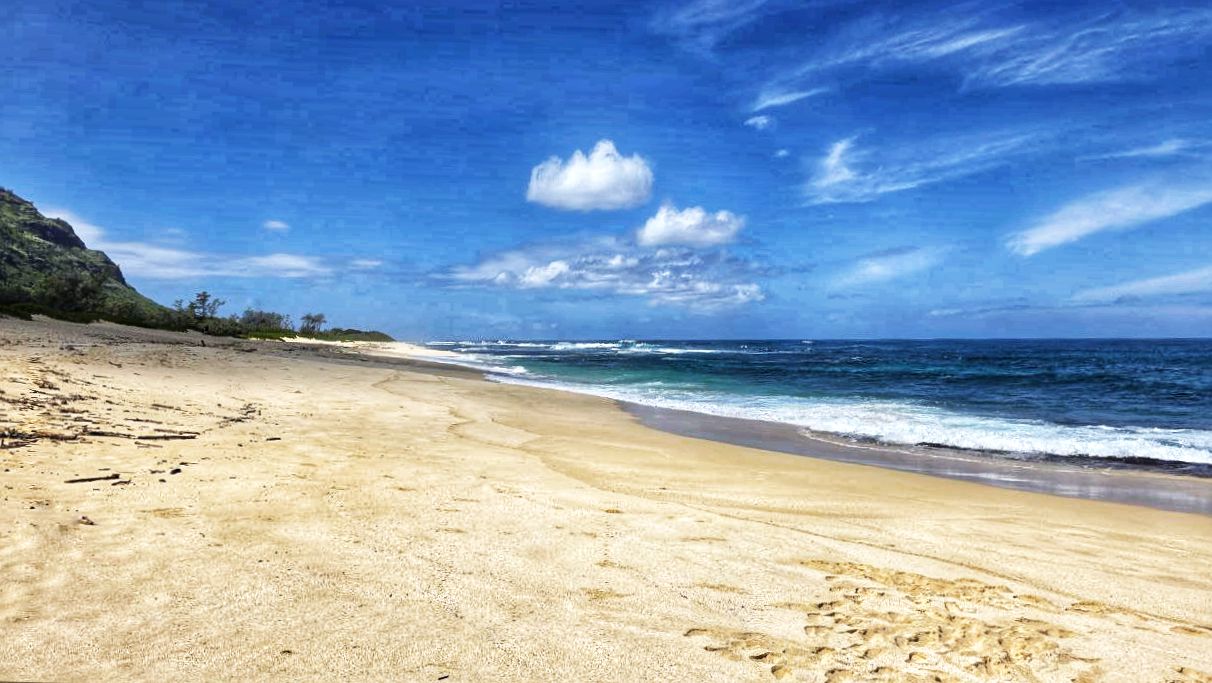
Most visitors think Oahu’s North Shore stops at Haleiwa because that is where traffic builds to pandemonium, where beach parking fills earlier than you can imagine, and where sitting in your car between the familiar lineup of surf breaks and food trucks largely defines the experience. Once people have crawled through and found a place to stand at Waimea or Sunset, the mental box gets checked, and the car points back toward Honolulu fast, as if everything worth seeing has already been seen. But it hasn’t.
Instead of turning around at Haleiwa, we continued west on Farrington Highway and watched the storefronts fall away in the rearview mirror. The line of rental cars thinned fast as the road narrowed and the mountains got closer to the pavement. On the ocean side, long stretches of sand opened up, and within a few miles, we were seeing more wind in the ironwood trees than cars on the road or people on the beach.
Most visitors leaving Haleiwa head east toward Sunset Beach and Pipeline, where traffic stacks up endlessly and parking lots overflow. We went the other way. Out toward Mokuleia, the commercial North Shore disappears fast, and what replaces it is space. There are no visitors circling for stalls and no steady lines at food trucks. You can pull over without searching for the one open spot in a packed lot, and entire sections of beach sit quietly without the usual cluster.
Dillingham Airfield and the working North Shore.
One of the first landmarks after Mokule’ia Beach (which we will write about soon) is what most people still call Dillingham Airfield, though its official name is Kawaihapai Airfield. It is owned by the U.S. Army and managed by the State of Hawaii Department of Transportation under a 50-year lease, and it has been operated as a military installation since the 1920s, with HDOT taking over management in 1962. HDOT leases 272 acres of the 650-acre Dillingham Military Reservation and operates the single 9,000-foot runway, with the civilian side used heavily for gliders and skydiving while the Army retains first priority for air/land operations and uses the field for helicopter night-vision training.
As we drove past, it did not feel like a visitor attraction at all, even though you can spot the roadside signs for glider rides and skydiving. A small single-engine plane rolled down the runway and lifted off against the Waianae Mountains, then a glider followed, towed upward before separating and moving almost silently above the coastline. It is one of those North Shore scenes that makes you slow down without thinking about it, because it looks like real working Oahu rather than the marketed version, with runway, mountains, and open water all in the same frame and very few people around to make it feel like a production.
Camps that have been here for generations.
Close to the airfield are two oceanfront camps that rarely enter any typical Oahu visitor’s plans. The first is Camp Mokuleia, which sits along the shoreline and is owned by the Episcopal Church. If you’re not on a retreat, you can rent a campsite or tentalo on the beach. A little farther west is YMCA Camp Erdman, which opened in 1926 and is approaching its 100th anniversary, still renting oceanfront cabins and yurts to the public.
The accommodations are straightforward, with sand steps away from the doors and long views of the horizon. This is not a resort strip, and you won’t find any valet stands or infinity pools. Families gather around grills, kids move freely between cabins and the beach, while the ocean feels part of the daily backdrop more than it is an Instagram photo opportunity.
Camp Mokuleia tentalos start at $100 a night. Camp Erdman yurts and cabins range from $250-$450 per night for up to 6 guests. For context, the average vacation rental in the Mokuleia area lists above $500 a night.
The shoreline here is not known for calm, protected swimming, and currents can be strong without lifeguard towers stationed every few hundred yards. The beach also has a lot of coral, which keeps swimmers more limited than some other beaches. And that fact alone keeps casual beach traffic lighter, and it helps explain why this stretch feels so different from busier Oahu North Shore stops. The camps and the character of the water belong to the same landscape, shaped more by geography than by commercial branding.
Where the pavement ends.
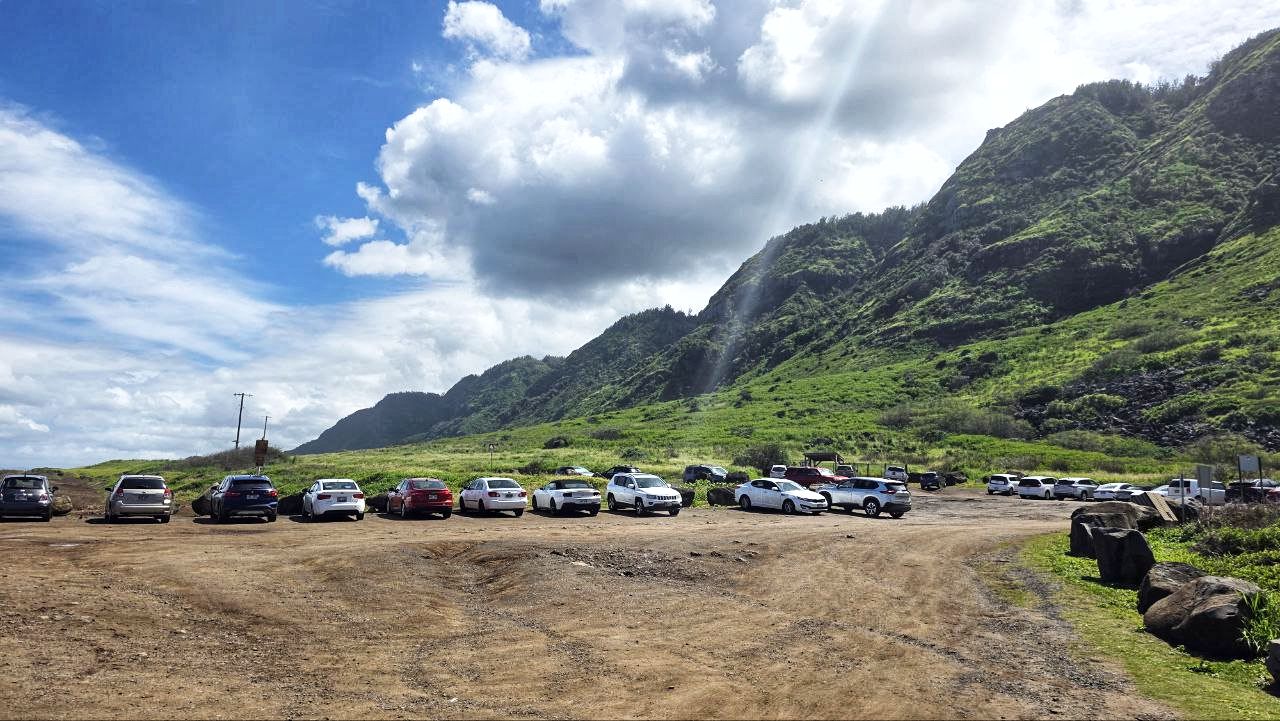
Eventually, Farrington Highway reaches a gravel lot where the pavement stops and a locked gate marks the entrance to the Mokuleia section of Kaena Point State Park. There is no visitor center funneling people through an entrance plaza. Instead, there is open sky, steady trade winds, and a handful of parked cars facing a dirt road that continues on foot toward the westernmost tip of Oahu, where you can meet the road that comes from the other side. This is truly a part of Oahu that most visitors never see.
Hikers follow the old railroad route for roughly 2.7 miles to Kaena Point itself, where seabirds nest behind protective fencing and monk seals are sometimes seen along the shore. The trail is exposed, hot, and largely flat, with no services and little shade, which naturally limits casual foot traffic. Consider not trying it in the middle of the day. But, standing at the end of the paved road, with the Waianae Mountains behind you and nothing but raw coastline ahead, feels less like arriving at any Oahu attraction and more like standing at the literal end of the island.
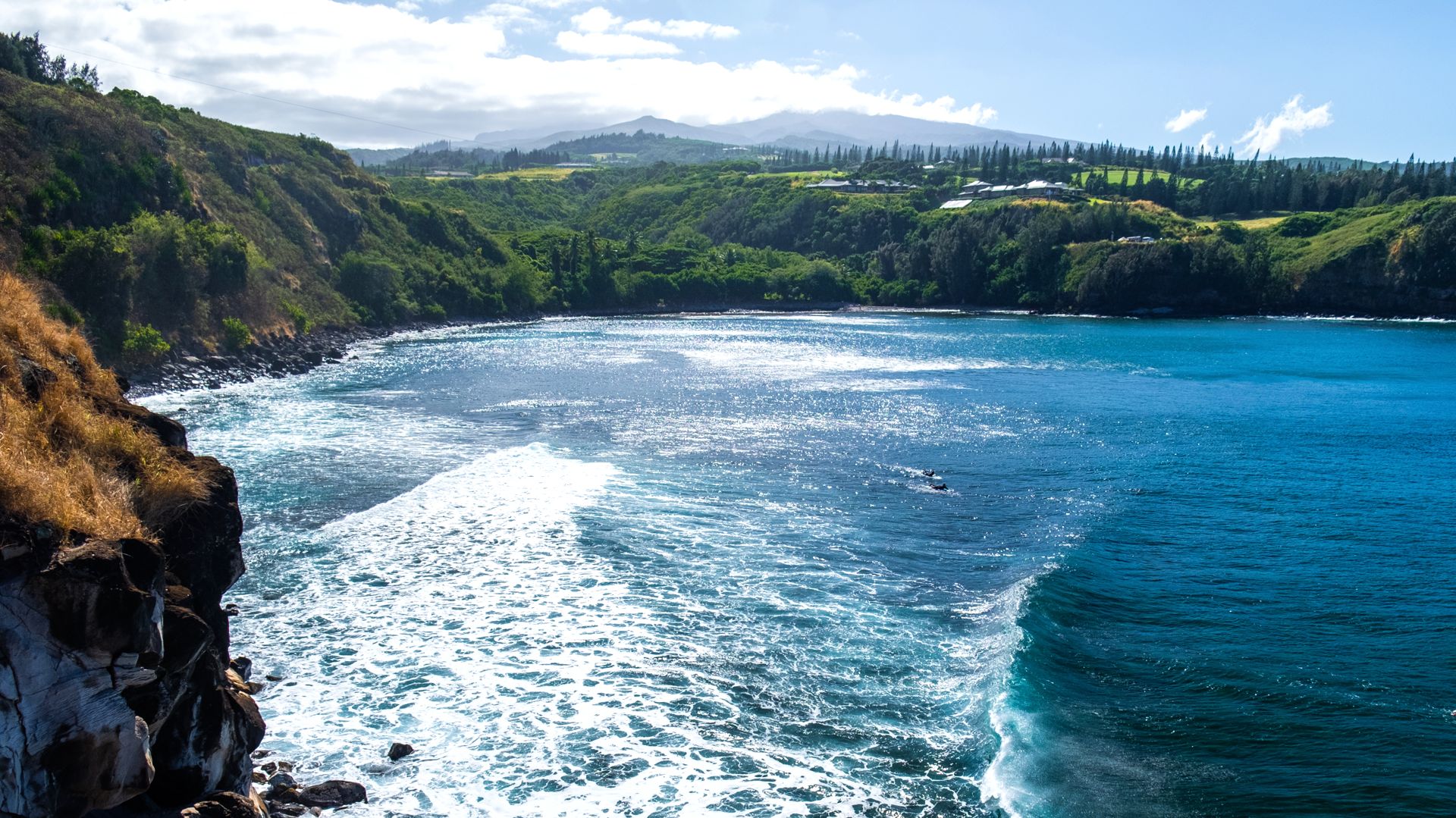
What stood out most was how little competition there was for space. There were only a few cars in the lot when we arrived, and long portions of the beach were untouched compared with the chaotic churn nearby at Haleiwa. It was a bit windy, the mountains anchored one side of the horizon, and the coastline extended westward without any indication that you were sharing it with scattered other people.
If you have been to the North Shore more than once and believe you have already seen it, have you ever kept driving past Haleiwa until the pavement runs out? It’s worth the drive.
Photo Credits: © Beat of Hawaii at Kaena Point State Park, Oahu.
Get Breaking Hawaii Travel News
I believe there’s a nudist beach in that area as well.
One of the best things about that area is the night sky. There little to no light pollution up there. Even with the makes eye you can see the Milky Way. The local astronomy club does star parties at the air field.
I direct all tourists to Iroquois Point Beach.
It is a long drive from Waikiki.
Empty most weekdays.
Plenty of free beachfront parking.
Dogs allowed on beach if leashed.
Clean. Feels like you are not on Oahu.
One beachfront restaurant (D’lish at the beach) offers tourists a unique non-Waikiki experience.
Maybe the beaches are bare because of the history of theft and car break in’s at Sunset beach and north shore in the past. Many articles about smash and grabs so when word gets around people don’t visit. Nobody also around if you need to be rescued. How long does it take for police to arrive if your car gets broken into and items stolen? Probably hours.
Oahu Is over crowded and thanks to articles like this there are fewer and fewer places for locals to go to avoid the crowds.
I grew up on Oahu, and even in the 60s and 70s, my classmates knew they had to be to the North Shore (any major surfing beach) by the crack of dawn due to the limited parking. If you found a spot mid-day, it was a minor miracle. Other classmates played polo at the Dillingham polo fields. A couple of years ago, my husband and I watched a skydiver land in a field of polo ponies, who looked as though they’d seen that happen before. Just returned from a week of high school reunion activities, and I was surprised by the light numbers of tourists; and how friendly and welcoming everyone was at the hotels and shops. Didn’t experience any of the negativity I keep reading about. Wonderful trip!
Maybe. Just maybe. You shouldn’t be exposing the secluded beaches we have left. Tourists have no business knowing these things
Lived on the Big Island winters for years and years in Waimea. I don’t know if the Big Island was considered crowded, but ‘outsiders’ might have assumed that. People wanting to build houses or housing development might have felt that land was in effect scarce. But…looking at the map and even taking water into account….there were/are a LOT of acres that could be responsibly developed. Housing still remains very scarce, I keep hearing, and the land restrictions are part of that. On the Kona Coast, one might wonder how so much of it got claimed for Hotels….a different kind of story.
Grew up in Hawaii. Mokuleia is beautiful for sure, but I would not go into waters without lifeguards close by. Did swim at Waimea Bay when young and never had lifeguards back then…wouldn’t ever do that now. Call me chicken. It’s really nice to be in nature and beat the crowds…but be safe.
Greetings from Kalapaki Beach!
We’ve been visiting Hawaii (from Madison,WI) for decades, stay mostly at HGVC & Marriott’s resorts. Having followed your beats recently.
Agreed with most of your comments. This may be our last visit here, feeling less & less thrilled with flying hassles, plus the Not so welcome vibes.
We hope all the best for Hawaii, may it thrive against all odds.
Yes, you’re so right about this beach, our favorite & the “best kept secret”.
We love to sit for hours, mesmerizing by the beautiful white caps rolling in…Priceless!!!
Having grown up as a teen in the 60’s surfing North Shore, I can’t live there anymore as way too crowded … and the minute the surf comes up, tons flock to the NS so you can’t even get to a grocery store. And never mind during competitive surf events … driving from Hale’iwa to Waimea Bay could take hours! And then tourism has become so extreme … good luck going to those no-more-“secret” local quiet beaches everyone knows about now.
We stayed at Camp Erdman years ago with our kids and it was one of our favorite Hawaii memories of all time. Simple cabins, beach, no crowds. I’m glad to see the camp is still there because most visitors have no idea it’s even a thing.
I love hiking at Kaena Point whenever I’m on Oahu and it never feels crowded compared to everywhere else. The wind can be brutal and the sun too, but that’s part of it. You actually hear the ocean instead of Oahu traffic.
We drove out there once poking around by accident and thought we missed something because there was absolutely nothing going on. No shops, no food trucks, barely any cars. It felt like a different island.
We turned around at Haleiwa last year because traffic was so awful and we rightly assumed it would only get worse. Maybe we gave up too soon. That drive sounds like what we were actually hoping for but never found.
Dillingham is one of my all-time favorite Oahu moments. Watching a glider go up against the Waianae Mountains while the beach sits empty next to you is pretty surreal. It’s not exactly any tourist scene, it’s just old Oahu being itself.