
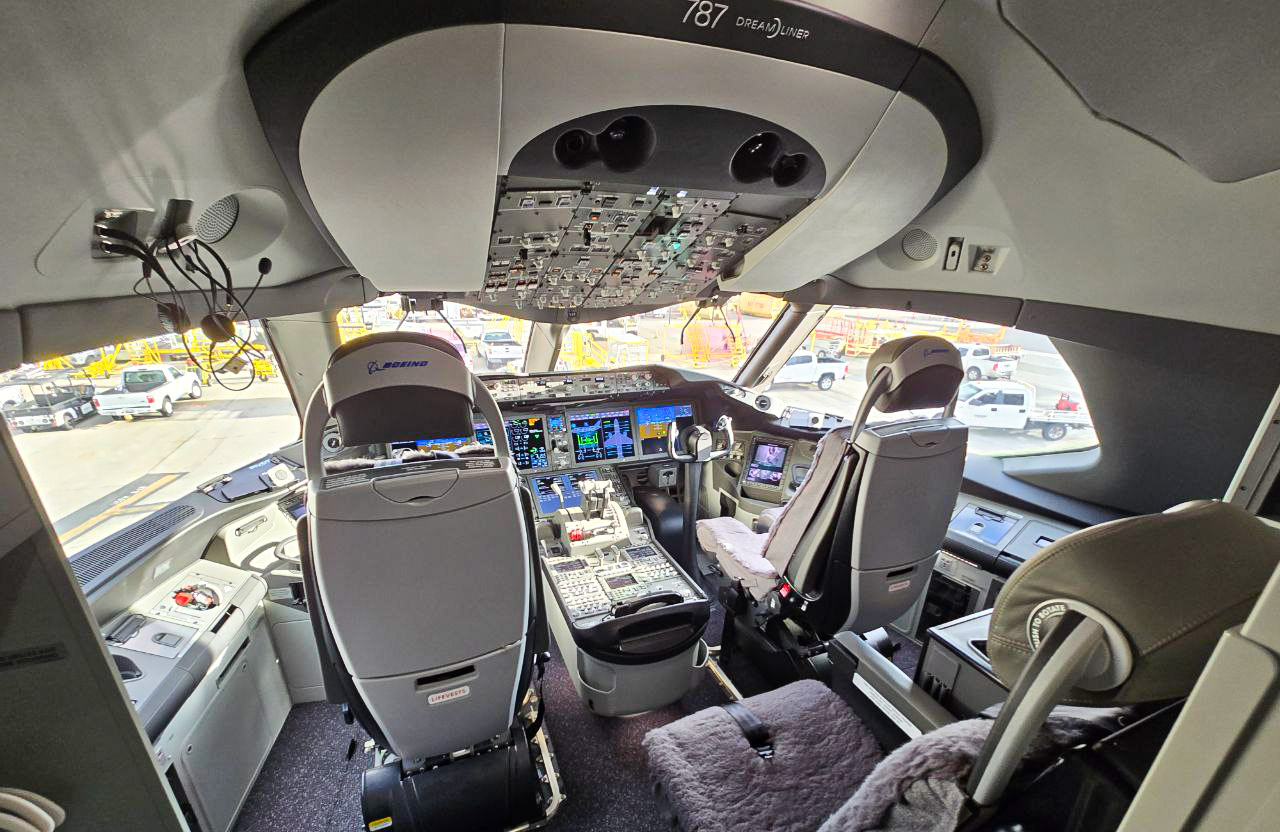
A man is now in federal custody in Honolulu after prosecutors say he spent years posing as an airline pilot or crew member to fly for free, including on Hawaiian Airlines flights and, at times, by requesting cockpit jump seat access.
Updated January 20, 2026, 12:15 PM HST: This article has been updated with latest details from federal court filings obtained by Beat of Hawaii.
According to federal prosecutors, Dallas Pokornik falsely claimed pilot credentials and used fabricated airline employee identification to obtain hundreds of no-cost flights on multiple carriers. The criminal charges filed in U.S. District Court in Hawaii stem directly from two Hawaiian Airlines flights in 2024. According to the indictment and detention motion obtained by Beat of Hawaii, the charged conduct ran from at least January 2024 through October 2024, while prosecutors say falsely claiming to be a pilot stretched back four years.
Court records show that Pokornik, a Canadian man extradited from Panama, previously worked as a flight attendant for Air Canada from July 17, 2017 through October 7, 2019. Prosecutors say he was never a pilot, but that experience placed him inside airline systems and gave him familiarity with employee travel privileges and the verification processes that later became central to how he performed the alleged fraud.
Hawaiian Airlines declined to comment, citing active litigation, and offered no explanation for how the alleged activity may have gone undetected for so long. That silence, and the odd timing of this case in relation to a nearly identical federal conviction just six months ago, raises new questions about how airline crew verification systems actually operate.
What federal prosecutors say happened.
Federal court filings allege that Pokornik repeatedly misrepresented himself as a licensed airline pilot to access travel benefits intended for airline crew. Prosecutors say he used a fake Air Canada employee badge and false employment claims in order to secure flights on Hawaiian Airlines, United Airlines, American Airlines, and Air Canada. They further allege that he exploited internal airline booking systems designed for crew travel, not consumer ticketing channels.
The government’s motion to detain Pokornik without bail describes him as a serious flight risk, noting that he is a Canadian citizen who has no ties to the United States and was extradited from Panama. Prosecutors are also alleging that he requested access to the cockpit jump seat despite having no pilot certification or airman’s certificate, a detail that elevates the case beyond ordinary ticket fraud and raises further concerns.
Cockpit jump seats are typically reserved for pilots, FAA inspectors, and other credentialed and authorized aviation personnel. Access is supposed to be verified through multiple layers of airline and federal security systems, including confirmation of employment and certification status across airlines.
According to prosecutors, Pokornik’s false representations caused airlines to issue tickets at no cost, including two Hawaiian Airlines flights on August 16 and October 17, 2024. Court filings have not yet specified how many times he successfully accessed a jump seat versus flying in the main cabin, but prosecutors have made clear that jump seat requests were part of his alleged scheme.
Pokornik has been charged with two counts of wire fraud, each carrying a potential penalty of up to 20 years in federal prison. He is currently being held at the Federal Detention Center in Honolulu and is represented by Federal Public Defender Craig Jerome.
Why Hawaiian Airlines is central to this case.
Although multiple airlines were allegedly involved, the case’s criminal charges themselves are tied specifically to Hawaiian Airlines flights. That makes this case particularly relevant for Hawaii travelers and places Hawaiian at the center of a broader discussion about crew verification and internal security control practices.
Hawaiian Airlines has long emphasized safety and trust as core elements of its nearly century-old brand while also navigating a lengthy and complex acquisition by Alaska Airlines. During periods of transition, airlines often rely on interconnected systems, shared databases, and cross-carrier trust that are designed to keep operations moving smoothly and safely.
Federal prosecutors have not alleged that Hawaiian Airlines knowingly failed to follow any required procedures. Still, the fact that the charged violations occurred on Hawaiian flights raises questions about whether existing safeguards were sufficient to detect repeated misrepresentation over an extended period.
A second case of a fake airline crew member in just six months.
This case follows closely on the heels of a federal conviction in June 2025 involving Tiron Alexander, a Florida man found guilty of wire fraud and entering secure airport areas by false pretenses. Prosecutors proved that Alexander booked over 120 free flights by posing as a flight attendant and by exploiting airline booking systems reserved for crew members.
In that case, court records reflect Alexander falsely claimed employment with multiple airlines, supplied badge numbers and hire dates, and used the assumption that crew credentials entered into airline systems would be trusted unless otherwise flagged. The scale of that activity and the length of time it went undetected also drew national attention.
The similarities between the Alexander and Pokornik cases are difficult to ignore. Both allege multi-year schemes, both involve multiple airlines, and both relied on internal airline systems designed to streamline legitimate crew travel, perhaps more than aggressively screen for fraud.
What this says about airline security systems.
Airline crew verification relies heavily on the Cockpit Access Security System (CASS), which allows airlines to confirm whether a person requesting jump seat access is an active, authorized employee of another carrier. The system depends on accurate data, timely updates, and consistent validation across airlines.
CASS operates within a broader ecosystem of legacy airline technology that predates modern threat models. Security researchers have warned in recent years that airline systems often prioritize operational efficiency and trust between carriers and systems, creating openings for deception when information is assumed to be valid.
Federal prosecutors have not alleged that Pokornik exploited any technical vulnerability. They have alleged deception, but deception that only succeeded where systems rely on trust and incomplete verification at key points in the process.
Why this matters to Hawaii travelers.
Hawaii’s dependence on air travel makes airline security issues more than distant concerns. Every visitor arrives by plane, and every resident relies on airlines for access to the mainland, other islands, and beyond.
This case is also taking place at a time when travelers are already being asked to trust increasingly automated identity checks, from Honolulu airport face scanning to digital verification systems. The idea that someone could pose as a pilot repeatedly and request cockpit access without getting caught sooner is hard to make sense of in relation with what travelers assume is already safely locked down.
First court appearance coming.
Pokornik made his initial appearance today before Chief U.S. Magistrate Judge Kenneth J. Mansfield in Honolulu. Prosecutors are seeking to keep him detained pending trial, arguing that he is a flight risk and no conditions could assure his appearance in court.
Prosecutors have also cited social media posts reflecting extensive international travel as part of their argument that Pokornik poses a serious risk if not detained. Upcoming court filings should shed more light on how the alleged scheme went down, how he was able to avoid detection for so long, and what finally triggered an intervention.
Does this change how you think about who’s sitting in the cockpit on your next Hawaii flight?
Get Breaking Hawaii Travel News


There’s way more to this story.
Buying industry reduced fare tickets and cockpit jump seat access are two vastly different things and would require two vastly different security breaches.
I suspect that the times he was riding in the cabin it was because he was on jump seat authority and there was a empty seat in the cabin.
The issue is the reliability of Air Canada’s cockpit jump seat authority system and its i.d’s. If he were in uniform and had an Air Canada badge that was counterfeit, it probably wouldn’t have been to hard to get through the “working crew” TSA station. Remember, he would still be screened, so he’s not carry any bombs or weapons. All the “known crew member” access does is allow someone to get through TSA without a boarding pass.
The more interesting thing is how he got cockpit jump seat authority. A pilot of another airline doesn’t just bop up to a gate, show and crew i.d. and get the jump seat.
And yet undeniably another hole in the ‘Swiss cheese” of aviation catastrophes …
My friend lived at a luxury condo complex next to SFO airport. She said almost all the pilots were drunk alcoholics until the day before they were scheduled to fly. Then they sobered up in time to fly, coming back home to be drunks again until the next flight.
I heard the same thing from a friend of mine who knew a pilot who was like that (I met him and he even abandoned a car once because he was drunk). I was hoping that things improved and airlines would test pilots more often for drugs and alcohol. This definitely doesn’t make me feel safe when flying ….
Just curious if anyone has heard of ” 9-11 ” ! ( Asking for a friend ).
Totally unacceptable & inexcusable negligence….
The whole TSA process is a Dog and Pony show!
What a waste of time and money.
“OMG” … glad that the real pilot(s) didn’t have a heart attack while flying … these fake “pilots” would have hundreds of lives in their hands. About as bad as the horror stories of the past with fake “doctors” treating real patients.
So let me get this straight. We’re body-scanned like criminals, pulled aside for suspicious shoes, forced to ditch belts and liquids, and made to spill our life stories. Yet someone impersonates a pilot for years, scores free flights, and even requests cockpit jumpseat access with zero alarms going off?
Unbelievable!
This isn’t operational efficiency. It’s negligence dressed up as trust. Systems meant to verify credentials run on the honor system, while regular travelers get treated like walking bombs. We scan for shoe explosives and sketchy vibes at security, but airlines and the FAA let phony crew slip through to lounge in jump seats?
Two imposters, multiple airlines, same glaring failure.
Airlines brag about their safety commitment but won’t bother authenticating who’s actually cleared to board. Policymakers, where’s your bite? Too busy with invasive passenger screening to fix?
This immediately brought to mind the movie “Catch Me If You Can”. Which, by the way, was excellent.
This is nothing new. Crafty people have done this since the 1960’s. They even made a movie about it in 2002 “Catch me if you can”. If you know how the system works it’s easily exploitable even today. Airlines work on the “trust but verify” system… they just ignore the verify part on non public facing pieces. These two people should be held up as examples of showing us the process is broken and that if truly nefarious entities wanted to do something to exploit the airline system they could.
This screams “Catch Me If You Can”. Yes, it certainly does make me very apprehensive to fly, since he certainly could have been a serious threat in the cockpit.
Airlines are certainly obsessed with efficiency and cost cutting. Trust-based systems save time and money until they don’t.
I appreciate not jumping to conclusions here. Just laying out what’s known makes it unsettling enough.
Years. That’s the part that stuck with me. Not days or weeks. He got away with this for years. Too weird.
Feels like an outlier situation to me, but we’ll have to wait and see how it turns out. People commit fraud everywhere. That doesn’t automatically mean whole systems are broken.
There has to be way more to this story than reported so far. Where did he stay in Hawaii? Did he have a girlfriend there??? What did pilots think of this dude riding jump-seat?
So if this guy knew how the system worked because he used to be a flight attendant, that actually makes this more concerning. I’m less worried about this one person and more worried about how many other security things we take for granted maybe are in a similar situation.
I never buy the “everything is secure” messaging we hear all the time. Most of it is trust layered on top of old systems as this points out.
After flying so much for decades I always assumed jump seat access was one of the most controlled things in aviation. The fact that someone could seemingly get away with this repeatedly without being stopped sooner is disturbing. Hope to hear more.
Wow! Keep us updated on this story! I wonder if he travelled in uniform ….