
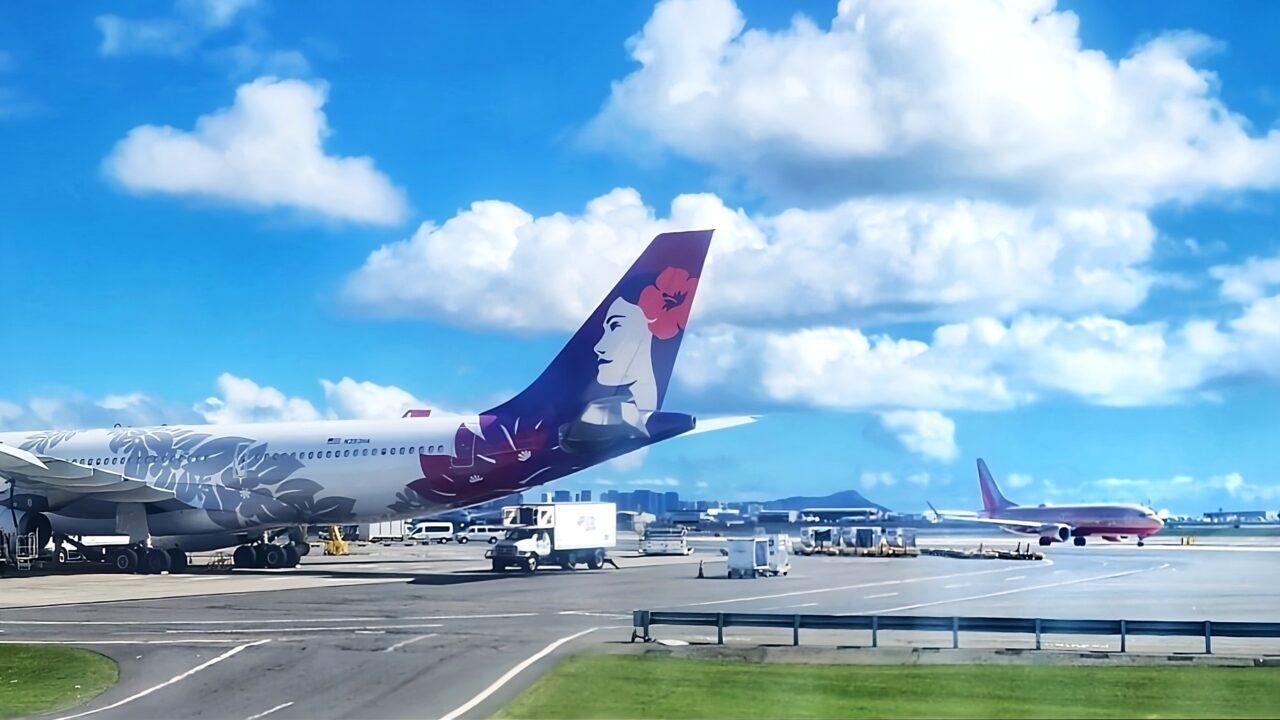
Hawaii travelers have been told their flying experience would get better. Cabin upgrades were promised, long-term investment was laid out, and Alaska was talking about a stronger future for Hawaiian. Less than three months later, that future looks a lot less secure. Alaska is under new financial pressure, Hawaii is named in its latest warning, and the improvements travelers were told to expect are now being tested by a fuel shock no one planned for.
Beat of Hawaii already covered the broader fuel hit in The Global Crisis Just Hit Your Hawaii Vacation and the booking pressure in Waiting To Book Your Hawaii Flight Could Cost You Hundreds Now, but Alaska laid out a Hawaii future in January, and the financial ground beneath shifted almost immediately. Which parts of that future still survive if this fuel environment lasts is the big question.
The line that matters most is the one Alaska told Reuters.
Alaska said it has about $3 billion in liquidity and $18 billion in unencumbered assets, has raised fares to offset higher fuel costs, has not cut capacity, and is “reviewing its cost structure.” So what might that mean? It does not mean Alaska announced any cuts today, but it does mean the company is looking hard at spending, priorities, and timing at the exact moment Hawaii travelers were expecting quite the opposite story.
Alaska is integrating Hawaiian, fuel costs are moving in the wrong direction, and its latest earnings guidance is much worse than it previously told investors. In that kind of environment, the easiest things to delay are often the things Hawaii travelers were looking forward to most, especially cabin upgrades, timelines, and anything that costs real money without fixing an immediate operational problem.
Financials just got worse at Alaska.
The company now expects an adjusted first quarter loss of $1.50 to $2.00 per share, versus prior guidance pegged at $0.50 to $1.50. It also expects fuel cost of $2.90 to $3.00 per gallon, with at least a $0.70 headwind coming from fuel alone.
Alaska made its Hawaii commitments three months ago, under a far friendlier fuel and overall financial picture. The company also said forward bookings were up more than 25% year over year. This wasn’t a story about visitors stopping their Hawaii trips. Now, those same visitors may still want Hawaii vacations, but the cost side has moved hard and fast enough to change the picture.
Alaska is telling investors that the environment turned against it quickly, and once that happens, every promise that looked reasonable under one set of assumptions starts to be evaluated under another.
Hawaii is within Alaska’s warning.
Recent severe rainstorms and flooding in Hawaii came at the same time as the fuel shock, together with unrest in another popular Alaska destination, Puerto Vallarta. These parts of the airline’s network account for about 30% of capacity, a bad mix for travelers.
The dominant carrier is under cost pressure, and Hawaii is part of the near-term drag Alaska just described to investors, while the future of Hawaii flying is still being presented as being on track.
What travelers were told less than 90 days ago.
Just 83 days ago, Alaska announced the largest aircraft order in its history and talked about a broad Hawaii-focused future that included a $600 million investment plan for Hawaiian over five years.
Alaska told travelers to expect a stronger product ahead, including A330 cabin refurbs beginning in 2028, wider investment in fleet, infrastructure, technology, and the Hawaiian brand. The promise was a better Hawaii flying experience over time, not just money, with better cabins, a more cohesive modern feel, and a sense that Hawaii was not simply being absorbed into Alaska’s mainland system and left to make do with whatever would happen next.
Interisland flying was already moving toward some new system and planes. BOH has suggested, at least in part, a rotating system of mainland aircraft tied into a broader network rather than a dedicated Hawaii-first setup that travelers have known for decades.
What happens to the promises?
The A330 cabin refurb was always one of the softer commitments, pushed out to starting in 2028 and discretionary enough to delay without breaking anything operationally. The $600 million Hawaii commitment is broad enough to survive in name, while the individual pieces readers were counting on get sorted out or changed.
According to Reuters, United is preparing for the worst, with CEO Scott Kirby modeling Brent oil as high as $175 a barrel and remaining above $100 through 2027. Reuters reported that stronger carriers, including Delta, see prolonged high fuel prices as an opportunity to keep investing while weaker rivals stumble.
What nobody can tell you yet.
A carrier under unexpected financial pressure, explicitly reviewing its cost structure, and operating in a fuel environment that other large airlines are already planning around through the end of 2027, is not a carrier likely to rush into optional upgrades, and Hawaii still has no real backup while all of this plays out.
What to look for next.
The first-quarter earnings call is where readers should listen for anything concrete on Hawaii capacity, A330 timelines, interisland fleet direction, and how specific the company still sounds when it talks about those plans, as well as the $600 million Hawaiian plan.
Reuters reported that analysts and ratings agencies are already pointing to the usual signs of stress in a prolonged fuel squeeze, increased airfares, deferred spending, deeper capacity cuts, and potentially parked aircraft, and new borrowing. Hawaii travelers were promised a better future in January. How much of it survives this is the question nobody can answer yet.
Has any of the recent news changed how you feel about a Hawaii vacation, and does today’s warning change it further?
Photo Credit: © Beat of Hawaii at HNL.
Get Breaking Hawaii Travel News






As said many times before, the alternative to AS acquiring HA was probably worse ( HA being liquidated with useable assets scavenged by competitors).
At least the main threat AS faces is also shared by the whole airline industry and I’m sure any prudent management should be reviewing spending & costs
in this new environment. I didn’t realize that Hawaii & PVR traffic alone accounts for 30%^ of AS capacity. Hawaii is by far a. leisure market and as such would historically get less ‘love’ from the airlines. Sadly, the romance & allure of Pualani won’t pay the bills even considering the fantastic marketing appeal and loyalty built throughout the years. AS management at least has proven in the past to be more than competent. Hopefully that will continue through the current turbulence economic environment….
I hope this isn’t another omen of things to come due to fuel prices. Back in 2008, yes it may have been Mesa Airlines that caused the fare war but what really brought Aloha Airlines down was the price of fuel. Back then, a barrel of oil shot up to USD140+, similar to what is happening now with Alaska/Hawaiian Airlines. To sustain operations, there will be belt tightening until the war ends. We can only hope for the best, the worst is Alaska abandoning Hawaiian Airlines and opening the door to Delta … their besty!
Seriously, if they didn’t simulate these worst-case scenarios before the purchase as part of due diligence, then the chickens have come home to roost and heads should roll.
Aloha,
Thirty percent of their market is leisure travel. Barring an economic crystal ball I would suggest changes are afoot. Spoiler alert…airlines are not a charity…
Mahalo
Well if they are smart they will do all the Hawaii flying with their Hawaiian Air brand and maximize the investment they made in Hawaii…..big “if” though 😉
We stay at the Nipili kai resort. It’s relaxing the people that work there are very nice. The food is reasonable and good. The snack bar is great and the kids that work there are polite and hard working there parents should be proud. We stay for 7 days also eat at mom’s BBQ and Joey’s kitchen the Nipili market is good also. Nipili is just a nice place. Be kind and respectful to everyone, and its a great vacation.
As someone who lives on Oahu and flies interisland a lot, my reaction is mixed. Alaska may still invest heavily in Hawaii and I sure hope that they do. But once you start hearing words like this, you do wonder whether Hawaii-specific things could slowly turn into compromises. I just hope that Hawaii is still a priority when conditions get harder.
My take is that us Hawaii travelers were just starting to believe things might actually improve, and now there are real questions about timing. I’m ok with a lot if I know where things are headed, but uncertainty is what has gotten old here. A330 upgrades, 717 replacement, great. If they are going to slip, please just be transparent.
They inherited a complicated situation and now fuel blows up right in the middle of executing it. Airlines are a tough business. It will be telltale where Hawaii lands in all of this.
I still think Alaska can pull this one off, but for the first time I am wondering what might get delayed or changed.