

Hawaii travelers sit at an interesting new crossroads. Airlines are unveiling cutting-edge cabins with lie-flat suites, premium economy, and lighter, greener materials. Yet those flying to and from the islands are left asking a blunt question: why are we still stuck with outdated options? The race is on, and the question here is whether Hawaii flyers are competing or not.
What has not happened yet for Hawaii flyers.
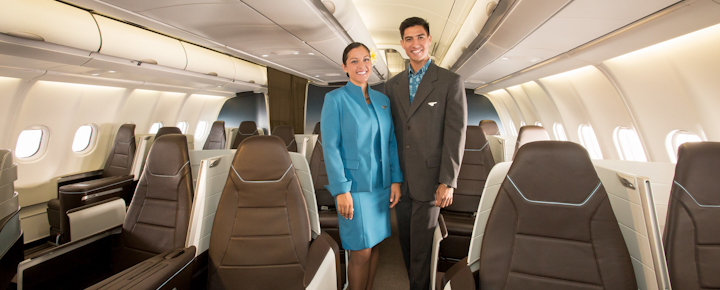
For a brief moment, Hawaiian Airlines seemed poised to join the big leagues of cabin innovation. When the carrier ordered the Boeing 787-9 Dreamliner, it announced it would be the launch customer for Adient’s new Ascent lie-flat suites. These were cutting-edge business-class seats with direct aisle access, sliding doors for privacy, and a fully lie-flat bed.
Hawaiian branded the Adient product as the Leihoku Suites, featuring 34 seats in a 1-2-1 configuration that finally provided every passenger with aisle access.
The seats debuted when Hawaiian’s Dreamliner entered service in 2024, but only after years of delays. Hawaiian’s own financial struggles, combined with pandemic-related delivery issues, pushed back the launch so long that Qatar Airways introduced the same Adient Ascent seat first. Hawaiian lost its chance to be recognized as a leader. Whether the design itself was ever award-worthy is open to debate, but Hawaiian certainly missed its moment.
Then came another miss. Hawaiian never introduced an actual premium economy, even as it became standard across most airlines’ long-haul fleets. Instead, it offered Extra Comfort, essentially coach seats with more legroom. That decision left Hawaii travelers without the middle-tier option that widebody passengers now expect.
For an airline that once promoted itself as a boutique international carrier, those missed chances left Hawaii flyers further behind global leaders.
Alaska’s integration and what might change next.
Now that Hawaiian is wholly owned by and part of Alaska Airlines, the future of Hawaii cabins is uncertain. A single operating certificate will arrive very soon, and with it, decisions about how much to invest in upgrades across all aircraft.
Alaska has never been a Crystal Cabin Award darling, but it has made steady improvements. Its refreshed First Class offers more legroom than other domestic carriers, redesigned leather seats with power outlets and device holders, and streaming entertainment on personal devices. Alaska has leaned into lighter, more sustainable materials and added small but meaningful service touches, including upgraded and innovative meals. Not revolutionary, but not standing still either.
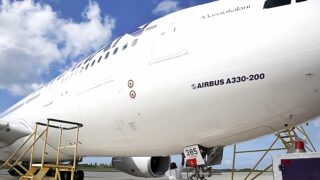
For Hawaii flyers, the real test will be the A330 retrofit and promised premium economy. That is where Alaska can close one of the biggest gaps between service to Hawaii and the rest of the world. And plans are already underway: Hawaiian’s A330 overhaul may reduce the number of economy seats by as many as 60 to create space for a dedicated premium economy cabin and an upgraded business class. Extra Comfort seating is also set to be reshaped. These changes will redefine the balance between price, comfort, and availability on some of Hawaii’s most important widebody routes.
Commenters and our own experience suggest that the Alaska first-class experience to and from Hawaii often hinges on a good seat, but a less refined soft product. Pre-departure service can be inconsistent, meals and portions vary, and lounge access is limited compared with Hawaiian. The net effect is a cabin many describe as closer to international premium economy than true business/first class, even while the seat is comfortable.
As for the Hawaiian Dreamliners, they are already flying for Alaska with the Leihōkū Suites under Hawaiian’s soon-to-be-retired branding. We have written before about how that identity will disappear. For the purposes of this story, the Dreamliners are simply not relevant. The future of cabin innovation for Hawaii rests on how Alaska handles the rest of the fleet.
The airline innovators.
To see what Hawaii flyers may be missing, look at who is actually winning recognition. United Airlines previously won a Crystal Cabin Award for its accessible seatback entertainment system, It has also been a finalist for its Polaris business class, although that appears only on limited Hawaii routes from key longer-distance hubs.
Meanwhile, international carriers continue to redefine long-haul travel as they invest in lie-flat suites with doors, full-service premium economy cabins, and lightweight, sustainable materials that reduce fuel burn and emissions. These innovations broaden access, improve comfort, and set new benchmarks that Hawaii travelers rarely experience.
It is a contradiction hard to miss. Hawaii depends on aviation more than anywhere else, yet the cabins serving the islands are rarely the ones setting the global standard. For the airlines that matter most in this market, Hawaii remains treated less like a prior showcase for innovation and more like just another domestic destination.
What this means for Hawaii flyers.
The consequences for travelers are real. Most flights between Hawaii and the mainland continue to operate without a premium economy option. Lie-flat seats exist but only on select aircraft, and those Hawaiian A330 first class cabins already look tired compared with the newer products available elsewhere. But change is finally coming.
For a place where air travel is as essential as highways are on the mainland, the gap matters. Other long-haul passengers board expecting lie-flats and an actual middle cabin. Hawaii flyers often pay some of the highest fares in the country for options that still lag. That contradiction hits hard when you depend on planes to go anywhere at all.
Will Alaska deliver next?
Alaska has a decision to make. A complete A330 retrofit with premium economy and refreshed business class could finally close one of the most significant gaps between Hawaii service and that of global competitors. That would give travelers the cabins they have long been missing and bring the islands closer to the standards already common on other long-haul routes.
But the alternative is just as possible. Alaska could decide to hold the line, invest lightly, and leave Hawaii flyers paying high fares for cabins that don’t feel current.
Will Alaska deliver the upgrades Hawaii travelers desire, or will the islands once again miss the airline innovation wave?
The contradiction that remains.
Hawaii relies on planes the way the mainland relies on highways. You would think that would make the islands a leader in cabin innovation. But it hasn’t. Hawaiian’s big swing at lie-flat seats went sideways. Premium economy never arrived. Alaska has been steady but not revolutionary. Now, however, it is setting its sights globally. And while United shows Hawaii flyers what’s possible, those cabins only appear on the rare Hawaii route.
Meanwhile, the rest of the world is moving fast on comfort, sustainability, and accessibility. Hawaii travelers are still left wondering whether they will ever catch up.
Where do you think Hawaii flyers stand? Will the Alaska–Hawaiian merger finally pull the islands into the cabin innovation race, or are we destined to keep watching from the sidelines?
Get Breaking Hawaii Travel News


I recently flew first class on Alaska Airlines new Max 737. Brand new plane that has no Wi-Fi. The redesigned first class seats were thinly padded and uncomfortable. Service was not bad and the food choices are much better than Hawaiian which is not vegetarian friendly.
I don’t see Alaska improving in cabin comfort. Maybe the wide body aircraft will be a different story. Paying a first class fare to fly in a single aisle plane is a complete waste.
BOH, I think your concerns are well founded. However, the degree of refurbishment AS puts into the A330s may depend on where else they intend to fly them. AS’s refurbishments of 737s have included improving rest rooms and 1st class seating, adding electrical outlets at each seat, and adding bigger overhead bins. They have in some cases added new 1st class seating without adding new bins, though.
There is reason for hope. AS’s overall 737 upgrade record has been very good. I think they see the A330s as an asset. Operationally, it gives them more flexibility to upgrade the entire A330 fleet all the same way. I am hoping that means 1-2-1 seating up front and premium economy.
We’ve flown the A330 extra comfort seats on multiple trips both ways. They’re not bad, but the planes are definitely tired and in need of a serious upgrade. Premium economy seats would clearly be better and those who want to pay the biz class fare or use miles will definitely enjoy an upgraded seat and cabin. The biz class section is really tired.
In the interim, flying first class on single aisle planes is still better than extra comfort even if the seats are basically the same or close as international premium economy seats.
IMO tourist’s traveling to Hawaii won’t get any luxury or upper class comfort. The latest and greatest won’t fall into markets where the locals get local discounts on inter-island flights because they have Hawaii identification. Why take the ware and tear of this if you get 20% less. Hawaii will get the older planes, more worn interiors because of the discount offered to all island residents. Don’t expect luxury when you live on a discounted rate. Small profits IMO are not good investments for the airlines.
@Don–I admit to not being completely knowledgeable about. HA’s kama’aina discounts but a quick scan of information about the program makes it look like the 20% discount is only for interisland flights. Other discounts are highly variable and my guess is that TPAC flights will not see that level of discounting. It also looks like only one or two routes at a time will offer the kama’aina discount, kind of like an advertised special.
That’s an important distinction given that interisland flights won’t use widebody aircraft. Routes that use A330s might support premium seating more than you think.
Aloha guys,
Read this yesterday…think Hawaiian/Alaska is making a huge mistake.
They charged then denied Joel Tudor flight with his long boards then wouldn’t refund the excess charge for the boards. !”This is a psa to every longboard surfer in the world that flys with @hawaiianairlines / @alaskaair – they denied my surfboards that I’ve flown with on their airlines for 35 yrs….refused to rebook or reimburse my ticket and even had the audacity to keep the charge on my card for the boards they denied!” They did this a few years ago to Billy Kemper. Yet, when you look at the website, they say yes to surf boards. Check into this?