
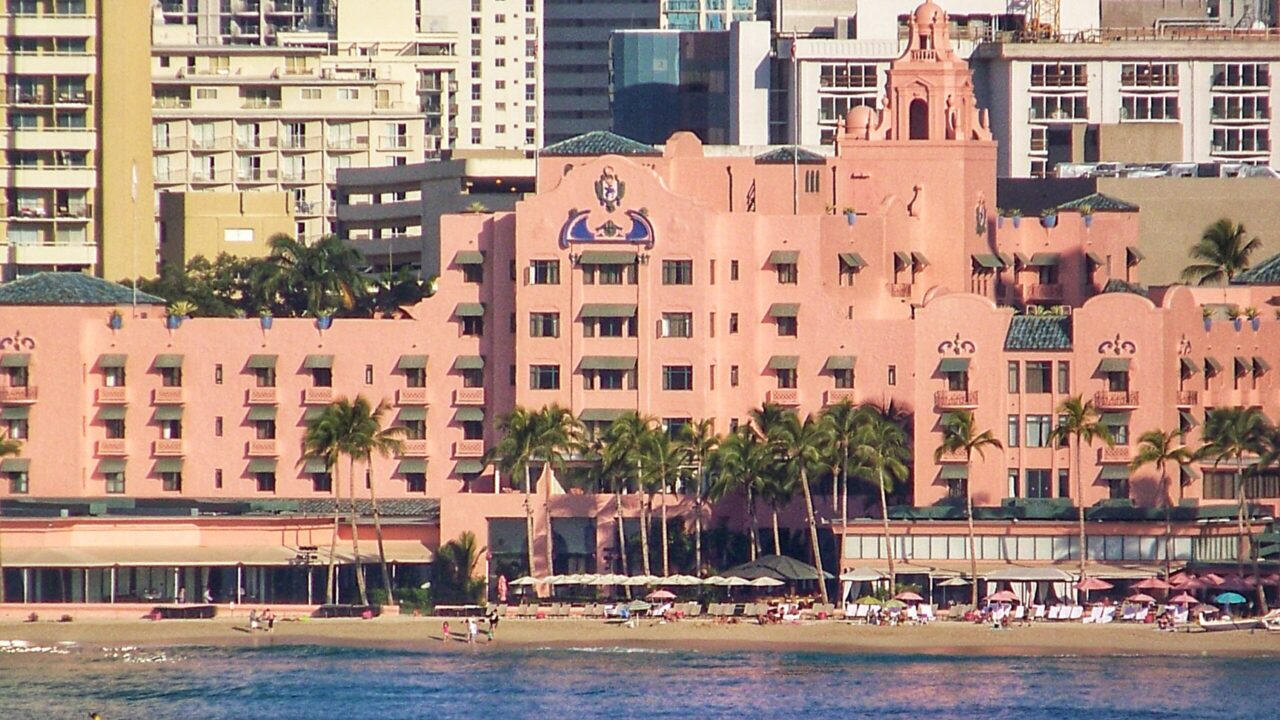
Forty years ago, Hawaii hosted a formal gala at the Royal Hawaiian to welcome a planeload of visitors who had just crossed the Pacific. The ballroom opened, guests arrived dressed for the evening, and there were speeches. The Honolulu arrival itself was treated as something worth marking.
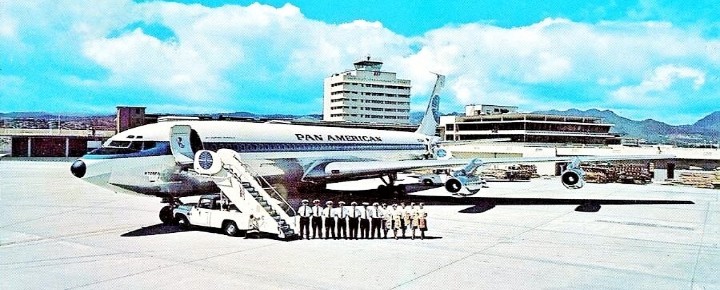
The flight in February 1986 marked the 50th anniversary of the original Pan Am China Clipper crossing that first linked Hawaii to Asia by commercial airliner. The widebody aircraft stopped in Honolulu for two days as part of that journey, and for the passengers, Hawaii was the prize rather than just a layover. The reception reflected the importance of how it received Hawaii visitors.
One of those passengers wrote to us. Cassell, who was based in Hong Kong at the time, flew on that trip and shared it with us. Here’s how the Honolulu stop was remembered:
“I was with Pan Am based in Hong Kong in Feb 1985. Pan Am re-enacted a flight done 50 years prior. The China Clipper. It flew from SFO to HNL, then Wake, Midway, Guam, and finally Manila, its final destination in 1935. We re-enacted the exact routing using a B747 aircraft, and it was sold to the public. All aviation buffs. The plane stopped in HNL for 2 days, and a huge gala was held at the Royal Hawaiian Hotel… It was an amazing time !! Also, just about the end of Pan Am in Asia/Pac. The Pacific Division was sold to United Airlines. Pac Day was 11 Feb 1986.”
Within weeks of that Honolulu stop, Pan Am’s Pacific Division went to United, and a few years later, Pan Am itself disappeared. The airline that once defined Pacific travel was absorbed into a larger network. Cassell didn’t write to us about corporate consolidation, but about the ballroom at the Royal Hawaiian and how Hawaii welcomed visitors upon arrival. That detail is what stayed with him for four decades.
When arrival in Hawaii felt like the event.
There was a time when landing in Honolulu felt like the long anticipated moment of the trip. Crossing five hours of ocean meant something in itself. Airlines built their Hawaii marketing around that very idea. Waikiki hotels leaned into it, too, once you stepped off the plane and reached the lobby.
If you have been coming here since the 1980s or 1990s, you likely remember that tone and the many nuances. It was not subtle. Hawaii projected a welcome first and foremost, then handled the details later.
Today, the experience begins very differently. You land, and there is no lei greeting. You collect your bag and check the trip details on your phone. The fees and taxes start stacking up, and you’ll need to check reservations that are required for some of the most popular and iconic sites. Before you reach the sand, you already understand how the system works and all the modern-day complexities.
Visitor numbers continued to climb for decades as roads and beaches filled up, and residents started to push back. After the pandemic pause, and again after the Lahaina fire, state leaders made it clear that tourism would be managed very differently going forward, and that visitors would fund far more of their impact. The language shifted, and the tone and the experience shifted with it.
The airline story runs in parallel.
Pan Am folded into United. The brand that once was the ultimate symbol of Pacific glamour did not survive consolidation, even though the routes continued under different names.
Hawaiian Airlines carried the island identity for decades after that and continued to reinforce the feeling that flying to Hawaii was still somehow different. Now Hawaiian sits inside Alaska’s network as part of another airline consolidation cycle. The aircraft still fly the same routes, but the names have changed, and the system around them feels different.
What once leaned on welcome and ceremony now leans on management and control. What once treated a Honolulu arrival as something to celebrate now treats it very differently.
The Royal Hawaiian still stands on Waikiki Beach, and the same stretch of sand still fills with visitors at sunset. Planes still make the final right turn and head in low over Oahu before touching down at Honolulu Airport. The setting all looks familiar, but the structure around arrival feels very different from what it once did.
Forty years ago, Hawaii threw a symbolic gala to welcome a planeload of visitors. Today, it operates a managed tourism system built around fees, reservations, and fewer visitors. One felt like a celebration, and the other feels transactional.
If you have been coming to Hawaii long enough to remember what we’re talking about, when arrival felt like it was the event itself, tell us what you remember and when it began to feel different to you. If you believe the shift was necessary to protect the islands, we get that, too. When did you first notice it felt different?
Lead Photo: © Beat of Hawaii at Royal Hawaiian Hotel in Waikiki.
Get Breaking Hawaii Travel News


The first Pan Am Airways System passenger flight was actually in October, 1936 to Oahu. Since November, 1935, they had transported only mail and cargo to prove it was safe to fly the route.
The Martin 130 Clipper splashed down in the Middle Loch of Pearl Harbor near Pearl City, where the passengers were taken by limo to the Royal Hawaiian Hotel on Waikiki.
At that time there were only two hotels on Waikiki Beach, the “Pink Palace” and the Moana. Both are still going strong today.
Passengers today are “greeted” by the Honolulu airport…
I landed at Honolulu Airport in September of 1989. As you stepped out of the jet instead of gasoline you smelled flowers. A woman was there to greet you but instead of putting the lei around your neck she held up a piece of cardboard with a lei stapled to it and on the cardboard, inside the loop of lei the word “Aloha!” was written in magic marker.
When my Mom went to Hawaii in the mid-60’s she said there was a pineapple juice fountain in the Honolulu airport for the incoming tourists.
I worked nights as a Security Guard and after I got off work I’d sneak in the back way of Dole and drink the pineapple juice for free!
I first visited Hawaii in 1971 & stayed at the Royal Hawaiian. I grew up listening to Hawaiian music since 1955, before Hawaii was a state.. To this day, I still get tears when I listen, every Saturday night, to my Hawaiian CDs. Keola Beamer said, “In Hawaii, music is more than personal expression; it keeps us connected to our history & culture.” Nowhere in all the comments about what is happening in BOH comments on Hawaii, do I every hear the raw emotion of music as it relates to what is happening. I am so sorry that what I read from locals & tourists don’t even understand what is lost when it comes to lost history & culture. At least I will Always have my music & memories. Guess I’m just an old f@rt but what can I say except those were the good old days.
I’d eat breakfast at the McDonalds on Hotel street and I’d sneer at that music but on my last breakfast there I wept at the sound of that music. You couldn’t get hash browns there, only a scoop of rice.
McDonalds served Saimin noodles in Hawaii back then. Now they do local breakfast platters instead. (Portuguese sausage, eggs and rice, etc.)
I first came to O’ahu, from Chicago’s O’hare in January 1967. I was so excited as it was the longest trip I’d ever taken. When we landed, I recall the beautiful fragrance of Plumeria (Frangipani) that seemed to engulf the airport. There was a lei greeting and a warmth of those I met. I spent two weeks on O’ahu exploring…the traffic was nonexistent…much easier to drive around than it is now. Everywhere I went people were friendly and helpful. Waikiki was reminiscent of the Hawai’i one used to read about. I’ve had a love affair w/the Islands since then. I moved to Kaua’i permanently 24yrs ago. It’s been sad to see the changes, but I’m so grateful that I first saw it in the late ’60s.
Our first family trip to Hawaii was in 1963. We only visited Oahu on this trip. I remember seeing the unobstructed view the Royal Hawaiian and how beautiful it looked. But once we saw the Ilikai being built, we knew that was the end of paradise as we knew it. Each year after this we went to other islands and ended up going to Maui every year. We did go back to Honolulu in 1973, I believe, and were shocked by what we saw. Now if we go to Oahu, we stay at Ko Olina.
In addition to this Aloha lost, later down the road I was very sad to see the Royal Hawaiian’s total refurbishing … removing all that used to feel a historically culturally significant treasure to visit … for someone who grew up here and used to like to periodically take it all in, so that I never forget is hard. I don’t go there anymore because they went total modern … just like Hale’iwa Joes decided to throw out the precious past and install totally modern. As boomer, it is deeply sad to have to see over the decades how no one cares about the Hawaiian culture or history. It’s just another place for tourists to come and go, drop Big taxing bucks on Everything …. most don’t care either. And governing folks are the most corrupt land grabbing thieves around.
Aloha Ginger,
Agree completely with you about the Royal Hawaiian Hotel. We have stayed there a number of times over the years.
I remember when they ripped up the beautiful gardens to build the somewhat unattractive Sheraton Waikiki. Then they proceeded to build a modern Tower adjacent to the historic Royal Hawaiian original building. IMHO It looks out of place next to the original majestic Royal Hawaiian. Sad indeed.
Daryl H: Even worse was when the tore up the luau grounds in front of the
Royal Hawaiian Hotel, facing Kalakaua Ave. to build the long, 4-story shopping complex. Now it seems more like Tokyo than Hawaii.
Yes Alex, I remember that very well. The late Rev. Dr. Abraham Akaka, who I knew, and members of historic Kawaiahao Church picketed the site for days to try and stop the construction of the Royal Hawaiian Center. The site had sacred and significant historical meaning for Hawaiians for many years. But of course money talks, so the construction prevailed and the beautiful peaceful grounds were sadly destroyed for a bunch of high end shops.
Aloha to all.
Oh yeah, I sure do remember those wonderful arrivals from back in the day. June 1965, my first trip to Hawaii. Was 18 years old, landed HNL on a PanAm 707, no jetways yet at the new terminal, just stairs. Once on the tarmac, ukulele playing and Hawaiians singing, traditional lei greeting, all on the tarmac before getting your bags. Then off to the original Halekulani Hotel for another welcome there at House Without Key. Just fabulous Aloha spirit everywhere. The smells of gorgeous plumeria, and soft swaying palms in the tradewinds. Magical in everyday way. For me the change was noticeable in the early 1990s and by 2000 the old traditional Hawaiian welcome was totally gone. When the lei stands finally left HNL, a precious part of Hawaii died.
So very sad.
I flew to Oahu on Continental Airlines in 1972 and 1973. Those were awesome flights on 747s with a pub in Coach class. After college, I returned in 1978 on a Pan Am flight from Tokyo, as my last stop on a round-the -world adventure. I miss both of those airlines. Now that I live in Maui, my favorite airline is Hawaiian, and I hope it doesn’t lose its island vibe with the transition.
I lived on Oahu for two years with my family while building twin towers and building structures. Yes, I was considered a howley for a short time until my construction crew realized I wasn’t there to intrude upon their heritage but to improve housing possibilities. Life was really great getting to know many families. The international market place was wonderful for our children and ourselves. Being able to buy clothing at reasonable prices. We met uncle Jack, the first to introduce shave ice. And many vendors that made a reasonable living at the market place. All Gone Now ! Because greedy corporations took over. Very little of the real Hawaiian style of life still remains, especially at Waikiki. Very sad to travel back over the years. I’ve realized that Kauai is now my island home. God family and Church still have a place there Kahu Jason at Gods Church Puka ministries are still there teaching the real word of God.
Aloha Frank, I agree completely with you about Kauai. We’ve been coming multiple times a year for many many years. Very special place. We all need to be good stewards for the future of the beautiful “Garden Isle!”
Aloha ke akua.
Regarding travel from the West Coast to Oahu: 40 years ago, my first trip to Oahu was in 1962 when my best friend, Gary, and I (both 16) flew out of LAX on a “Pink Cloud Flight” 4-engine prop to spend about 8-weeks of our summer surfing and working for my uncle in Kailua. While the flight took forever, when we landed, we were greeted with leis and that wonderful weather. Since then, I have traveled to or through Hawaii solo or with family a number of times, once courtesy of the U. S. Navy, but none compared to that great first trip. It’s like a dream. I feel fortunate to have experienced what used to be.