
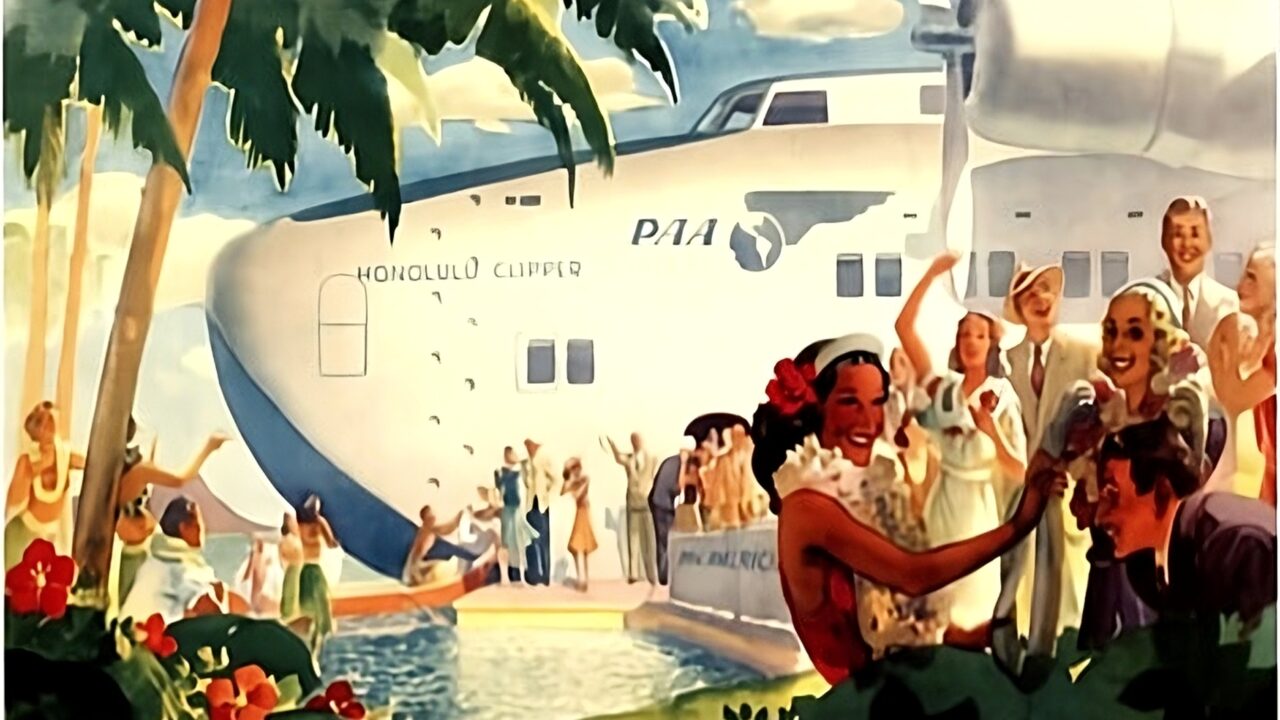
Pan Am has been gone for thirty-four years as of today, yet its imprint on Hawaii travel has never really disappeared. Pan Am was the first commercial airline to reach Hawaii, beginning service in 1935 with its famous flying boats. Those early Clippers landed on the water in Pearl Harbor, long before Honolulu had runways suited for transpacific landplanes.
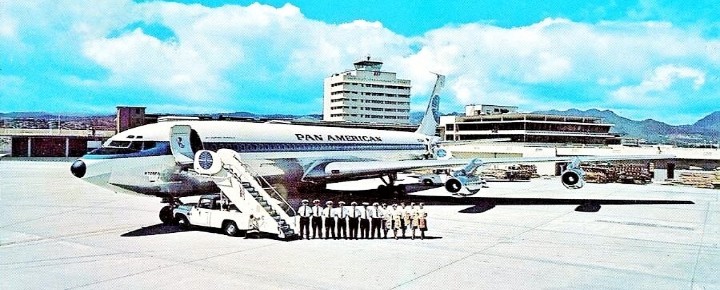
Pan Am ended its flying boat era in Hawaii in 1946, when the last Boeing 314 Clipper departed, and landplane service took over. The airline then used DC-4s and DC-6s at Honolulu Airport until jets arrived in 1959, transforming the entire Hawaii travel experience.
Even people who never stepped onto one of those blue and white jets still know what Pan Am meant. It represented the long-awaited dream of Hawaii, the elegance and anticipation of crossing an ocean, and that first moment of arrival in the air that felt warmer and softer and smelled different.
All of that was shaped more by Pan Am than any other airline. It still feels strange that something so central to Hawaii’s story in the jet age disappeared in a single December day, and stranger still how present it nonetheless remains.
The final hours of Pan Am captured the quiet ending of an era.
The last flight to touch down was PA436, a Boeing 727 named Clipper Goodwill, arriving in Miami after a run from Bridgetown with Captain Mark Pyle at the controls. It was a modest regional hop for an airline that had once spanned the world, yet the moment carried the weight of decades.
When that aircraft rolled to a stop, it closed the book on a company that had carried millions of people into their first view of Hawaii and helped shape how the world imagined these islands. The contrast between that simple last flight and Pan Am’s place in Hawaii’s history adds a poignancy that still resonates.
Pan Am collapsed under a combination of high fuel costs, heavy debt from the purchase of National Airlines, the reputational and financial fallout from the Lockerbie bombing, and the early 1990s recession. By the time it sold its most valuable routes just to stay afloat, the airline had nothing left to sustain itself.
For many visitors of a certain era, Pan Am was their first connection to Hawaii. It was often the airline that carried them on honeymoons, long planned family trips, and milestone journeys they had saved years to take. The comments we receive whenever Pan Am comes up are among the most vivid and heartfelt we see.
Earlier this year, readers responded strongly to Hawaii’s golden age of travel returning with Pan Am?, recalling flights that felt ceremonial rather than routine. In First Pan Am Hawaii flight changed the world April 17, 1935, their memories again underscored how different travel felt when Hawaii seemed farther away and more revealing.
Pan Am did not just connect Hawaii to the mainland. It helped shape early Hawaii tourism, when only a few weekly flights arrived, and Honolulu felt more like an outpost than a hub. The airport was smaller. The welcome was softer. People stepped off a plane into anticipation rather than congestion.
Even the airline’s advertising shaped how Hawaii was perceived, and it is striking how much of that early image still influences what people look for when they return decades later. That has changed with time. Today, dozens upon dozens of daily flights funnel into terminals that often feel strained and hurried. Hawaii remains extraordinary, but the emotional space around arriving here has shifted.
That contrast is part of why memories of Pan Am remain so strong. They are tied to a version of Hawaii travel that felt more open, slower, and more revealing than what visitors often encounter now.
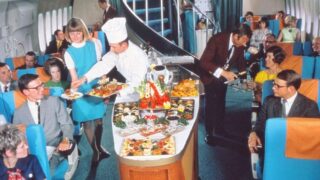
Readers told us exactly that in What was the last great Hawaii flight you remember?. Pan Am rose immediately to the top of the responses. Even people who flew it only once can still describe the look of the cabin, the uniforms, the meals, the service tone, and how it felt as the coastline appeared below the wing. Those memories have lasted far longer than the airline itself and continue to create a thread that connects generations of Hawaii travelers.
Hawaii was already changing even while Pan Am was still flying.
Tourism was expanding at a pace that worried many residents. Visitors were beginning to feel the crowds. Yet Pan Am sits right at the threshold of that transformation, where the older rhythm of travel was still present, and the modern pressures had not fully arrived. That is likely why memories of the airline carry such resonance. They are connected to a time when coming to Hawaii felt both monumental and uncomplicated, when the idea of arrival carried its own kind of magic.
The speed with which everything shifted after Pan Am’s final touchdown also left a mark. An airline that once symbolized global travel disappeared almost instantly. Hawaii moved into a new era of aviation and a new relationship with visitor volume, flight frequency, and infrastructure strain. The gap left by Pan Am was not simply logistical. It was emotional. No successor airline ever occupied the same cultural space, and the experience of flying to Hawaii gradually became something different. Many travelers still measure that change against what Pan Am represented to them.
Thirty-four years later, its presence still shows up in the comments you send us, in the photos you share, and in the stories passed down to grandchildren now making their own trips to Hawaii. Pan Am helped shape the earliest version of modern Hawaii tourism, and it continues to influence the way people talk about their connection to these islands.
Did you ever fly Pan Am to Hawaii, or do you have a story from someone who did? What stands out most for you about that era of travel and how it compares with today?
Get Breaking Hawaii Travel News


I have so many memories of Pan Am …my 1st flight to the US (Nice-New York) then buying a ticket to LA in the Pan Am building …many years later, a stewardess bringing my cats from Nice to New York (in 1st class) and my 1st flight to Hawaii in December of 1989 with my husband at that time. We flew business class and it felt like 1st class. They also gave us discounts for the Sheraton in Honolulu. And of course, there were plenty of pictures of Elvis at the International Market who had arrived on Pan Am back in the days ….We actually found out that Pan Am went bankrupt while on vacation in the Virgin Islands and Delta flew us to Puerto Rico. I didn’t realize then how much I would miss Pan Am!
Excellent article. Thank you from a former Pan Am flight attendant based in Hawaii, 1978-1982. I will always love Hawaii. Those were the best times of my 17 years at Pan Am—Mahalo nui loa.
Come back to Hawaii!
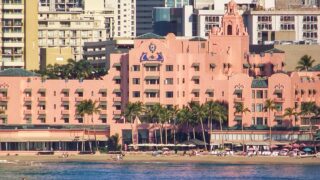
I was with Pan Am based in Hong Kong in Feb 1985. Pan Am re-enacted a flight done 50 years prior. The China Clipper. It went from SFO to HNL then Wake Midway Guam and finally Manila which was its final destination in 1935. We re-enacted the exact routing using a B747 aircraft and it was sold to the public. All aviation buffs. The plane stopped in HNL for 2 days and a huge gala was held at the Royal Hawaiian Hotel. The event took on political overtones in Manila as, at hat time, the Marcos’s (senior) were being hounded out by People Power. It was an amazing time !! Also, just about the end of Pan Am in Asia/Pac. The Pacific Division was sold to United Airlines.
Pac Day was 11 Feb 1986. The Marcos’s left for Hawaii soon after.
Much of this article reflects a certain long-after-the-fact “romantic” reminiscences of Pan American Airlines based on its connection with Hawaii and other exotic locations that Pan Am flew to.
That having been said, at least during its 15 years of more of its operation, Pam Am’s reputation was already sinking badly. For better or worse, my wife and I flew Pan Am only once back in 1975 and swore never to fly that airline again. We were on a non-stop from Rome to Idlewild (New York) on a 747 and experienced the worst pre-flight and in-flight service we ever encountered to-date or even since. Flight attendants & ground crew were surly, unfriendly, & acted as if they were doing us a favor by allowing us to fly with them. There was a terrible relationship between Pan Am employees and management which was very noticeable in the service or lack thereof in the cabin.
Very, very sad!
In 1978, I flew around the world using Pan Am 1 and 2. They were offering a program called “Around the World in 80 Days”. I chose the cheapest of 4 offerings, which was coach standby for $999. (For $1599, you could purchase reserved flights in first class.) I didn’t know how long I would want to stay in some places, so standby was my best choice. It wasn’t difficult to get gate agents to extend the 80-day limit, which I did twice. My last stopover was Honolulu in time for Thanksgiving, which I shared with a dozen other young people on the same ticket. There were many young Americans I kept bumping into along the way.
What a great trip, and a lifetime of awesome memories!
My best Hawaii flights were actually on Continental. They flew 747s from LAX and had a pub in coach class. Once you landed in Honolulu, for the next 30 days, you could fly to any neighbor island for $7.00 each.
I hated to see the demise of both of these great airlines.
As a longtime member of the Pan Am Historical Foundation, I have read about the first passenger flights of Pan Am to Honolulu in October of 1936.
The Clippers splashed down in Pearl Harbor and passengers deplaned in Pearl City.
They were driven to the Royal Hawaiian Hotel on Waikiki. The crew, however, were taken to a different hotel. Pan Am management didn’t want the passengers to see the crew smoking, drinking or carrying on with the cute hula girls.
BTW, any Pan Am personnel caught smoking or drinking in uniform was terminated.
The unofficial flag carrier of the United States. You can’t beat the experience: Pan Am.
Great article. As a long time Pan Am flyer I miss it to this day. The seats may be better on today’s US airlines but none of them come close to the in flight food and service up front that Pan Am offered.
To your point the purchase of National Airlines followed so shortly after by Carter’s deregulation of the airline industry doomed them. In retrospect perhaps not buying National Airlines and building their own domestic network would have saved them. But then airlines like Northwest ultimately failed as well, so who knows.
Thanks for the story.
My Mamma and Tutu told me so many times about travel from Honolulu to the West Coast aboard the Matson Lurline and Malolo. Then they would tell me about “The Clipper” and what a wonder that was. When we went aboard one of the first 747, I remember my Mom saying how it couldn’t compare to “the Clipper”. Pan Am holds fond memories for our family and we were sad to see it go. Same with Continental. My first personal remembrance is picking up family that came in on a Stratocruiser. We were in awe of the plane crew…the Flight officers so “official” and the Stewardesses were spectacular!