

You get all the way to airline checkout on your computer screen thinking you have finally finished the math for a Hawaii trip, and then the bag fees land on top like one final insult. Flights, hotels, a car, and then this. Clark Griswold (Christmas Vacation) had the right phrasing years ago: “It feels like a bag over the head and a punch in the face.”
Hawaii travelers know that feeling better than most because these are rarely quick or light little mainland hops. They are longer trips, often family trips, and the kind of trips where pretending everyone will live out of a carry-on stops sounding realistic quickly.
That is what makes the latest Alaska and Hawaiian increases feel less like news and more like industry confirmation. Every major carrier had already raised checked bag fees ahead of them. Alaska and Hawaiian Airlines were among the last holdouts, which made the move feel more inevitable than anything else.
The first checked bag is now $45, the second is $55, the third jumps to $200, and the old prepay discount is gone. The logic behind all this sounds familiar because it is: fuel costs, volatility, and broader uncertainty. The same rationale that normalized bag fees across the industry to begin with is still being used at this very moment. Instead of ever going down, they have only gone higher.
It started with oil and never left.
Bag fees entered the modern airline system in 2008, when oil prices were surging, and airlines needed new revenue without openly announcing higher fares across the board. Charging for checked baggage solved two problems at once. It brought in extra money immediately and let airlines preserve the illusion that the base fare was still reasonable, or at least competitive.
Once one carrier stuck its neck out and the sky didn’t fall, everybody else had permission to follow. American introduced a $15 fee for the first checked bag in May 2008, citing record fuel prices, and the rest of the industry followed soon thereafter. It has tripled since then.
What seems like it might have happened later never did. Oil did not stay at crisis levels forever. For example, it dropped sharply from 2014 to 2016. Then, 2020 wiped out demand and sent energy markets into more chaos. If checked bag fees had truly been a fuel surcharge in all but name, those were the moments when travelers should have seen some kind of relief. Right? They saw none. Brent crude fell by nearly 50% in 2014.
A cost-based surcharge that never comes down when costs do isn’t really a surcharge. It is just another airline revenue stream. There has never been a path back.
The fee became a Wall Street line item.
Airlines do not treat baggage fees as some minor side charge sitting off to the side of their business model. They treat them as part of the revenue architecture. It’s part of what analysts look at, part of what executives include in forward guidance, and part of what profitability expectations assume will continue.
That is also why politicians rarely get anywhere near this. Public anger is real, but the success of the fee structure does not rely on public sentiment.
Alaska Air Group’s 2024 annual filing reported $548 million in passenger ancillary revenue, a category that includes bag fees and other charges, and its 2025 report showed that 50% of the company’s revenue now comes from premium products, loyalty ancillaries, and cargo.
With numbers like that, rolling them back is not framed as corporate generosity. It is framed as a matter of giving up money. Alaska’s proxy statement says executive incentive compensation is tied in part to profitability and pretax margin performance, which shows how closely management is measured against the revenue and margin outcomes those fees help produce.
What Hawaii travelers pay that others don’t.
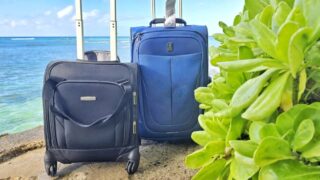
Hawaii travelers get hurt more because Hawaii trips are different than most domestic trips. They are longer. They involve families more often than not. They involve more gear, more clothing, and more stuff people talk themselves out of bringing on a shorter mainland trip. The fee may look like the same fee on paper, but the way it hits a Hawaii traveler is different.
A family of four flying to Maui and checking one bag each is now looking at $360 round trip just in first-bag charges. That is before anybody adds a second checked bag. Once even part of the group checks a second bag, that total moves into the $400 to $600 range.
This is where Hawaii becomes one of the most expensive domestic markets for baggage. Not because the fee itself is different from everywhere else, but because the shape of the trip makes it harder to avoid. Mainland travelers can sometimes decide to pack lighter and live with it. Hawaii travelers can say that too, right up until they actually start packing.
The workaround airlines love to point to.
Both a paid co-branded credit card or elite status can definitely waive the fees. But for most Hawaii travelers who make the trip once or twice a year, an annual card fee paid specifically to avoid bag fees is just the bag fee paid another way. An elite status that unlocks free bags requires more flying volume than what once-a-year Hawaii vacation travelers accumulate. The escape hatch sure exists. It just wasn’t built for everyone.
Inter-island adds another layer.
The inter-island piece does not drive the biggest part of the cost, but it adds more friction to a trip that already has plenty. Intra-Hawaii pricing and exemptions are their own thing, and Alaska and Southwest both have resident benefits that remain in place. Even so, Hawaii visitors know how easily an itinerary can split into separate tickets, separate check-ins, or separate baggage logic that stops feeling seamless the moment bag fees are involved. The system is designed to capture revenue at each step, and Hawaii itineraries often have more steps than most.
Why no politician or price drop will fix this.
There are always two comforting ideas floating around when bag fees spike again. One is that if fuel returns to its previous level, the fee logic will disappear with it. The other is that if enough people get angry, someone in government will finally force the issue. The problem is that both ideas have already been tested by reality and failed miserably.
Fuel has already fallen dramatically more than once without any change to these fees. Hawaii travelers have already lived through those cycles and got nothing back. Political pressure has surfaced repeatedly over the years as airlines piled on more charges, but the fee structure only grew deeper.
The latest round of airline fees is impossible to ignore.
Alaska/Hawaiian was the last of the major carriers to raise fees, following United, Delta, Southwest, and American, all of which did so this week. Being last didn’t mean being reluctant. It meant the industry had already established the floor, and Alaska walked straight on in. You can understand exactly why this will not change and still feel it the same way when you get to that final booking screen.
What would it take for you to actually change how you pack for Hawaii?
Get Breaking Hawaii Travel News



I was charged twice for the same baggage fee during check-in at Kona Airport.
The staff initially attempted to charge my first card, then told me it could not be processed and asked me to provide another card.
I followed the staff member’s instructions and paid with a second card, but later discovered that both cards had been charged.
I am still at Kona Airport, but I was told that the refund could only be handled by phone or email and was not given an opportunity to resolve it directly at the counter.
Please review the two transactions and refund the duplicate charge. I can provide receipts and credit card transaction records upon request.
With Atmos gold status and credit cards we have not paid bag fees in years to Hawai’i. Flying on United to St. Thomas I used miles for the fare and United card for the taxes. When I have done this on other airlines like Delta the fees were covered. Not on United. Airlines really look for ways to charge you more and United seems worse than others.
I certainly agree with the comment about people needing to learn how to pack. My wife and I did a 29 day trip to Australia, Indonesia, back to Australia then to Fiji packing only 1 carry on and a personal item. I had snorkeling equipment too and still had some unused clothing when I returned. Granted, we washed some clothes in sinks a couple times. We also did a 23 day European cruise/East Coast trip earlier last year with no checked luggage.
So if you have the Hawaiian Barclays credit card, do you still get 1-2 free checked bags?
I’d pack an even smaller carry-on bag but for the TSA 3.5 oz liquid rule. Yes, you can buy things like, say, mosquito repellent (see article on this site), but if you don’t use it all, you end up leaving it or throwing it out, which is a waste.
People really need to learn how to pack. I get amused every time I am at a luggage carousel and watch people pick up multiple bags per person for a 1 or 2 week vacation. We just returned from a 3 week vacation to Australia and New Zealand. We had one carry-on size suitcase (which we checked) and 1 small duffle for each of us. Only had to do laundry 1 time. Taking a couple of hours one evening to do laundry isn’t a big deal.
Your statement “an annual card fee paid specifically to avoid bag fees is just the bag fee paid another way” is nosense. A $95 annual fee for a card that gets you free checked bags for everyone on your ticket is a long way from the “$400 – $600” in checked bag fees you cite. Add on the bonus miles you can get for signing up for the card, which can be enough for 2 round trip tickets to Hawaiʻi depending on the card, and it becomes a no brainer.
My husband and I both get a free checked bag due to credit card perks. We usually only check a Sunday Golf bag since we fly carry on. We have laundry when we go to Hawaii, which is a big help- but, how much do you need to take? A bathing suit, shorts and a couple of T- shirts, a couple of dresses or Aloha shirt, undies, slippers, sandals or hiking boots and you are done!
If you have in room laundry facilities(i.e.. Condo), it is very easy to pack just a carry on for a week in Hawaii. If you have to visit a laundry, it’s almost too time consuming , and a waste of vacation time.
I concur with the first 3 posts so far……… People just pack too much. I see it with every relative or friend from the mainland who flies over for a visit. By the end of their trip they’re admitting they didn’t need so much and are sorry they brought it all.
I’m not sure how the airlines would react if every passenger all of a sudden started traveling light. Would fares or bag fares go down? Probably not but I’d sure like to test it. Imagine boarding a plane without the passengers fighting for overhead space or being able to quickly deplane.
When I started flying(1960s), the overhead bins were used for jackets, purses, gifts, booze, and just about anything that was light. All passengers checked their bags, no bag fees. Now it’s a complete mess. The airlines produced the mess when they added baggage fees. Now, it takes twice as long to board and deplane.