

Alaska Airlines just placed the largest aircraft order in its history, committing to 110 new Boeing jets with deliveries stretching through 2035. For Hawaii travelers, the headline is not the number.
One month ago, Alaska CFO Shane Tackett said Hawaiian’s A321neo fleet was “too few” to sustain long-term. It would need to “double that number or zero,” he said, calling the outcome “binary one way or another.” The path to doubling? “Today we don’t see it.
This week, Alaska ordered 105 Boeing 737s and five 787s in the largest aircraft purchase in company history. Alaska’s January 7 announcement focused entirely on Boeing aircraft and future deliveries extending over the next decade.
What it does not do is address the Hawaiian fleet it already owns. There is no A321neo mention, and nothing connecting Hawaiian’s narrow-body fleet to this aircraft order.
What Alaska’s CEO said on camera, and didn’t.
Ben Minicucci went on CNBC and listed Alaska’s hubs, including Seattle, Portland, San Francisco, Los Angeles, San Diego, Anchorage, and Honolulu, as he described the airline as West Coast-based. Hawaii was named in the same breath as the rest of the network hubs, but without the emphasis Alaska used when addressing us in Honolulu to announce the Hawaiian acquisition.
When the conversation shifted to growth and long-haul strategy, the discussion centered elsewhere. Minicucci described the global launch coming out of Seattle, with five international routes growing to twelve or more, and talked about European demand, Seattle loyalty, and nonstop flying from the Pacific Northwest. Honolulu did not come up in that part of the discussion as future plans were being described.
At this point, the question appears to shift from whether the A321neos fit Alaska’s plans to how long they remain in place and which aircraft eventually replace the routes they fly today.
This looks familiar if you remember Virgin America.
Alaska has been here before, and it was not even sentimental about it. After buying Virgin America, Alaska inherited another fleet of Airbus A321 aircraft that also did not fit its long-term direction. It then did what airlines do when they want simplicity and cost control: phase them out.
Alaska sold the Airbus aircraft to American Airlines and went back to a Boeing-only narrow-body operation. That history doesn’t prove what will happen next, but it does tell you what Alaska values when complexity meets rigorous cost control.
Hawaiian’s narrow-body situation may be even more awkward than Virgin’s, and it is small too. Hawaiian has 18 A321neos, and small fleets are always the easiest to declare as inefficient once the integration story moves on.
This is less about the airplane than the airline.
Hawaiian grew into an Airbus airline over time, and the A321neo fit naturally into that world. Alaska, by contrast, has always been a Boeing airline, and its largest fleet commitment ever reinforces that identity more than ever.
On paper, the A321neo and the 737 MAX 10 are very similar. They have similar flight lengths, carry similar passenger counts, and compete directly for the same kinds of routes. This is not about one aircraft being clearly better suited to Hawaii than the other.
What differs is where those airplanes sit operationally for Alaska. The airline’s future narrow-body flying is being built around the 737 MAX family, with common training, maintenance, and scheduling across a single fleet type. That’s good business. In that environment, the A321neos are not misfits because there’s anything wrong with them. They are misfits because they are part of a different system.
The widebody talk is Seattle-first, and that’s significant for Hawaii.
The five additional 787-10s Dreamliners were described as supporting international expansion from Seattle. In the CNBC interview, Minicucci discussed Rome, London, and Reykjavik, and framed the 787 as a key step toward Alaska becoming a fourth global carrier.
None of that is anti-Hawaii. It is just very clear where Alaska wants the long-haul identity to live and believes it can succeed there, including in branding, loyalty focus, and the growth narrative.
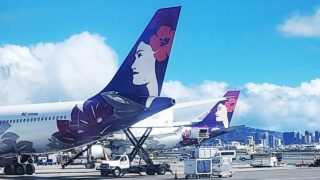
Meanwhile, Hawaiian still has 24 A330-200s sitting in the background, with retrofit promises pushed out to start in 2028, and no sense of urgency in that. Hawaiian also has 19 aging 717s for interisland travel that remain unresolved, and the longer this goes without a concrete plan, the more Hawaii travelers are left guessing what “investment” is supposed to mean in real planes, seats, and schedules.
Hawaiian’s A321neos are the outliers.
Nothing about Hawaiian’s planes or schedule changes will happen in the near future. The capable A321neos will keep flying, and the routes they serve will remain in place for now.
What changed is that Alaska deeply committed its narrow-body future elsewhere, using a different aircraft family and a different operating model. From here on out, Hawaiian’s A321neos are the outliers. They are being managed until the next announcement.
Replacement for that fleet may not arrive as an announcement about Hawaiian. It could show up gradually as aircraft get reassigned and routes evolve. That is how such transitions usually happen, and this order made perfectly clear the direction Alaska has chosen.
For those who have flown both Hawaiian’s A321neos and Alaska’s 737s, what differences matter most to you?
Get Breaking Hawaii Travel News




The last thing I want to fly on is a Boeing 737 max.
Just realize none of this is happening fast. Alaska will be getting a bump in 737 deliveries once the MAX-10 starts being delivered in 2027. This new order won’t result in additional deliveries until 2031. I wouldn’t be surprised to see some kind of deal to buy used 737s so Alaska can sell off the A321s sooner.
The announcement I’m really waiting for is what’s going to happen to the fleet of 717s. I’m betting those are larger in the mid of Alaska’s management as something that needs replacement. AS once had a large fleet of MD80s and they got rid of them in the early ‘aughts. It’s been a story here multiple times, for a good reason.
And, sadly, a nod to the pax & crew of AS 261 … May they RIP….
First Boeing has a huge back log for both 737 Max and 787-10, so unless Alaska orders get moved up it will take years for the change over to be completed.
Second I’m a pilot who’s flown on both A321neos and 737 Max on a flights to Maui I prefer the A321neos it sits higher on it’s landing gear which lends it a better landing craft in OGG’s unpredictable turbulent conditions. During our last trip to Maui on a Max we had to do a go around, because of OGG’s turbulence and Max’s short landing gear.
3rd I do prefer A321neos cabin layout over the Max, but the Max seems to have better wifi. We sit in the extra leg room seating on each plane which seems to be equal and some of the A321neos are starting to show their age, so unless I’m flying into Maui it’s a toss up.
This shouldn’t be any surprise, Alaska is headquartered in Seattle and that’s their main hub. Guess where Boeing is headquartered and where their main assembly plan is located? Yup, just south of Seattle. So it makes since that Hawaii is falling to the wayside and that Hawaiian Air was just a move to gain more flight territory when the real focus is on long haul international, not domestic flights. Sad, very sad.
Just a small aside, Boeing moved its corporate headquarters to Virginia several years ago, but 737 production is still in Washington.
Boeing is headquartered in suburban Washington, D.C. Not too long ago, the company moved its Commercial Airplane division back to Seattle.
You can be confident a company like Alaska Air Group doesn’t make multi-billion dollar decisions based on physical proximity.
Alaska’s strategy will virtually guarantee that Hawaiian’s A321s are replaced with Max10s. It’s a smart move that simplifies maintenance and operations.
Alaska’s focus on the bottom line helps indemnify them against the haphazard decisions that landed Hawaiian on the verge of bankruptcy. The only question is, will there be a dedicated sub-fleet in HA colors, or will it all be an all-Alaska livery?
Alaska Airlines has been pretty consistent that when all the dust settles, all the Hawaii service will be Hawaiian Airlines branded.
Like the previous comment, loved the L-1011 of the ‘80’s and early ‘90’s, First, which we’d take from LAX with Delta, before direct service from Sky Harbor. The A330 became our choice once Hawaiian began Direct service over American (America West & USAir) and their Single Aisle Choice, that also became Red-Eyes. To the 737 and A-321 Neo, understand the economic realization, but similarity generalities are convenient, but forced to make these choices since Covid, the A-321 has a larger First Class Cabin, more Room in Seat and Overhead, considerably better then the 737MAX. Tangent issue is the glitch where one has to commit to a Fare, before knowing whether or not one can upgrade to First! For myself, now a widower, it’s moot, after 95 Trips to Hawaii from ‘86-‘19.
Economize of scale did not favor VX’s 53 strong fleet of then present buses and New Engine Option stretches at Alaska, so one should not be too perplexed by the likely outcome disposition of this equipment type from HA in the merged entity.
Sure i would still love to fly aboard an L1011 Tristar to make an Island hop, but nostalgia doesn’t keep the lights on and times move on. Hawaiian has a beautiful history, and will continue to do so as its heritage is incorporated in to a sustainable enterprise and livelihood for its people.