
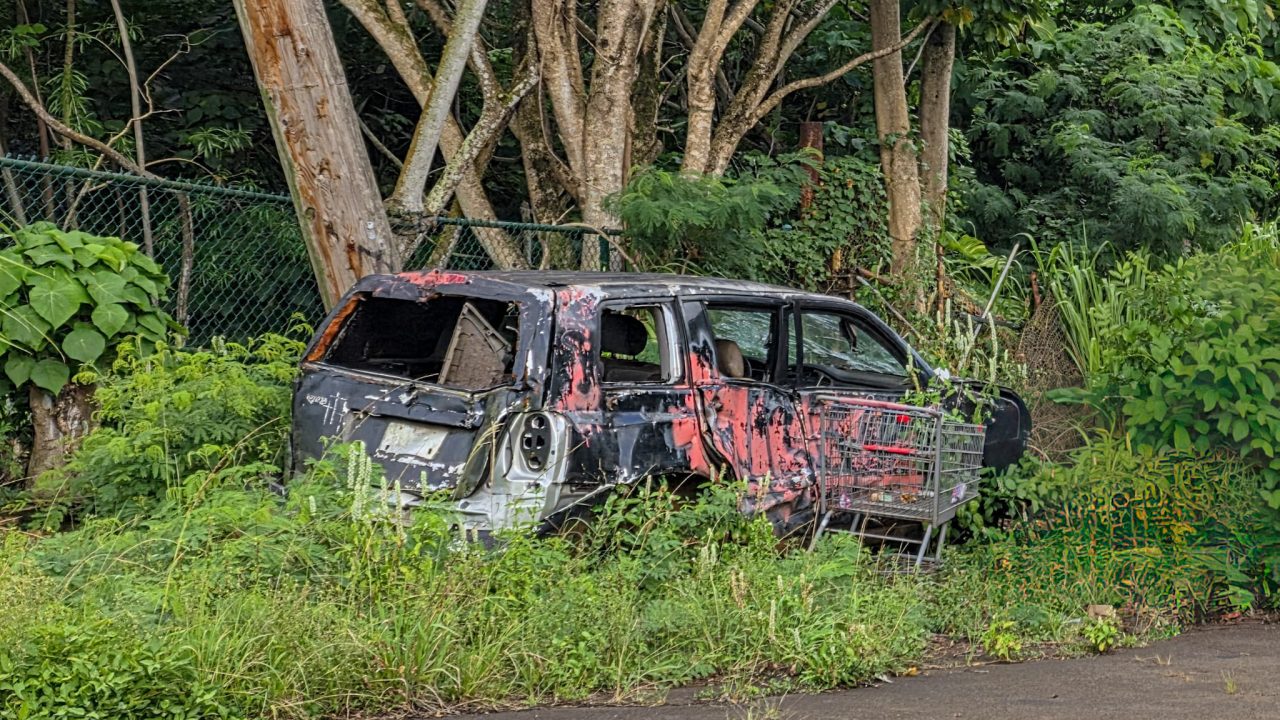
If you’ve driven around the islands, you’ve probably seen abandoned cars and wondered why they stay along Hawaii roadsides for so long. Our lead photo is a car we saw last night in Lihue near the Kauai County Building. Visitors have commented to us about seeing rusting sedans, pickups with flat tires, and SUVs slowly disappearing into the grass. Sometimes they appear to have been burned out. They clash with the scenery in a way that is hard to miss, especially for a visitor arriving expecting postcard-perfect Hawaii.
A Maui visitor recently wrote to us, puzzled by the same thing. On every trip, they said, they see twenty or thirty abandoned vehicles along the roadside and wonder why the county does not simply tow them, trace the registrations, and bill whoever left them there.
Here is the part that makes no sense at first. On some islands you can have a junk car towed away for free, and yet the roadsides are still lined with them.
Visitors have been asking us this for years.
The Maui reader who wrote was not the first, and will not be the last. We have fielded this same question from visitors across more than seven years of reader comments, and the pattern in it is part of why we finally went looking for the full answer and this article. The cars register with people who love these islands, and the not-knowing why has stayed with them long after the trip ended.
A reader named George put it as plainly as anyone, asking why the cars and old couches are not simply picked up and hauled away. Another, Gary, described the same burned-out vehicles sitting in the same spots six and twelve months later on return visits. A Maui regular named J pointed to the drive from Kahului to Lahaina, where cars sit half-hidden in the brush beside the highway and, by his account, have been there for years.
Some readers have tried to chase the answer down themselves. One named Fred wrote in to ask which law or county policy was responsible, after an almost-new car sat in front of his condo for three days and then was left in the middle of the night, towed by someone he never saw. That is the same puzzle we set out to solve, and the real answer has less to do with anyone not caring and more to do with how the system actually works.
It isn’t because nobody cares.
Residents see these vehicles every day too, and they are just as tired of them as visitors are. The cars are not left behind because local communities have stopped noticing them, or because anyone thinks they belong beside the road.
The real answer sits at the intersection of island economics, county responsibility, title paperwork, limited recycling capacity, and state law. Once we started checking into the process, the roadside mystery began to look less like neglect and more like a system that gets overloaded long before the car ever disappears.
Even free towing has not made these cars disappear.
You might think cost is the whole story, and on some islands the counties have actually removed it. On Maui and Oahu, a registered owner can have a junk vehicle towed and scrapped at no charge, which should in theory end the problem. Yet the dumped cars are still there, which tells you the price of disposal was never the only barrier.
The free programs only work for the clean, documented owner. They require a clear title that matches your ID, a vehicle junked properly at motor vehicles, forms filled out, and a DMV appointment. Many of the cars that get abandoned may have changed hands multiple times for cash without the title ever transferring, so the person holding a dead car often cannot prove it is theirs to junk, and the free tow does nothing for that situation.
There is also the matter of effort against the path of least resistance. Junking a car legally takes paperwork, DMV steps, and a scheduled pickup, while pushing a dead car onto a shoulder at night costs nothing and takes minutes. For some people who are simply done with a worthless car, the free option is more than they will do, even potentially at no cost.
Almost everything occurs at the county level.
Many people assume abandoned vehicles are a state problem, or that calling a state lawmaker should move a specific car. In practice, cleanup is handled almost entirely by the counties, which means the visible roadside problem depends on county staffing, towing capacity, paperwork, and access to disposal facilities.
In practice, a county police or enforcement officer tags the vehicle, and a county coordinator and solid-waste staff arrange the tow and disposal. Counties have restructured who does this over the years, but it remains a county job funded by county budgets.
The state did set one major rule. A 2018 law, Act 48, required counties to take abandoned vehicles into custody within ten business days, but county officials called it an unfunded Honolulu-centric mandate they could not fulfill without more money.
That explains why the answer is not as simple as “just tow it already.” The state set the deadline, but counties were left paying for towing, processing, storage, disposal, and staff time needed to meet it.
Why owners are often not billed.
The obvious follow-up question is why counties cannot just identify the owner and recover the cost. Sometimes they can, but Hawaii’s title and transfer gap makes that much harder than it sounds.
Cars may be sold several times without ownership ever being properly transferred. By the time one is abandoned, the registered owner in the county system may not be the person who last drove it, dumped it, burned it, or stripped it for parts.
County officials have said that unreported and fraudulent title transfers are a major reason cost recovery fails. That is why counties have long urged buyers and sellers to complete transfers in person at the Motor Vehicle Registration window, where both parties can ensure that the title actually does change hands.
There is also a property-line surprise element. Counties can act on public roads and public property, but if a vehicle sits on private property, even a few feet from the public road where drivers notice it (case in point, our photo), removal is generally the property owner’s responsibility under Hawaii law.
The system is even worse than it looks.
The fragility of the system showed in May 2026, when the main metals recycler on one island briefly stopped taking vehicles entirely because it had run out of capacity, and the county suspended free disposal and paused abandoned-vehicle processing entirely until this could be resolved. When one out of space facility can stall the entire pipeline, it is easy to see how cars stack up on Hawaii’s roadsides faster than crews can ever clear them.
What actually happens after a vehicle is reported abandoned?
Under Hawaii law, an abandoned vehicle is one left unattended for more than 24 hours on a public highway or unlawfully parked on public property. A derelict vehicle is one with major parts removed, material damage, or a condition that makes it inoperable.
Once a complaint comes in, the vehicle can be tagged, reviewed, and moved through the county process. Depending on backlog, location, condition, and available towing, the real timeline can run weeks, with disposal taking longer after the vehicle is finally removed.
On most islands, the endpoint is a single main metals recycler. That one-facility bottleneck is part of why the problem can get further backed up, especially when more cars enter the system than can be processed in a reasonable time frame.
Hawaii is penalizing owners, not clearing the backlog.
Rather than solving the problem only by funding faster removal, the state has shifted toward enforcement aimed at the accountability gap. Under current Hawaii law, owners with unpaid abandoned-vehicle charges can be denied vehicle registration, blocked from transferring ownership, and reported to the examiner of drivers, who can suspend, revoke, or refuse to renew a driver’s license.
Repeat violations can bring additional penalties. A third violation can trigger a $750 fine, and a fourth or later violation can bring a $1,000 fine, on top of towing, storage, processing, and disposal costs.
That approach may help close the loophole for people who can be tied to a vehicle, but it does not immediately remove cars already sitting on the roadside. It is a stick aimed at future behavior, not a tow truck aimed at every car visitors saw this week.
Counties also run prevention programs, letting registered owners junk vehicles at little or no cost. That is intended to make legal disposal easier before a car becomes a public problem.
So when you pass another abandoned car on a road in Hawaii, there’s a chance it has already entered a process slower than anyone wants. What looks simple is actually a tangle of island-disposal costs, title problems, property lines, recycling limits, and county capacity, all showing up in that one place that everyone can see.
Lead Photo: © Beat of Hawaii in Lihue, Kauai.
By Rob and Jeff, Beat of Hawaii.
Some of the most meaningful parts of Hawaii are the ones visitors walk right past without knowing they are there. We’ve spent nearly 20 years finding them firsthand for BOH as full-time Hawaii residents reporting on travel, culture, and island life, and telling you what they mean for your trip. Join us →
Get Breaking Hawaii Travel News





I spend a fair amount of time on The Big Island (yes, I said it), and the AV’s seen here are found mostly in the outlying areas, specifically along The Belt Road (Hwy 11) starting south of Captain Cooke until South Point Rd. I’ve seen AV’s at the Scenic Point near Hawaiian Ocean View Estates and also at the Scenic Point above Puʻuhonua o Hōnaunau. The last time we were heading down there we passed a fire truck heading up the hill. When we rounded the curve we came upon a smoldering AV in the Scenic Point parking lot. And then there’s Pu’uhonua Rd between Puʻuhonua o Hōnaunau and Napo’oo’o. Not just AV’s there, yard waste, household waste, demolition waste, appliances, you name it. Pathetic.
In my opinion, you have to consider the source. Some of it is pure laziness, considering all of these items, including vehicles, with some effort, can be disposed of for free (not free, included in your tax bill). Some of it is tweakers, out doing what they do in the wee hours.
As much as this annoys me in Hawai’i – I’ve been to a multitude of islands around the world and this isn’t exclusive to Hawai’i unfortunately…
One way ticket dreamers from the mainland. No USPS scanning, port enforcement, drugs, tweakers, grifters, homeless, cars. Almost in that order. State and county need to start at the top. This is an island state and if you had the actual resources stopping a lot of the nonsense from ever getting here the downstream affect would stop a majority of this. Rules are for rule followers…
In case you missed the memo, Hawaii actually is still a part of America so guess what, there are No border checkpoints between any of our states nor will there ever be. Of all of the many posts about this topic, yours is by far the most ridiculous one.
Typical of Hawaii and its incompetent government, and they complain about tourists ruining the islands.
When will they start taxing the tourists for this too?
I don’t believe that is the kind of encouragement the state’s leaders actually need. They just might take it as a challenge.
A related issue on Maui is cars with years-expired safety check stickers. I am guessing their registration is expired as well. I have seen such a situation on pickup trucks at our condo complex (trucks belonging to tradespeople) that are clearly still being driven. Is that not a ticketable violation?
On the mainland I once drove 10 minutes from home to get some snacks and got stopped for having an expired inspection sticker – just a few days over the deadline. I received a $20 ticket and points on my license that raised our car insurance cost. Has anyone ever heard of this happening in Hawaii? I sort of doubt it.
Actual explanation is far simpler: Hawaii is truly a 3rd world country that happens to have the US dollar as its currency. I’ve lived here 30 years and Nothing works. Not at Any level. Almost Anything that is run at the County level is “broken, dysfunctional, lazy, or incompetent.” The State level is slightly better (but not much). The Federal level is also broken, as it is in the rest of the country.
The neighbor islands have woefully inadequate infrastructure, and “County Planning” is one of the greatest oxymorons you will ever encounter. Tourism also just keeps getting worse and worse, but we don’t even have the infrastructure to support our residents. The Lahaina fires have also shifted a massive amount of tourism to other areas that simply can’t handle it. It’s no longer practical to go out to many restaurants because they either become too crowded and the prices have risen to “tourist levels”, pricing out many of the locals.
I’m surprised this comment got through….
Along those lines, go visit any Indian reservation on the mainland and report back. You’ll find the same thing there. What’s unique about Hawaii is that it is a top line tourist destination too.
You are absolutely right, but as I said in my post, consider the source.
Appreciate the article and I realize you are only reporting the “facts” but it all sounds like a whole bunch of excuses…..not our problem ie because the title pwork may not have been transferred; we can’t do it because county doesn’t have the money; the recycle plant can’t handle any more, blah blah blah. If it was an opportunity for the county to Make money they’d figure it out, but since it might be a dead expense (probably because they don’t want to hurt a local) nothing gets done. Btw I don’t think I see any locals commenting, only tourists mentioning what an eyesore it is. Keep voting the same people in office and see what changes Maui.
This abandoned car issue is just another symptom of Hawaii’s ineffective, self serving, toothless government. Unfortunately, it’s becoming another symbol of what Hawaii has become. ‘Do as I say, not as I do.
I’m not fully buying it, if there is a requirement to document sales an transfers then charge the original owner. This would ensure people properly transfer the tile rather than risk the fees. Or, just take any car for free and raise the taxes to cover that increase.
Every state has some version of this issue. However, I believe that the way Hawaii titles and licenses cars goes a long way to making this problem much bigger than it needs to be.
I own cars in three states. In two of the states I am the owner of the license plate regardless of what vehicle it is on. In Hawaii the plate stays with the car. So when I sell a car, in say Colorado, I take the plates off. The new owner must register the car to get a legal plate for it. They can of course steal a plate or use one found or previously used on another car. But, in any case other than registering their ownership they are breaking the law.
The Hawaii system is by far the easiest to game. And there doesn’t seem to be any negative consequence for those who sell a car without reporting the sale.
I have investigated complaint and looked into this insane abandoned car problem on these islands for years. There is a law that says you can have up to 200 ft.² of junk on your property. In what way does that have any common sense? I can’t stand it, told as a former mainlander I have an “impact” on these islands, yet junk cars are mostly the property of locals. You can’t have it both ways. It’s disrespectful and offensive to leave it for someone else to clean up. The whole system stinks. In a fantasy world, how about a delivery system to drop these cars into an active volcano and let them return to the carbon state they came from. Magical thinking!
“junk cars are mostly the property of locals”. Mostly?
I know there are a number of stakeholders who want a piece of the Green fee, but a rotting car dripping fluids should certainly qualify as an environmental problem. If the counties claim state mandated removal is unfunded, well, there is a funding source if the law allows or is modified. If a vehicle is on private property the counties should proactively be allowed to request permission of the owner to enter the property to remove only specific named items.
On Maui, the abandoned cars and the woefully inadequate infrastructure including roads tells the same story. People keep asking where the money goes because these basic maintenance items aren’t keeping up.
Clearly abandoned cars and old appliances should be near the top of the list of visible things to fix. Those, plus public restrooms and road repairs are key. Cleaning up what people already see and use would build more trust in Hawaii than most anything else.
Yes, Hawaii is such a contraction. It has abandoned cars, high prices, and plenty of problems. It also has extraordinary beauty.
Anyone with an abandoned car has resources to properly tow, including making time to do the DMV paperwork. Owners of cars that are not properly taken off the road by the owners should be fined and do community service. If finances are the issue then The DMV should provide additional paperwork for funds to address. You also shouldn’t be able to renew your driver’s license if an abandoned car appears under your name.
If Hawaii is going to collect visitor fees in the name of island stewardship, then people are rightly going to ask why basic cleanup like this still is so far behind. Abandoned cars are one of the first things visitors notice.
Take the drive from Kihei to Kahului and count how many junked vehicles you pass. It is embarrassing, especially in a place where tourism is everything and that talks so much about caring for the land.
As visitors we’ve gotten blamed for a lot of things, but are not the ones leaving refrigerators, tires, and these dead cars along the roads. That part of the conversation needs to be more honest and a solution needs to be forthcoming. Doesn’t anyone complain?
The abandoned cars and appliances are not being left by tourists, and most people know that. It’s frustrating for everyone, because it makes the islands look neglected even when many people are trying hard to keep them beautiful. This is a failure of the state and counties that should be addressed as a priority.
We had a neighbor actually dump a non-working car off the highway not far from their house. No current tags on it either, and since it is just off the highway by a few feet, no one seems to ever check on it. So it has been there easily two or more years. Wonder if this happens in other places, or just here in Hawaii.
When I was a kid in Connecticut, we often drove to NYC, and as soon as we crossed the line into NY State, we would see cars alongside the highway stripped of their wheels and much else. My father always said that’s what happened there when your car broke down and you had to leave it to get help.
From your article, though, I am guessing that there was something about NY State’s practices that encouraged this because we didn’t see stripped, abandoned cars in Connecticut.
I am also wondering why in Hawaii the abandoned cars don’t seem to get raided for valuable parts, like catalytic converters or such. Where we live in New England now, we had an old abandoned house down the road from us, and one night unknown people stripped and took away all the copper pipes from the house.
Maybe in Hawaii and on the islands there is no easy market for used car parts?
Michael abandoned cars get stripped quickly. In a 24 hour period on the North Shore of Kauai one year I saw the whole front clip taken off of a car that a young lady had left her because she ran out of gas. Fenders hood bumper the whole shebang. There is a huge market for used car parts just like there is everywhere.
This is a very easy solution. If any law maker or any resident truly cares about the island they will support my proposal. If you have ever traveled to Singapore you will see it in full force. When we register our vehicles year after year the cost goes down with an aging vehicle. Instead the cost should go up. The age of the vehicle will cost you. Every vehicle ownership should also be taxed yearly. If a vehicle is not operable then dispose of it appropriately otherwise you pay dearly to store it. Let taxation detour bad behavior.
Love taxing things, don’t ya Jane. I’m guessing no such thing as a bad tax in your view.
I don’t think most psople assume nobody cares. What confuses everyone is why registered owners or insurance companies or someone is not held responsible when a vehicle is just dumped. There are VIN numbers to check, and these trace back to somewhere and someone.
Drive from Kahului toward West Maui and you will see exactly what people are talking about. Some cars are half-hidden in the brush, but they have clearly been there a very long time.
I took have never understood why the counties cannot just pick them up and haul them away. Same goes for old couches, appliances, and other junk left where everyone can see it. Is this getting much worse or am I just noticing it more?
We’re very regular visitors. The burned-out cars really get to me. We have seen some of the same ones six months later, and then again the next year. How is that even possible when Hawaii is completely reliant on visitors?
We visit Maui often and love the island, but the abandoned cars are definitely harder to ignore. It always surprises us that something so visible can sit there trip after trip as though it doesn’t matter.
Another example of the Lazy work attitude of the Maui County workers. They get that pay check not matter what?
So how exactly is it the “lazy workers” fault? If they don’t get the work order to pick up a vehicle at the legal owners place or along the road why would they just use county resources to do something like that?
You obviously didn’t read the article. It’s the County of Maui ‘process’ that hinders quick removal of abandoned vehicles. Not the “Lazy work attitude” you speak of as most of the removal is done by private tow companies.