
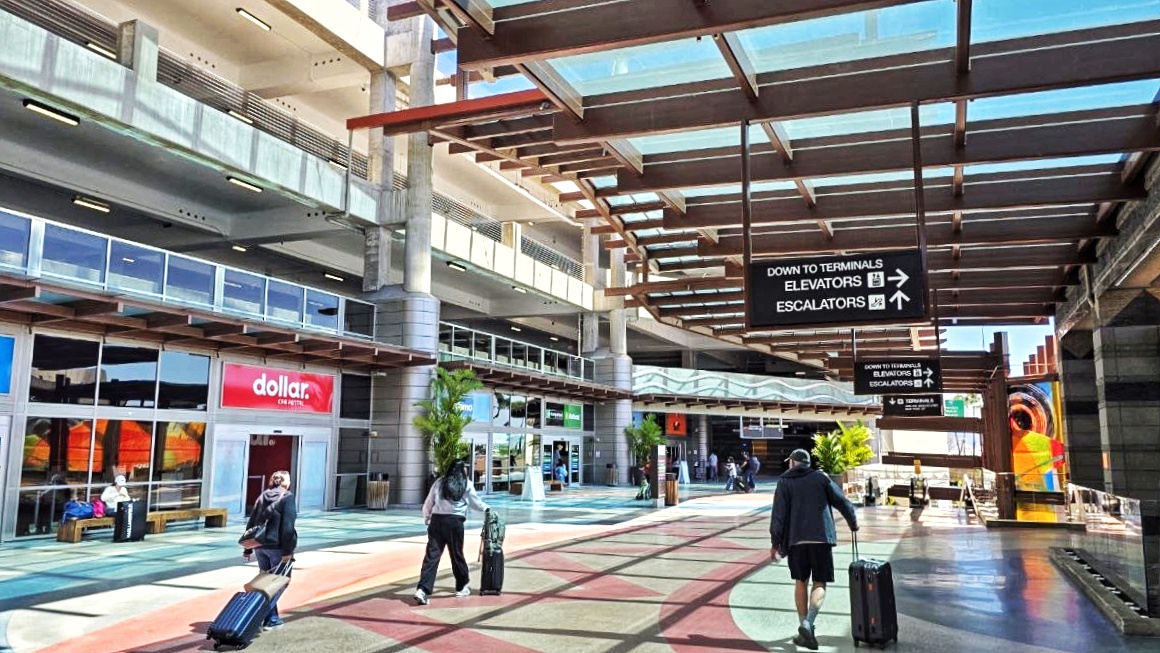
You do not need any reminder to know Hawaii’s airports have problems. Travelers have been dealing with them for years. It shows up in cramped gate areas, food that rarely lives up to expectations, baggage delays, tired ticket lobbies, and terminals that feel patched together rather than rebuilt.
None of that is new, and even the airlines themselves have complained about it for decades. What is new is that Hawaii has finally put a giant price tag on how much work has been deferred, stretched out, or only half delivered while visitors kept coming and fares kept climbing.
The state is now talking about nearly $7 billion in airport modernization through the early 2030s. That sounds huge because it is. It also sounds immediate, and that is where the plan starts to break down for travelers.
Most of what is being announced now will not materially change the airport experience this year. Much of it will not change next year either. In many cases, the dates that matter most to passengers will be in the 2028, 2029, 2030 time frame, and beyond. Hawaii is finally acknowledging how old, strained, and uneven its airport system has become, and the traveler walking through Honolulu, Kahului, Kona, or Lihue this year will still encounter many of the same frustrations that have persisted for decades.
Hawaii’s airports didn’t get this way overnight.
The announcement is not a fresh start, and seeing it that way is erroneous. This is what happens when years of delayed work, partial upgrades, and rising traffic finally come together into one giant cost number. Travelers know the symptoms even if they have never seen them in writing.
Honolulu can still move people through at a fairly massive scale, all while feeling worn down once you get past security. Kahului can feel crowded and dated at the same time. Kona still has charm because it is open-air, but charm stops being pleasing when the airport itself is strained. Lihue remains small enough to feel manageable until the whole thing clogs all at once.
That is why Hawaii’s poor passenger satisfaction results never felt surprising in our J.D. Power dead-last rankings piece. They simply put numbers on what people are already experiencing in real time. The terminals work in the narrowest sense that flights operate, people board, bags usually arrive, and the system keeps moving. But that is not the same as saying the airports feel good to use, or that they match what travelers paying Hawaii prices reasonably expect.
The state is now trying to answer years of wear with a decade of major capital spending. While that does not erase what Hawaii travelers have been experiencing, it decidedly confirms it.
What the $7 billion actually covers.
The number is large enough to create its own giant fix-illusion. Hawaii is not getting one clean, simple airport overhaul. It is getting a long pipeline of work divided across terminals, airfields, and supporting infrastructure.
The biggest chunk, or roughly $4 billion, is tied to terminal improvements. Another $1.8 billion goes to airfield work, including runways and taxiways. About $1 billion goes to ancillary projects that help airports function but do not necessarily directly benefit passengers. The schedule stretches from now into 2033. That tells travelers how quickly visible change will arrive. In a word, slowly.
Federal grants here will cover only a small piece of the total, about $520 million of the $6.86 billion package. The rest comes from airport revenues, bonds, airline charges, and costs that ultimately flow back into what travelers pay to fly here. Hawaii is not about to receive any free rebuild from Washington.
This is a system that pays for itself over time, with travelers in the cost chain directly, whether anyone says so or not. And while a $7 billion plan sounds like a rescue, the project list running for the next eight years suggests that visitors should continue to pack patience.
Honolulu gets the biggest work and the longest wait.
Honolulu is the airport most Hawaii travelers know best, and it is also the easiest place to see the split between what has been promised and what has actually changed over the years. The state’s largest airport handles a relatively huge volume and, in operational terms, often does it quite well. That has never meant the passenger experience feels polished, because more often than not, it doesn’t.
The current work in Honolulu runs years into the future. According to HDOT’s February 2026 project timeline, ticket lobby renovations are expected through 2027, the Diamond Head Extension plans runs through 2032, and Concourse E improvements continue through 2030.
Travelers have already seen this play out in the concessions story. Restaurant names get announced. Local branding gets rolled out. Then people walk through the terminal and find the gap between the press release and the airport they are actually standing in. That mismatch has become part of the Honolulu experience. It is not that nothing is happening. It is that the timeline and the visible payoff there have never seemed to line up in the way travelers would assume they should.
Honolulu can point to real operational success. Flights generally leave on time and the HNL keeps moving, yet the terminal experience still feels like a place where the cosmetic promises from the Department of Transportation outrun the physical reality of change at the airport.
Kahului’s progress is real, but so is the disruption ahead.
Maui travelers know Kahului as an airport that can feel tight, crowded, and tired all at once. That is not a new complaint, and the current project slate makes clear the state knows it and plans to change what it can. According to HDOT’s February 2026 project timeline, ticket lobby and baggage claim renovations are scheduled through 2028, and the outbound baggage system replacement runs through 2029. The entire airport’s cut-up and inflexible design has long been bemoaned by the very airlines that use OGG the most. And that isn’t changeable in any practical sense.
Then there is Maui’s Runway 2-20, a piece of infrastructure that has been in continuous use for more than 80 years and is heading toward major reconstruction. That is much more than just another maintenance line item. It is a big project with operational consequences, including a temporary closure. Public discussion has started, but the exact timing still has not evolved into something travelers can easily understand and plan around.
The work is real, and the need is obvious. The dates stretch out. And the disruption will be a big part of the story before the improvement arrives.
For Maui, that is the issue because Kahului is the island’s front door for visitors. When the ticket lobby is under renovation, baggage systems are being overhauled, and runway work is looming, travelers feel it directly. There is a long repair job coming on a system that people are already using at full speed.
Kona is still planning its future while patching the present.
Kona has always been a little different, thanks to its open-air layout, which gives it a unique personality many travelers still appreciate. It can feel more relaxed than Honolulu and more memorable than a sealed-up mainland terminal. That only goes so far, however, when the airport is under strain, especially in the heat, the weather, or during peak traffic.
The state has a $137 million terminal improvement program there running through December 2030. At the same time, the master plan update continues through 2027. That means Kona is still in an awkward phase of planning big-picture changes while also trying to manage the present airport issues for those travelers who are using it now.
The runway story captures that tension well. Federal money has gone into rehabilitation, including a substantial FAA grant, and yet cracking issues have remained part of the airport conversation. Travelers do not necessarily keep track of these repair phases, engineering issues, and funding. They see money spent and assume the problem should be over. When it is not, that erodes confidence.
Lihue may be the clearest example of what got scaled back.
Lihue is the airport that many Beat of Hawaii readers know in the most intimate way. It is also where the state’s ambitions already ran into public resistance and led to a subsequent retreat. Earlier master planning faced community pushback and was scaled back into a smaller optimization approach. That means Lihue now sits in a different category from the larger rebuild stories elsewhere.
The inline baggage system, one of the more practical upgrades that could improve operations, is not expected to be completed until June 2029. That is a long wait at an airport where congestion is not theoretical, and the footprint leaves little room for easy fixes.
Lihue airport may not be the one getting the flashiest transformation. Lihue is being optimized, not expanded or reimagined. For people who use it often, that is not a simple distinction. It is the whole evolving story.
Honolulu’s on-time record makes the airport problem harder to dismiss.
One of the strangest parts of Hawaii’s airport story is that Honolulu has been excellent at getting flights out on time, yet many passengers remain underwhelmed by the airport itself. Obviously, Hawaii’s weather sits centrally in that part of the story. And at one point in 2025, HNL posted more than 90% on-time departures and ranked first among large airports globally on that measure.
That should sound like evidence of it being a great airport, but it also shows that most airport rankings are incomplete when taken out of the bigger context. Honolulu can succeed in one way and still disappoint people in nearly every other part of the experience. Those things are not contradictory.
Much of this explains why this modernization plan is being met with less excitement than the state probably hopes. The airport works well enough to keep planes moving. It has not worked nearly as well at making the trip through the terminal feel easy, pleasant, or up to date. Hawaii’s airport problems have never been only about whether flights depart. It has been about whether the whole experience feels worth what people are paying to get and be here.
What travelers get now is not what the announcement implies.
The state has not announced a near-term transformation of the Hawaii airport experience. It has announced a decade-long list of projects built around work that many would argue should have been underway or finished long ago. Some of it will help, and some of it is badly needed, but none of that changes the timing problem.
A traveler coming through Hawaii in 2026 or 2027 is still likely to encounter many of the same conditions that have defined these airports for years. Any meaningful payoffs from many of these projects sit much further out than that.
None of this makes the work unimportant, but it makes the gap between the announcement and reality hard to ignore. Hawaii finally has a dollar number large enough to describe its airport problems honestly. What it does not have, at least not yet, is a reason for travelers to think their upcoming trips through these terminals will feel very different from the last one.
Have you been through Hawaii’s airports recently, and which one felt best, most improved, or most disappointing to you?
Photo Credit: © Beat of Hawaii at HNL Consolidated Rental Car Facility
Get Breaking Hawaii Travel News




Maybe the problem is simple. You can’t lay asphalt in hot weather because it won’t cure or harden in hot weather. The other flip of the coin is that nobody wants to work a night shift. Result poor runways and airport problems just linger on.
Lots of luck! The only way to make real changes at HNL is to partner with an Airline. SeaTac partners with Alaska Airlines which does design and construction and gets reimbursed. Take a look. Google “SeaTac Concourse c expansion” that will be opening very soon. So sad here!
Sounds like typical mis-managed bureaucracy, One-Party Rule, the Train from the west side, finely coming to reality, 50 years later, than discussions of bringing ‘Eyesore’ Light Rail to Waikiki, who’s getting paid resonates!
“Patience is a virtue!”
In Apr 2025, I recall sitting at the HA gate at HNL at 4:00PM local time and wondered why no nearby food or merchandise concessions were operating !! And sitting at the gate at OGG and looking around and feeling that the place looked the same as it did in 1986, but much more worn out !!
But there is hope. Back in 2014, then-VP Joe BIden equated New York’s LaGuardia Airport as “something in a third-world country”.
Now, 12 years after that comment and after an $8 Billion reconstruction, LaGuardia (LGA) is now considered one of the nicest, flyer-friendly airports In The World !! Meanwhile, JFK International, on the eastern end of Queens NYC, is in the midst of a $19 Billion (yes Billion $$$) reconstruction. Both airports are operated by Port Authority of NY/NJ, and the projects are funded by bonds and public/ private joint ventures.
HNL is a joke!!!
Hawaii Airports is a embrasment all the empty stores know food options but Buger king Panda a few Bars everthing close between 6pm 8 pm
Compare the websites of Westcoast airports to Hawaii. You see pride on the mainland, as they put their pictures front and center on each airport. Who runs Hawaii’s airport? Call and try to find out, and good luck…. It must be a person with no pride in what they do, simply collecting a check.
Seriously, how is anything about Hawaii’s airports finally getting fixed the least bit surprising when you have HDOT, a state agency that can’t even keep the roads across Hawaii in good shape, being in charge of the airports too! It is long past time for Hawaii to finally have an airport authority that is Only responsible for the management of the state’s airports!