
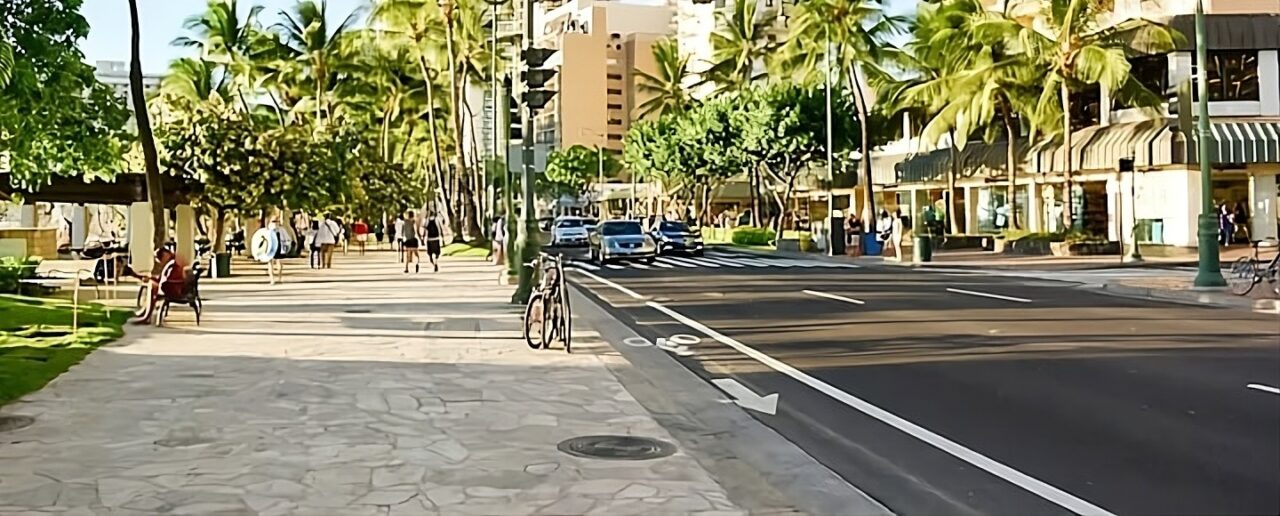
It has now been confirmed that a recent motorcyclist’s death marked the 60th traffic fatality on Oahu this year. That number is more than double the count at the same time in 2024, when the island had reported 29 fatalities. Behind the grim headline is a less discussed truth: many of these deaths, particularly pedestrian deaths, are not just tragic accidents. They are the predictable result of long-standing infrastructure neglect.
Hawaii’s sidewalk problem isn’t just about sidewalks.
We first wrote about this issue years ago, when the removal of a key crosswalk in Honolulu resulted in a pedestrian being struck by a car. That case led to a lawsuit, and while it made waves at the time, nothing changed.
On Oahu, sidewalks often disappear mid-block, and crosswalks are removed without any alternatives. Basic public infrastructure, such as lighting, benches, and shelters at bus stops, is either deteriorating or being deliberately removed.
In Waikiki, sidewalks away from the central area of Kalākaua Avenue can be so narrow that visitors with strollers or mobility aids are forced into the street.
On North Shore Oahu, Kamehameha Highway has almost no shoulder in key surf zones like Waimea and Pipeline, yet visitors still walk along it daily.
Here on Kauai, the situation on Poipu Road is particularly concerning, with no sidewalks in place between resorts and shopping areas. It becomes dangerous for visitors and locals to walk along the shoulder.
These are not isolated complaints. We reviewed recent comments received from hundreds of Hawaii residents and visitors about their pedestrian experiences. Most described it as unsafe, stressful, and at times humiliating.
What residents and visitors see every day.
Drivers honking at elderly pedestrians in Waikiki as they slowly cross Kalakaua Avenue. Visitors stepping into traffic to pass mopeds parked on the sidewalk near Diamond Head. Parents lifting strollers over broken curb edges in Ala Moana. Tourists stranded at TheBus stops with no seating or shade, unsure if they’re even in the right spot.
Visitors report struggling to find places to sit while waiting for buses along Kuhio Avenue, where seating has been removed entirely. Others describe needing to walk blocks out of the way just to find a legal crosswalk across Ala Moana Boulevard. These are not minor inconveniences. They’re the lived consequences of design choices that put cars first.
What happened to Vision Zero?
Hawaii adopted Vision Zero years ago, committing to eliminate traffic deaths. But the reality on the ground suggests that implementation has stalled. Residents report that intersections and corridors known to be dangerous have seen little to no change.
In 2020, Honolulu renewed its Complete Streets policy to improve pedestrian and bicycle infrastructure. But many of the promised upgrades never made it to visitor zones like Waikiki, Ala Moana, or resort corridors where thousands of tourists walk daily.
The sidewalk problem is not just about safety. It’s about equality. Those who rely on walking or public transit are often those who choose not to drive for a variety of reasons or cannot afford cars. Hawaii’s infrastructure increasingly tells them they are second-class citizens.
A deeper question about who matters.
Why has this issue persisted for so long? With 60 pedestrian fatalities already this year, Hawaii risks climbing to the top of this tragic list. Despite the urgency, safety improvements often come slowly, frequently only after preventable tragedies occur.
It took a fatality to get new striping and signage at some intersections. In other cases, residents have reported dangerous locations repeatedly for years without action.
Students from UH Manoa participated in projects earlier this year aimed at improving pedestrian safety, such as drafting updated signage and striping plans through the Pookela Fellows program. These efforts align with long-standing concerns: sidewalks that are too narrow or nonexistent, shaded bus stops replaced by open-air concrete pads, and routes made inaccessible for anyone using a mobility aid.
What could actually make a difference.
Safety experts have long emphasized that a few targeted changes could have an outsized impact: installing mid-block crosswalks in high-use areas, adding curb ramps and tactile paving, protecting sidewalks with buffers, and restoring shade and seating at bus stops.
Hawaii tourism officials may want to take note. For many visitors, especially those without rental cars, walking is central to their Hawaii experience, especially in Honolulu. When that experience includes dodging traffic, skipping puddles, or watching buses blow past both them and inaccessible stops, the aloha fades quickly.
The stories keep coming.
There are still no sidewalks in parts of North Shore resort zones, where visitors walk narrow shoulders next to speeding cars. In Waikiki, lighting is broken at key crosswalks. And at Ko Olina, some luxury properties are fenced off in ways that block historic pedestrian paths. It’s hard to ignore the pattern.
So we ask again: is Hawaii really safe for walking?
If you live here or have visited recently, we want to hear what your experience was like. Did you feel safe as a pedestrian? Were sidewalks and crossings easy to navigate? Did you notice improvements or feel like things have gotten worse?
We know this isn’t just a Honolulu issue. From Hilo to Lihue, the gaps in this critical infrastructure are everywhere. Let us know in the comments below.
Get Breaking Hawaii Travel News



I am born and raised here and let me say that I am lucky to be alive because I have been nearly struck by vehicles in Hawaii crosswalks more than I can count. Now that I’m a mom of 4 children it is even more concerning that we all risk our lives every day just to cross a street. It’s really just a bad combination of people first of all not caring enough or being aware to stop their car for a pedestrian. Because ultimately driving a vehicle is a big responsibility and quite frankly people are not taking it seriously. Yes, pedestrians must also use proper road etiquette…but c’mon people…where is the aloha? Where is the common sense? And courtesy? Stop rushing and taking lives! Do you think I carried my child for 8 months, gave birth and raised them all these years, just so one ignorant human being who could have taken 10 more seconds to stop and look for a pedestrian, would take my childs life in seconds? We cant even walk without feeling like we could die today!
The reason for the removal of the benches is probably because of the homeless situation. All you have to do is to walk along Kuhio for example, and you’ll see the remaining benches turned into beds, ad hoc storage units, and waste bins…
Best Regards
This issue extends to private property as well. We live in Kona and now very rarely venture into down town due to the onerous parking situation – an issue for another story.
But recently we did park in the only public lot near the pier and visited a shop and a nearby restaurant for lunch. Most of the businesses opposite the sea wall have steps at entrances and business courts that have such steep steps and many lack any sort of handrails. None of these are any where near code. We have little interest in going back and our tourists are not likely to consider this part of town “quaint” as opposed to rather run-down.
Every year I visited Oahu I heard sirens and then experienced medics attending to some pedestrian that got hit in a crosswalk. Even 55 years ago. It was a daily issue. Returning back years later nothing different. Closed sidewalks, scaffalding, construction zones with a fenced off sidewalk etc. IMO anything that improves safety costs money which Hawaii never parts with. Somehow you see this is a pattern as parks,restrooms, and public areas are all run down and poorly maintained. It’s all about enter at your own risk and travel about at your own risk. I just found the answer of don’t trust cars and watch twice before entering crosswalks plus be double cautious. Blame the tourist because that is how Hawaii see’s it all the time.
This article powerfully exposes the dangerous neglect of pedestrian infrastructure in Hawaii, turning tourist experiences into constant hazards. It’s disheartening that basic safety and equality seem so out of reach, especially with Vision Zero goals. The lack of action is inexcusable.
This is a massive failure of county government and zoning commissions. Failure to require sidewalks with any new development should be mandatory, and sidewalks need to be retroactively installed on properties previously developed without them. We need to hold our elected leaders accountable. If they don’t fix this, they need to be replaced by those willing to take on the challenge.
Walking infrastructure in Waikiki has long been controlled by street/sidewalk adjacent businesses trying to push potential customer traffic onto their properties. Sidewalks literally leave public property in places, the sidewalk right of way is obstructed or planted over, and pedestrians are forced onto private property. Not only does this extend transit in those areas for people just trying to take the shortest route from Point A to Point B, those walkways on private properties are First Amendment fee zones: no posters, demonstrations, etc. The City, Waikiki Business Improvement District, and the businesses are all complicit.
You nailed it: design is policy. If we can make room for car rentals and ride shares, we can make room for people on foot.
We thought our Waikiki hotel was walkable to restaurants etc. It was, technically, but we ended up having to walk in the street half the time because of blocked sidewalks and scaffolding. Felt really unsafe and unpleasant.
It’s worth on Maui. We have very few sidewalks and they are usually not maintained. Most are near golf courses and resorts and I don’t understand why they wouldn’t contribute to keep their guests safe. Regarding the local population in Maui, most love their trucks and SUV’s more than sidewalks. That alone is insane (literally).
“Local population” SUV driver on Maui here. I drive an SUV as it’s more comfortable for my drive from Upcountry to Lāhainā and back. I did not know that it was my responsibility to install sidewalks on Maui. Thought that was either the State or County’s responsibility with my tax dollars?
We traveled with a baby stroller and it became a literal obstacle course. I love Hawaii with all my heart, but I’ve never felt more invisible as a pedestrian in Honolulu.
Before the Kukui’ula project was built on the south shore of Kaua’i, it was mandated that they install a sidewalk from the shopping center to Koloa Rd along the new western bypass road. Soon the sidewalk was installed from the shopping center to their main entrance but never continued all the way to Koloa road. It was scary watching kids on bicycles, strollers and wheelchairs, and walkers/joggers on the shoulders of a fairly main road. Eventually I started repeatedly calling the mayor and a couple of county council people that I knew, and said a group of us were going to write letters to the editor etc. if things didn’t improve. Shortly thereafter, Kukui’ula installed the other half of the sidewalk from their project all the way to Koloa Rd! I don’t know if tourists’ complaints would make an impact, but hopefully voting locals will if they are persistent enough.
This is a long overdue issue that needs to be addressed. Hawaii spends millions courting tourists but can’t put in a curb ramp at an intersection? Priorities.
I’ve been visiting Waikiki for decades and the walking experience is definitely worse now. No shade, no benches, and way more traffic stress. It’s not just an eyesore and it changes how the whole trip feels. Please fix the sidewalks!