

In a grainy image, a man appears to stand behind a tree on a narrow Hawaii ridge on Oahu—barely visible, yet impossible to forget. Even ten years later, that “shadow man” still haunts online forums and Hawaii, and the hiker who took the photo has never returned.
Eighteen-year-old Daylenn Pua texted the picture to his grandmother while hiking toward the Haiku Stairs (Stairway to Heaven) on Oahu ten years ago. It was supposed to be an adventure. Instead, it became the last thing anyone heard from him.

This spring, that photo resurfaced again in both social media and in stories across Europe where people asked us about it, reigniting speculation—and exposing just how little most people know about the place hidden behind the haunting picture.
The trail was already long off-limits.
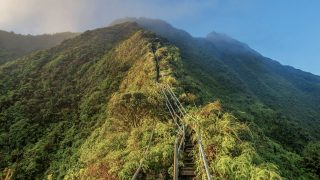
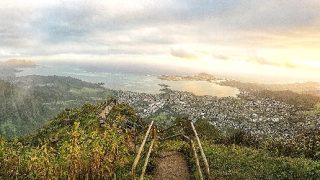
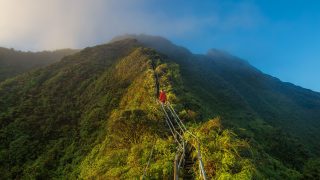
The Haiku Stairs, where this happened, weren’t just remote. Even then, they were illegal to access. Built by the U.S. Navy during World War II, the nearly 4,000-step staircase ascends the Koolau range to an abandoned communications facility. Though officially closed since 1987, the trail developed an unending cult following online. The city of Honolulu began final removal efforts in 2024, but lawsuits quickly stalled the process again. As of today, most of the stairs remain off-limits, patrolled, and yet very much intact.
Pua didn’t enter via the stairs themselves. Instead, he chose the longer, steeper Moanalua Ridge approach. The route is grueling and dangerous, with narrow drop-offs and sometimes fast-changing weather. Despite clear no-trespassing signs, hikers continue to risk it—some for the views, others for the Instagrammable, social media proof.
The viral mystery that keeps resurfacing.
When the photo emerged, Pua’s family publicly pleaded for the man in the frame to come forward. But no one ever did. Honolulu Police never named a suspect, and official search efforts concluded with no recovery. Fellow hikers on the ridge that day reported hearing screams—one even recalled calling 911 after hearing someone yell “help me” as the wind briefly died. And still nothing.
Over the past decade, internet users have repeatedly returned to the story, searching for new clues. Some claim the image was altered. Others believe it’s a paranormal encounter. However, Hawaii residents familiar with the area see something else: a tragic pattern of risk, curiosity, and disregard for real danger.
The cultural cost of going viral.
Stories like this don’t just live on Reddit—they keep spreading. And when they do, the details get flattened. Haiku Stairs isn’t some abandoned amusement park ride. It’s part of a living island, with fragile ridgelines, decaying infrastructure, and deep meaning for those who call it home. In Hawaiian tradition, the land isn’t just scenery—it’s alive and has meaning.
“This isn’t a haunted house you sneak into for thrills,” one reader wrote after seeing the story go viral again. “It’s a real place with real history. People need to stop treating it like a dare.”
Social media has turned stories like this into digital folklore. But the clicks and theories come at a cost. For every “shadow man” post, there’s a family that never got closure. For every trending trail, there’s a rescue team searching steep ridges because someone thought the warning signs in Hawaii didn’t apply to them.
What travelers should know now.
Hawaii has breathtaking hikes open to the public and maintained for safety and access. Before setting out, use trusted tools to know where you’re going. Check sites including AllTrails and Hawaii Department of Land and Natural Resources trail maps. Stick to approved and legal routes, go early in the day, check the weather, and tell someone where you’re headed.
If a trail is closed, assume there’s a good reason. If residents are warning you away, listen. And if a trail is only “famous” on social media, that’s not a recommendation—it’s a red flag. The photos might be stunning, but they don’t show the rescues, the injuries, or the people who never made it back.
The Haiku Stairs still stand—and so does the risk.
As of 2025, the stairs remain in legal limbo. Last year, a court halted complete removal, allowing only the dismantling of dislodged segments. The city continues to argue that the stairs pose a liability and security burden, while preservation groups call for restoration, managed access, and cultural education.
That standoff has left the trail in a gray zone—physically present but definitely officially closed. Fines for trespassing remain in place. Enforcement is real, but so is the persistent pull of the forbidden Haiku Stairs.
While these stairs may not be on your travel map, they’re definitely all over social media, and that makes them seem more accessible than they are. The myth is stronger than the facts.
What Hawaii remembers that social media forgets.
To most people online, the “shadow man” is a creepy detail in a viral photo. But it’s not a meme here in Hawaii—it’s a real loss. One of many. It’s not a puzzle to solve or content to reshare. It’s what happens when curiosity wins out over caution, and when people forget that the islands aren’t here solely for their entertainment.
Pua’s disappearance doesn’t need another theory but rather should be remembered. The best way to do that is by respecting the places that have already given too much.
The story that really matters.
Ten years after he vanished, the photo still circulates. The stairs are still fenced off. And hikers still ignore the warnings. The shadow in the trees remains a mystery. But the story that matters isn’t the one in the photo—it’s the one Hawaii’s been trying to tell all along: respect the land, and remember the lives it holds.
Photo Credit: Crimestoppers Honolulu.
Get Breaking Hawaii Travel News



“The city continues to argue that the stairs pose a liability and security burden, while preservation groups call for restoration, managed access, and cultural education.”
The stairs should definitely be dismantled. The liability and security burden overwhelms the so called “managed access” and “cultural education”. I find it funny that some groups find something that the U.S. military built to be “cultural”.
Enough already. Just take the rest of it down, return the area to its natural state.
What I find interesting in the photo is, or am I imagining it, does a face appear in the black rock below the man’s shadow?
Mahalo nui for the article. Pray that people, tourists and locals, take it to heart.
Thank you for writing this touching, cautionary tale. I still remember talking with Moke Boy’s family and how they waited there, allowed to stay in the park, for news of their family member that never came. This article brings home a good point that the land is alive and so is the sea. Having a healthy respect for both is absolutely necessary.
Somebody knows something. Mysteries that never get solved in Hawaii are just weird. And there are too many of them.
I’ve been up Moanalua Ridge and it was intense. You can definitely see how someone could slip or get lost fast. Who knows. Weather changes in minutes there too. Sad story.
I don’t believe in woowoo, but something about this one just feels… wrong. I hope at least his family found some peace.
People don’t realize how dangerous some of these hikes are. Even the legal ones can be treacherous. There’s are reasons the stairs were closed.
That “shadow man” figure has fueled so many theories online over the years. But none of them explain why no one has ever come forward. It makes you wonder what else that photo captured.
I still remember when this story first broke. Something about that photo gave me chills. I’ve hiked near that area—never the stairs—and it really stayed with me. It’s not just a hike. It feels like something more.