
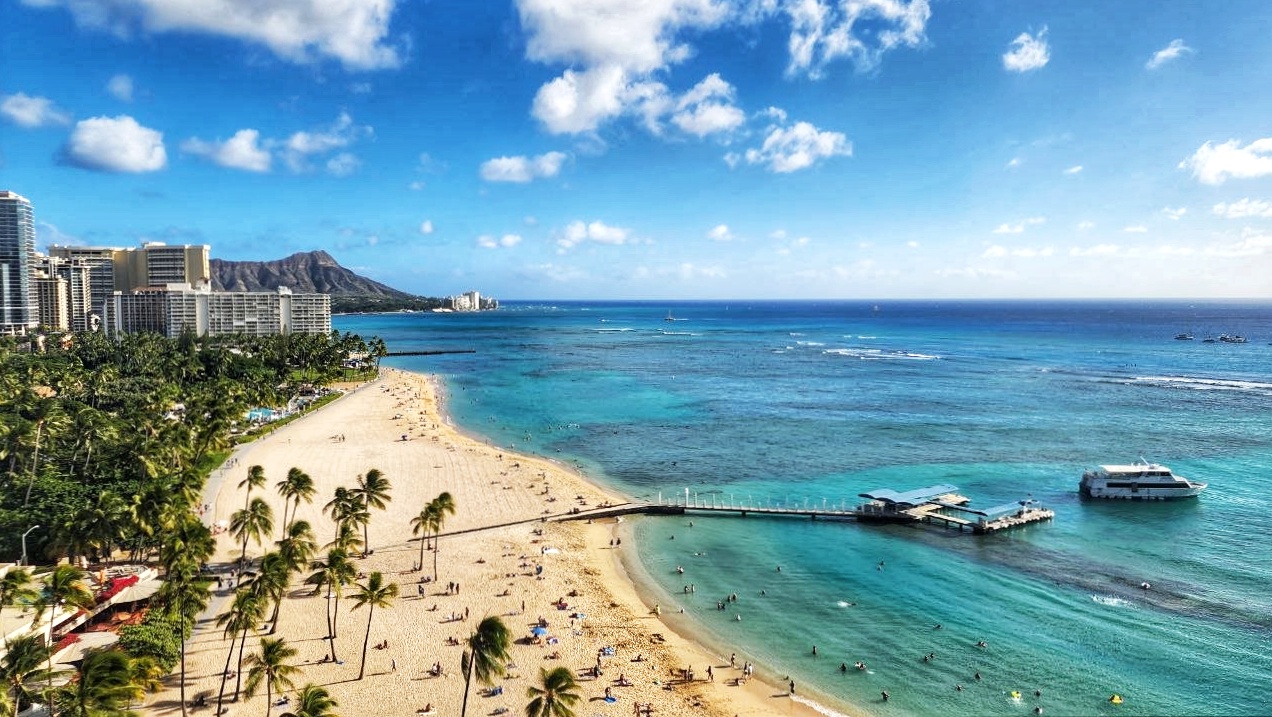
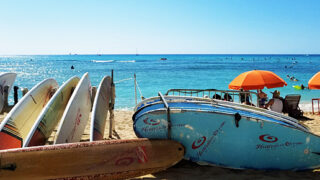
The stretch of sand fronting Hilton Hawaiian Village and Hale Koa Hotel (pictured above) is said to be the most photographed beachfront in Hawaii. It’s the postcard view millions of visitors picture when they book Waikiki, and it’s where guests at two of Oahu’s best-known properties step out of their towers expecting Diamond Head, palm trees, and clear sand.
The Hale Koa Hotel is an Armed Forces Recreation Center (AFRC) resort. Its next-door neighbor, Hilton Hawaiian Village, is the largest hotel in the islands and the largest Hilton resort in the world.
We’ve written before about what Hilton Hawaiian Village gets right and what it gets very wrong, which is a different story, but the beach in front of it has become its own situation. In recent weeks, paying guests have been reporting something else outside their lanais: tents pitched directly in front of their hotels, lining the beach in both directions.
Last week, on May 1, seven agencies conducted a coordinated evening sweep. One day later, a hotel guest wrote that the tents were still there. For travelers checking into Waikiki, the question isn’t whether enforcement happened. It did. The question is whether it changed anything visitors actually encounter when they walk from their room toward the beach.
The enforcement happened, then another guest complaint arose.
The multi-agency operation took place from 5:30 pm in the beachside areas of the Hale Koa Hotel and the Hilton Hawaiian Village. Honolulu police described it as a joint operation responding to safety concerns and illegal activity in one of Waikiki’s most visible visitor areas. The two properties share a continuous stretch of beachfront, so what one set of guests sees in front of their hotel is part of the same space as what the other set sees.
In reviews posted the next day, it was reported that tents were still directly in front of Hale Koa and that several more were visible in both directions, including toward the Hilton Hawaiian Village beachfront. The commenter wrote that, from their perspective, local law enforcement was not addressing the situation. That is one guest’s report, not something we could independently confirm. The timing, however, stands out, with less than 24 hours separating a seven-agency evening operation from a guest writing that the beach in front of his hotel had not changed.
The story is that multiple agencies moved in, arrests and citations followed, and a guest staying there described the beachfront as if nothing had changed, even the very next day.
The May 1 police operation brought agencies together.
The May 1 operation involved the Honolulu Police Department, DOCARE, DLNR, the Department of Taxation Criminal Investigation Section, U.S. Army Military Police, Hale Koa security, and Hilton Hawaiian Village security, according to the Honolulu Police Department’s report. That’s a broad lineup for what was a two+ hour evening operation.
HPD reported contempt arrests of three suspects connected to five outstanding warrants, one peddling citation, and seven parking citations during the operation. DOCARE and DLNR issued six camping warnings, one peddling warning, seven peddling citations, and one citation for allegedly offering for sale undersized opihi. The Department of Taxation Criminal Investigation Section also took action in connection with an ongoing fraud investigation.
The detail shows this wasn’t just a visual cleanup or a hotel security response. The sweep involved warrants, peddling, camping warnings, parking citations, and even the sale of seafood in violation of rules.
Waikiki enforcement is more complex than most visitors realize.
To a visitor walking from an expensive hotel tower to the beach, this part of Waikiki looks like one continuous resort corridor. In reality, it’s split among agencies and property lines that don’t all align, in contrast to what guests expect to see from a lanai or beach chair.
DLNR controls the actual beach zone. The U.S. Army Garrison Hawaii controls the beach-walk connection toward Kalia Road. The City and County of Honolulu handles other portions nearby. HPD, DOCARE, military police, Hale Koa security, and Hilton Hawaiian Village security all have responsibility for various pieces of that very same visitor-centric area.
That’s likely why the single operation involved so many players, and why enforcement in Waikiki can look very strange to visitors when tents, peddling, public safety concerns, and hotel guest expectations all collide in the same narrow space of Hawaii’s most iconic beach.
Most visitors don’t arrive expecting any of this. Then they see the ocean, sand, hotels, tents, and assorted officers, all in the very same picture.
April reviews had already raised the issue.
The visitor review after the operation didn’t appear to be an isolated incident. Earlier visitor complaints in reviews and emails we received from April had already pointed to a visible shift in what some area hotel guests said they were seeing along this beachfront.
For example, one review indicated that this was the very first year these visitors had seen tents lining the beach in front of these high-priced Waikiki Beach hotel rooms. The original wording was sharper than what we’d choose to repeat here, but the substance was clear enough: the guests felt the beachfront view and arrival experience had changed in a way that was shocking and was clearly something they hadn’t encountered on prior visits.
Another review last month reported a broader pattern of safety concerns, including open drug use and another incident involving one of the resort pools. Those are guest claims we are hearing. They are part of the visitor-facing picture because they show how this impacted some guests beyond just appearance or aesthetics. BOH will be back on the scene at Waikiki shortly for more first-hand reporting on this.
For travelers paying high Waikiki resort rates at beachfront properties, the difference between a managed public space and a visibly stressed one, unfortunately, quickly becomes part of the Hawaii vacation story. It affects where people walk, whether they feel comfortable with family, and how they describe Waikiki after they get home.
The recent operation doesn’t answer the question of what’s next.
The May 1 operation proves that local agencies can coordinate around this incredibly important beach corridor when enough pressure builds. It doesn’t, however, indicate that the area has changed in any lasting way, and officials haven’t publicly confirmed any sustained pattern of follow-up operations.
These distinctions are important for visitors arriving now. The confirmed facts are that an enforcement operation occurred, arrests and citations were issued, and guests subsequently reported that tents were still visible directly in front of Hale Koa and in both directions, including toward the Hilton Hawaiian Village.
What we can’t yet confirm is whether the area has remained cleared, whether additional operations will follow, or how this will affect visitors to Hawaii checking in and their experiences.
The uncertainty is part of Waikiki’s changing reality. It remains Hawaii’s most famous visitor zone, and at the same time, it’s a dense urban beachfront where public access, enforcement, homelessness, military land, luxury resort expectations, and visitor comfort all converge in the same small space.
Many residents already skip Waikiki for other beach days. Yet visitors do choose Waikiki precisely because they expect the opposite: easy access, predictable walks, safety and security, and a beachfront experience that feels managed.
The May 1 operation shows that the system at Waikiki can respond. If you’ve recently stayed near Hale Koa, Hilton Hawaiian Village, or Fort DeRussy, what did you see along this iconic beach corridor?
Did Waikiki feel different from prior trips, or was this just part of the broader reality of staying in an urban beachfront area, no matter how renowned? We invite your comments below.
Lead Photo Credit: © Beat of Hawaii showing beaches fronting Hilton Hawaiian Village and Hale Koa Hotel.
Get Breaking Hawaii Travel News


Welcome to Hawaii where nothing is as it seems!
We were at the Hilton Hawaiian Village in mid-April, and there were multiple tents stretching down the beach from the HHV to past the Hale Koa. We’re also retired military, and have talked to multiple military families who visit regularly. Just after we left a Hale Koa guest reported that a woman was struck by a homeless man, another homeless man was sleeping in the bushes next to the Barefoot Bar on the Hale Koa property, and that a child had stepped on a used needle in the sand. These reports were covered in the Hale Koa military family website that we follow. We usually come back in October, but are seriously reconsidering. We’ve never seen this before this year. Our son lives there and said there are many encampments on other beaches. Please Honolulu-don’t become Portland.
Lee, for years – and it may still be going on – Hawaii gave homeless one-way passage to Portland, Oregon. It was (still is) a slap in the face to Oregonians that exacerbated the crisis you refer to. I was on a flight where two policemen escorted a homeless person on to the plane and sat him in an open seat next to Me just before takeoff. Sitting next to someone who had not showered in a while was no fun. Hawaii could afford to do this. Would be interesting to know if it still happens.
Remember a year ago tents were a problem around the circle Hotel and in back of the police area bathrooms and the city imposed some you can only reside on the beach from 8:30 am until 7 pm and no overnight camping. Now it’s at the other end. The problem never got fixed until video went viral. Don’t Hawaii claim beaches are public and not property of hotels? Residents claim the beaches should be public. How do you know these tent dwellers aren’t paid actors by the state to discourage tourists from using the beaches? You can’t visit North Shore freely with the new tourist control system and now this kind of system to control Waikiki beach? If beaches are public then why would hotel security even get involved? Hawaii IMO wants tourists to think the only safe place to be is at your hotel. This isn’t crowd control it’s tourists control at it’s best.
I was there 4/27-4/29. My favorite waikiki tradition was to walk down to the beach before sunrise and just enjoy it. Every 30 feet there was a homeless person sleeping there, to say lanai is generous.
Sad to say that of all our Western Pacific States have fallen to no respect, no law.
Well, that does it for us ! We’ve been going to that beach for years, except 4 years of Covid. We stay at the Ilikai. That beach is so nice. And not crowded. I’m shocked and flabbergasted that this is tolerated. I’m not wealthy but I can tolerate the high prices for 2 weeks or so each year. Not the homeless camping on the beach !! The drugs and not feeling safe, no way.
Depending on each individual, you could view the ‘Hawaiian’ social legal culture’ regarding law enforcement as ‘good or bad’. In general it is rather forgiving and a bit ‘soft on crime’ A situation like these went on in Hilo a few years ago for many, many months….there really didn’t seem to be a real consensus of public opinion on how to or even if..to ‘crack down.’ I can’t know for sure, but I’d be surprised if this kind of factor might have a roll in the Tent tolerance situation depicted in this article. These same kinds of situations play out regularly across the U.S….and often it is easiest to ‘look the other way.’ An obvious issue is …where would the ‘campers’ go? Or even the drug dealers?
The tents are still up on the beach. I saw them yesterday. Even walking through the park, where the owners of these tents go during the day, now raises safety concerns.
I’ve lived in Waikiki for 20 years, and the quality of life has deteriorated significantly—there are a lot of homeless people and illegal activity, roaring motorcycles and crowing roosters keep me up at night, the sandy shores have been washed away by erosion, and the seawater is still dirty after the spring rains.
I was in Waikiki at the end of March and walked the beach every morning. I was surprised by multiple unhoused people laying on towels/blankets in front of both hotels and using the shower/foot rinse for their morning toilette. There was a volleyball tournament going on so that might have been the reason there were tents. This is unnerving, creates a stressful situation even if not personally approached, and definitely puts a damper on a long anticipated/expensive vacation.
Your article is long overdue. I wrote to Beat of Hawaii over a year ago citing this tent city on these beaches. I even enclosed pictures. Yet there was no response by your publication. Your reporting on this matter has been severely lacking.
I lived in Waikiki last year and saw this problem get progressively worse. I wrote to the Governor, the Mayor the Police Chief. Nothing. All these agencies do is issue warnings. The homeless laugh and the tents are back the next day.
There is drug use. The public showers have a stench. The public bathrooms have been taken over. Beach front views are obstructed with tents and bums. Families and young children are being harassed.
This problem is easily solved as these tents and vagrants are illegally occupying the beach. Yet:
• The authorities won’t clear them out
• The journalists won’t report on this
• The paying public is left with the mess
I will no longer visit Oahu.
It’s time to start identifying most of the so-called “homeless” people accurately.
We know from a recent UCSF study (and I know from 25 years working in the field) that 2/3 of them are drug addicts and/or suffer mental illness due to prolonged drug abuse.
Substance abuse cannot be fixed merely by giving housing to an addict; they will simply trash whatever accommodations you give them and continue their drug habit.
Unless and until the authorities are prepared to do what is necessary to actually fix the problem (hint: it requires coerced treatment in a secure facility), the “homeless” problem will continue to grow.
Given the proclivities of politicians in charge of most major cities; I wouldn’t hold my breath…
The Hawaii Hilton Village was the gold standard for a resort vacation. My folks made the annual pilgrimage there from the late 60s to 1980, when dad unexpectedly passed. I have carried on the tradition. The last great experience there was 2023 and was still the gold standard. The strike there just ruined it, management did respond or notify us of the limited services available during the strike, no even during check in. I want to say it was the general manager promised to comp us 3 days and wave a fee, but the 3 comp’d days were never reflected in the final tally. That was disappointing. We are going to try it again, this fall. We hope they can clear the beach of the “riff raff” before this fall. I am concerned about the renovations of the Ali’i tower and the impact on the tranquility of our stay. Let’s hope Hilton management thinks about their quests, and properly notifies them of renovation inconveniences such as noise, restaurant and shop closures.
Why risk your happy Mother’s xpectations and hard earned $$$ for what probably will not be solved. Go stay at Hilton on the Big Island or in Kauai. Much nicer, clean and safe.
Not your mother’s expectations. That must have been AI taking over my post. I am sure you would be happier elsewhere in the islands.
Another example of the government doing nothing to address this obvious problem.
Lived on Maui nearly 50 years ago. Have family there still. Helped with
Lahaina fire recovery efforts. Lost good friends. Lived on Oahu more recently.
Hawaii is special place to me and my family. I have a difficult time deciding if we will return. Painful to think that the Islands have changed so much!!
Aloha?
H
“The commenter wrote that, from their perspective, local law enforcement was not addressing the situation.” Ya think? Welcome to Hawaii where legitimate business owners, and home owners are the only people worthy of jail time! And away from Waikiki tourist are told to hide their belongings (far away from where they are parking). More Jail and less Rail should be the operating philosophy of all Hawaii Government, particularly on Oahu.
Fix this please. I can stay in San Diego and see homeless tents.
We stayed at the HHV Grand Waikikian as per usual from April 11 – 25. We love the walk along this stretch of beach. We noticed the pitched tents and camping paraphernalia. We thought it was odd but thought perhaps it was legal somehow. We have never seen tents here in our previous years of staying at the GW. We usually walk this path early in the morning and in the evening. We wondered if this was new or not. We didn’t mention it to any HHV staff as it was really bothering us, it was just something we hadn’t seen before.
About 15 years ago, the Assistant Manager of the Hale Koa called the police on me because I was street performing with my telescope on the beach behind the Hale Koa, letting people look at the planets through my telescope. I was on the sand near the sidewalk. I had been doing it almost every night for several months, but the Assistant manager, a Hawaiian man, who was on patrol around the hotel, said that he had never seen me there before. He called the police and as I was packing up my stuff to leave, he kept harassing me, calling me a Haole (a derogatory term that Hawaiians use mostly toward white people) and kept saying for me to get my (trash) off of his beach. The subject came up that I’m retired military and when I showed my retired military ID, he kept insisting that I was never military, and kept calling me haole. As I was packing up my stuff to leave, I asked the police officer, who looked mostly Japanese, if he could ask him to stop harassing me, and he said no.
Waikiki used to be great, but it was going downhill even back during my last visit in 2022. Now I go to Miami.
All I can say is Wow. I never would have thought that tents would be even allowed to set up on Waikiki Beach. And in front of the Hilton. I really feel for the guests who unknowingly booked here and then walked down into this. Well now that you have reported it, expect visitors to bypass this area to vacation at and go elsewhere.
I was just in Honolulu last week, and walking along the beachfront noticed the tents. I questioned who was in those, since I didn’t see them last year. It’s definitely an eyesore when you’re spending $300 plus a night for a room and then even more if you want to rent chairs and umbrellas.
Looking at the camera feed from the Hilton Hawaiian Village, the stretch of Waikiki described in your article seems to be clear of tents as of May 9th.
This is definitely not good to hear! If Waikiki in general, and the area around the Hilton Hawaiian Village resort, and the Hale Koa, develop into a homeless drug and crime infested area, it will destroy tourism in Hawaii, especially on Oahu and Honolulu. This is something that the inefficient and at times incompetent government agencies of the state of Hawaii must address immediately! Ignoring this problem would be disastrous for the economy of Hawaii and its people.
We are longtime returning visitors to Waikiki and, yes, I would definitely agree that this year was the first year we have noticed so much illegal tent camping on Waikiki beach. (There are posted signs to inform people that it’s not allowed so we were wondering why law enforcement didn’t follow up on this obvious violation… I still wonder why there aren’t officers there on a daily or nightly basis doing walk throughs)
I normally feel very safe there but honestly I felt uneasy when someone told us that one of the campers had a knife. I understand that there are different stakeholders involved but public safety could and should obviously be a priority. Police should enforce the posted regulations against camping.
OK! I’ll pitch my tent and get a free room! Free stuff all around for everyone!!
In Hawaii that’s an easy problem to solve. The Hawaii government should just pay for rooms at the Hilton Hawaiian Village for the “tent dwellers” to live in.
Simple.
Hawaii is one of the 50 united states of America, so I’m not sure what you mean by the “Hawaii government” to house homeless in a hotel. Are you meaning the federal government⁉️
Hawaii has a state government.
Ridiculous!