
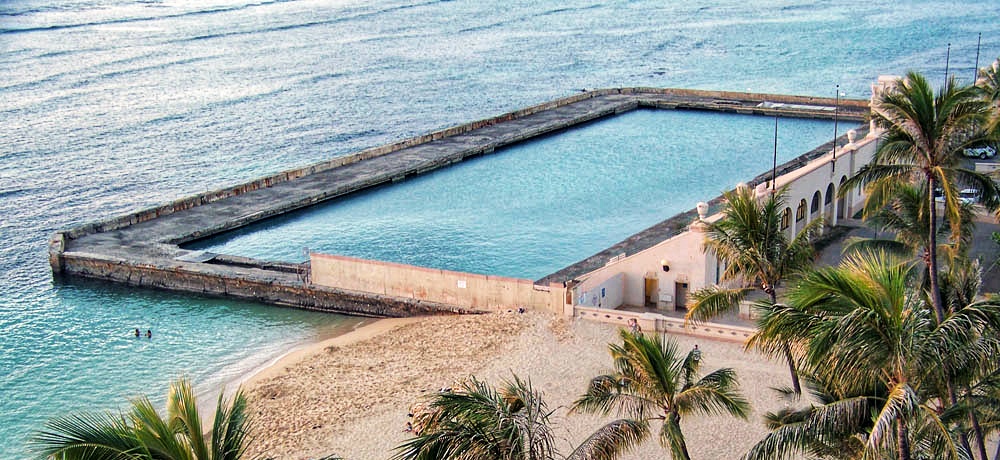
Honolulu’s longest-running preservation saga has taken yet another turn. After months of renewed optimism that the Waikiki Natatorium War Memorial would finally be restored, Mayor Rick Blangiardi this week all but declared the dream dead.
“It’s a long shot,” he said, citing ballooning costs now estimated between fifty and one hundred million dollars. He admitted that he once hoped for restoration, but he cannot see a viable way forward. City Council Chair Tommy Waters echoed the sentiment, warning that protecting Kaimana Beach and its seawall is the city’s immediate priority.
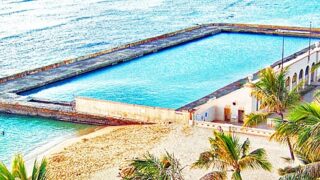
For many residents and visitors, the Natatorium has long symbolized the city’s inability to follow through on its promises. The archway still stands in solemn beauty at the edge of Waikiki, but behind it sits a pool overtaken by algae and broken concrete.
From hope to retreat in just months.
The reversal is striking. Only in June, when we last wrote about the Waikiki Natatorium, officials were still discussing a functional Natatorium, with a projected cost of thirty to thirty-five million dollars and fundraising support from the Friends of the Natatorium. That news coincided with the push to restore the landmark in time for its centennial in 2027. Optimism spread, with many hopeful that decades of false starts might finally give way to action.
Now, just three months later, that seemingly grounded optimism has evaporated. The familiar Hawaii cycle of bold talk followed by political retreat is repeating itself, leaving residents frustrated and visitors confused.
A place too visible to ignore.
Anyone who walks past the site along Kapiolani Park can see and feel the tension. To one side is a popular family beach where kids play in the sand. Opposite it is a locked gate hiding a stagnant pool that once hosted Duke Kahanamoku and Olympic champions. Then, to the right is a narrow sea wall.
Visitors stop to stare, often surprised to learn that this is not just another ruin, but a World War I memorial to the more than 10,000 Hawaii residents who served. The contrast between the vibrant shoreline and the decaying landmark is a jarring reminder of promises left unfulfilled.
Reader voices say it all.
When Beat of Hawaii last covered the Natatorium, readers shared memories that stretched across decades.
Rush remembered school field trips in the 1960s, when visits to the Natatorium were part of a curriculum that also included Pearl Harbor, Bishop Museum, and Punchbowl. “I loved Summer School, it didn’t cost us anything to visit these historical sites,” he said.
June recalled learning to swim there in the 1970s, calling it “our personal pool, as pretty much by then no one was using the Natatorium.”
Others described the neglect more bluntly.
Jay H said that every time he walked through the upper park section on the seaside, it seemed to be crumbling worse and worse. “The Nat is a disgrace. It’s a war memorial. Either fix it or tear it down.”
Bk compared Hawaii’s approach to that of Australia, where public ocean pools are maintained and celebrated, writing that “Hawaii lets Waikiki Natatorium, Aloha Stadium, roads rot. North Sydney’s pool—clean and well-maintained—shows that upkeep works. Hawaii skips it.”
Not all voices were critical. Shirley reflected a sentiment still strong in parts of the community: “I agree this relic should be restored because of awesome memories and to bring honor to our ohana that were lost.”
Taken together, the comments highlight a divide between nostalgia, financial skepticism, and the desire to honor service members properly.
The cost of inaction.
The Natatorium has now been closed for nearly fifty years. In that time, successive mayors have promised action. Some called for demolition, others for complete restoration, while still others advocated for a compromise. Plans were drawn and lawsuits filed, yet the gates never reopened.
The price tag today makes the impasse even more challenging to overcome. Beyond construction, a restored Natatorium would require lifeguards, insurance, maintenance crews, and security. As one reader pointed out, the annual upkeep alone could take funds from other high-priority community needs.
Yet leaving the structure to rot is no solution either. Seawall erosion continues to threaten Kaimana Beach, and the memorial itself deteriorates in public view.
Same story, different project.
For many, the Natatorium has become more than one failed promise. It fits a bigger pattern. The rail system’s runaway costs, the endless wait over Aloha Stadium, and even the closure of the Haiku Stairs all point to the same problem: Hawaii leaders start strong, then stall.
Reader Matthew L put it bluntly: “This is what you call a lack of political will. There’s a lot of ‘give up’ going around lately. A disturbing trend.”
The Natatorium, in this way, is not just a closed pool. It is one more example of Hawaii’s struggles with follow-through and priorities.
What will happen next?
For the moment, the city says its priority is stabilizing the seawall to protect Kaimana Beach. Friends of the Natatorium still push for complete restoration, but the mayor’s remarks make clear there is little political appetite for such a costly project. Lawsuits could resurface if demolition is considered, but for now, the landmark remains in limbo.
That leaves the public caught between memory and reality. Each day, residents and visitors pass under the archway, reminded of what the Natatorium once was and unsure of what it will ever become.
The question for Hawaii.
Should the Natatorium be restored to its former glory, or torn down and replaced with a simpler memorial? Or will Honolulu just let it sit until the ocean finally takes it back?
It’s a question leaders have sidestepped for nearly fifty years already. And it remains unanswered today, as another mayor joins the long list of those who promised action but left only words.
We welcome your thoughts on the Waikiki Natatorium War Memorial. What do you think should be done?
Get Breaking Hawaii Travel News



It was labeled a war memorial as an excuse to have it constructed. Ala Moana Beach Park has a memorial arch for some unknown reason as well.
The natatorium was a disgusting foot fungus place with all the charm of a seldom cleaned park restroom when I went there in the late 60″s. It would soon revert to the similar condition of all the other C&C restroom facilities if rebuilt. It also had dark and not inviting water and bottom.
Ala Moana park is good for swimming because it is: 1. deep 2. Open and accessible 3. Flushed naturally and constantly by currents and tides.
Just remove it and leave or enlarge the swimming area by dredging the reef to have a bigger swimming area like Ala Moana Park.
The money is there. But the politicians have other ideas how to spend it, like the useless rail at a half billion per mile! To allow the Nat War Memorial to decay for 50yrs is all you need to know about Oahu’s politics. Shameful.
Procrastination ! Open in the seventies many fond memories needed foundation fundings and upkeep where is the aloha Aina
Politicians kuleana
It’s not the cost, it’s the liability issues associated with the facility.
Best Regards
Good point, and I wouldn’t be surprised that a developer has their sights on that plot. I must say that Hawaii has become a haven for money elitists. Step 1, run out the natives. Step 2: Buy up all the real estate. Step 3: run off all the locals. Step 4: Change the laws to own the beaches. Hawaii is under siege. If you don’t fight back now, it may be too late.
What about ‘Coco Palms’? I remember that when I was there in the 1960’s.
I remember swimming here in the late 1960s. It was pretty gross under the stands even then. Still, at the same time, I remember this was an unusual setting, and the fact that I have a strong memory of it, even this many years later, makes it a significant landmark worth preserving. But I also remember the stink of the Dole Pineapple factory when passing over the bridge, LOL.
In the meantime, the City and the state are willing to spend big taxpayer dollars on projects that benefit developers and private companies, see our rail debacle and the Aloha Stadium project that’s already turning into its own debacle.
I hate to see anything with so much history not being given the attention it deserves. I haven’t seen any updates on Coco Palms in the last 8 months or so either, is that still a go? Love getting your daily news by the way! Thanks and have a blessed day!
Thanks for the article BOH. Sadly, lawsuits only serve to paralyze our country rather than solve problems. Not just the Natatorium. Look at the Coco Palms.