

Every time we plan a trip to Waikiki, we find ourselves asking the same question: hotel or condo? After dozens of stays, you would think we would have a clear answer, but it is never that simple. Choosing between a hotel and a vacation rental in Waikiki is not just about cost. It is about how you want to experience the islands.
When we choose hotels.
For visits of four nights or less, hotels almost always win. Convenience beats everything. You check in, drop your bags, and the front desk takes care of the rest. There is no need to meet someone for keys, no lockboxes to deal with, no cleaning fee, and no wondering if the Wi-Fi works. Housekeeping generally makes the beds, the pool is ready, and if something breaks at an odd hour, someone is available to answer the phone.
We tend to use hotels when we are working on short notice or catching early flights. The Prince Waikiki, for example, works well when we are on assignment, with quick access at the far end of Waikiki, easy parking in and out, and no fumbling with a lockbox code at night. It is efficient and reliable, which matters more than square footage on those kinds of trips.
When we choose vacation rentals.
Once a stay hits about a week or more, the math definitely changes. Suddenly, the kitchen, sometimes the laundry, and extra space become real advantages. A condo near Diamond Head or in Waikiki proper lets us spread out, make breakfast, and still be a short walk to the beach. For more extended visits when we are working, a table to work at and a full-size refrigerator are essentials that make a difference.
Rentals also work well for families or groups that require more than one sleeping area. A one-bedroom condo with a sliding door or an actual two-bedroom unit can mean peace instead of chaos. That is worth a lot if you are traveling with kids or teenagers who need their own space.
The legal reality.
Short-term vacation rentals are allowed in resort-zoned areas such as Waikiki, Ko Olina, and Turtle Bay. Outside those zones, most rentals must meet a 30-day minimum stay. Always look for a Honolulu short-term rental registration number or non-conforming use certificate listed in the ad, along with a Hawaii tax ID. Illegal rentals get shut down regularly, and guests can be displaced mid-trip with no refund. It is not worth the risk, even if the price looks amazing.
The real cost comparison.
(Rates below are typical starting prices for Waikiki and already include Hawaii’s roughly 19% combined taxes and fees. Real-world totals vary widely by season and location.)
For a typical family of four staying seven nights, the math looks more like this.
Hotel example
Room rate: $400 per night with taxes = $2,800
Resort fee: $50 per night = $350
Parking: $50 per night = $350
Breakfast out: $100 per day = $700
Total: about $4,200 plus lunches/dinners
What you get: daily service, a front desk, pools, and amenities, but mostly every meal is out. Many Waikiki hotels now include a small refrigerator and some have microwaves, so you can keep drinks or leftovers cold and at least do minimal “cooking.”
Vacation rental example
Nightly rate: $275 per night = $1,925
Cleaning fee: $200 (one time)
Parking: often free or up to $30 per night = $0–210
Groceries for breakfast and snacks: $150
Total: $2,275–2,485 plus lunches/dinners
Some condos include beach chairs, coolers, or snorkel sets, which can save even more once you arrive.
Even with updated pricing, there is still a difference of about $1,700 for a week. Whether that gap is worth it depends entirely on how you travel and how much you will use the kitchen and extra space.
Remember that sample rates above are starting points; these rise during holidays, school breaks, and peak visitor periods.
Have you found a hotel or rental that offered great value in Waikiki? Share your tips in the comments.
The space question.
A standard Waikiki hotel room can feel tight fast. Add a fold-out sofa, and you will know why so many families look for connecting rooms. Hotel suites help a lot but come at a premium. Condos solve that by giving you doors between living and sleeping areas, often with a real kitchen. The trade-off is service and sometimes in Waikiki, soundproofing.
A good rule: under four nights, live with the squeeze. Four or more nights, that teenager or eight-year-old sharing your hotel room starts to feel like a much bigger problem than $200 in vacation rental cleaning fees.
Hidden costs both ways.
Hotels hide their extras in resort and parking fees. Breakfasts alone can add hundreds of dollars and are wisely avoided. Minibar items and laundry service only add more.
Rentals hide their costs differently. Cleaning and platform fees show up late in the booking process. You buy supplies, take out your own trash, and handle laundry. Some buildings charge for parking, and availability can be limited even when paid.
Both sides have gotchas. Read the fine print on resort fees before booking hotels, and read reviews before booking rentals, especially about check-in/check-out requirements.
What you actually get.
Hotels offer ease and at least a modicum of indulgence. There is a lobby, pool towels, maybe bell staff, and sometimes even entertainment. You pay for the convenience.
Vacation rentals give you the freedom to live like a local. A real kitchen means coffee whenever you want. A washer/dryer that helps keep packing light. You can eat in when you feel like it and live more like a resident than a guest. For many repeat travelers, that flexibility has become the definition of comfort and what a Hawaii vacation should feel like.
Trip length sweet spots.
One to three nights: hotels almost always win. Cleaning fees make rentals impractical, and you will not have time to use the kitchen anyway.
Four to six nights: toss-up. The longer you stay, the more condo savings start to appear.
Seven nights or more: rentals often win. The cleaning fee is spread out, and using the kitchen and laundry saves time and money.
The parking wild card.
Parking is the hidden cost that can change everything in Honolulu. Most Waikiki hotels now charge $40 to $60 per night for parking, and valet is often the only option. Some reach higher in cost. That can add $350 to $420 to the cost of a week-long stay.
We once paid $79 a night for valet parking, only to realize a nearby condo would have offered free parking. An apartment with free or low-cost parking completely changes the equation. If you plan to have a rental car for your time in Honolulu and explore daily, that perk matters. If you plan to stay more put, skip the car entirely and rely on taxis, rideshares, or The Bus.
Kitchen economics.
A family breakfast at a hotel restaurant typically costs between $80 and $120. The same breakfast from groceries is $15 to $20. Over the course of a week, that is $600 saved if you are willing to cook. Many Hawaii visitors find a middle ground: quick breakfasts in, lunches out, which are often less expensive, and then simple dinners on the lanai. It is not about cooking full meals, just avoiding the three-meal-a-day exhausting restaurant cycle.
Location variables.
Every part of Waikiki has its own trade-offs. Beachfront hotels and condos charge a premium for being steps from the sand. Properties near Diamond Head tend to be quieter and more residential. Those closer to the Ala Wai Canal are cheaper and still walkable. Zoo-side Waikiki, toward Diamond Head, is more walkable to parks, hiking, and free parking, while the other end puts you closer to Ala Moana shopping. Almost everything in Waikiki is within a fifteen-minute walk of the beach, so focus more on what you will actually do than on the exact distance.
Booking considerations.
Hotels offer loyalty points (if you care), elite perks, and typically flexible cancellation policies. Rentals are more rigid but sometimes cheaper when booked directly through local management companies instead of global platforms like Booking or Airbnb. For Christmas, summer, or other peak periods, try to book at least six months ahead. In shoulder seasons, waiting can be smart and really pay off. Always compare the total price after taxes, resort fees, parking, and cleaning charges before deciding which one really costs less.
When each works best.
Choose hotels when you want a vacation from everything, including cooking and logistics.
Choose vacation rentals when you need space, plan a longer stay, or want to live at your own pace. Laundry, kitchens, and parking often tip the scales.
What we do.
We have stayed in everything from small hotel rooms to huge oceanfront ones, as well as tiny condos and spacious, elegant ones that felt like home. For fast work trips where we are developing content and constantly on the move, hotels win. For more extended stays where we need to write and edit, condos with real desk space and quiet mornings do. Ultimately, the best choice depends on the kind of trip you want. Whether it is convenience or space, matching your stay to your travel style makes all the difference.
Hotel or condo people: what is your Waikiki go-to and what finally sold you on it? Bonus points if you share what you actually paid. Know someone planning a trip to Waikiki? Share this guide with them; it might save them hundreds.
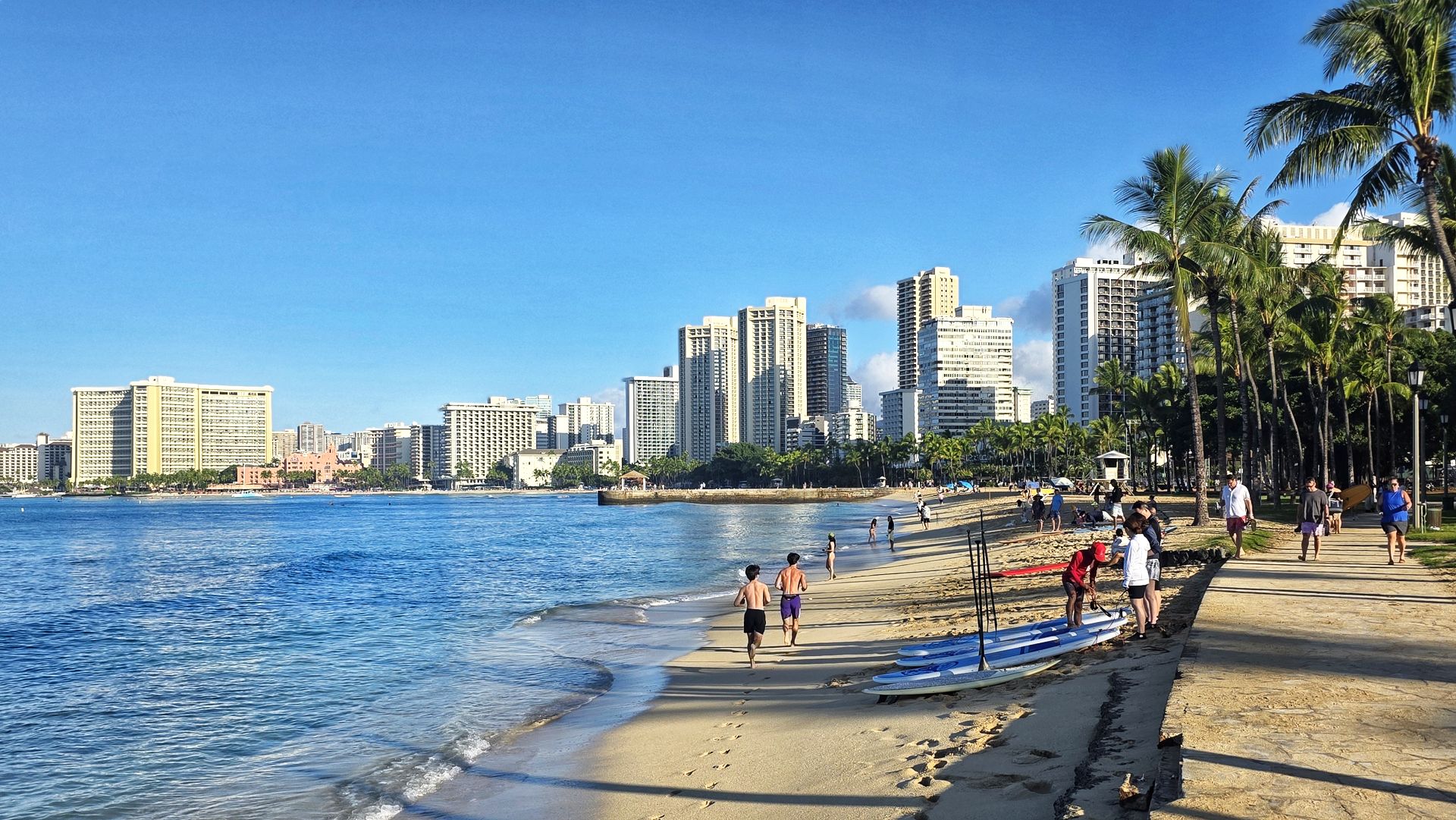
Lead Photo – Beat of Hawaii in Waikiki.
Get Breaking Hawaii Travel News





Just wanted to comment on your hotel versus vacation rental. My wife and I own 3 vacation rentals, 1 in Kauai and 2 on the Big Island. Vrbo has now started posting all costs in the price that are showed to the guest. That includes the cleaning fee and administration fee if there are any. So, when a guest looks at a property for a single night, it is showing a price that includes everything a guest will pay.
Great article, as usual! Taxes and fees are ridiculous, and probably only getting worse. We’ll be visiting family soon on Kauai and rented a condo for 3 weeks. Looking forward to a leisurely trip.
Thank you for always being so on top of everything! Amazing journalism!
I agree it can be a balance of what your needs are and what kind of accommodation works for you- we go to Hawaii every year (no kids)but we do go when the rates are lower – you can find a week in Waikiki at a three star and above hotel for minimum $1500 a week if you avoid the rip off resorts and stay in smaller places-there are some really cute and very clean hotels that have balconies and kitchenettes and full service nice restaurants. Kitchenettes are great, we save so much on making our own coffee and breakfast each day- we can eat yogurts with fruit and oatmeal packets – you can make eggs too in a microwave. We eat a restaurant meal that is local take out half the time and cheaper than sit down restaurants. Now that Waikiki has a Target it is a game changer. You don’t need a car all week long either, we rent a car right in Waikiki and return it same day or maybe keep it for two days max. It doesn’t have to be high dollar to have a nice week.
Returning “home” to Honolulu in February for a 50th high school reunion kick-off activity. My husband and I love staying at the Ilikai. Used to stay at the Hilton (with and without kids), and then tired of the congestion and ever-escalating prices. Ilikai is quieter, and the rooms are larger with nice kitchens. (The Ilikai was originally a condominium, and it holds a lot of nostalgia for me since it’s where my father lived while he awaited my mom and me to join him, way back in 1967.) We often forgo a car and use an Uber for an occasional outing somewhere. Walking up and down Waikiki, reliving old memories, and attending church on the beach in front of the Hilton are treats. We really enjoy walking – to the zoo, Kapiolani park, and Ala Moana. We’ve stayed at timeshares and Airbnb-type rentals on Oahu, Hawaii, Maui, and Kauai, and most of the time they didn’t live up to the hype or expectations. I won’t even begin to tell you what we experienced in Kailua in January of 2024!
We’ve found a solution that combines the best of both. The Aston Waikīkī Sunset. It’s a high rise condo building at the Diamond Head end of Waikiki, but run like a hotel. Mostly one bedroom condos, but a few 2 bedroom units as well. So you’ve got the space of a condo apartment, full kitchen, etc. along with 24 hour front desk, swimming pool, housekeeping, and maintenance staff on call to respond to any requests usually within 5 minutes. There are laundry facilities on every floor. And a very convenient location, 5 minutes walk to Waikīkī Beach, and very close to the zoo & Kapiolani Park. We wouldn’t consider staying anywhere else!
It all isn’t about costs. Read the reviews, comments of prior guests. I’ve seen people experience filthy mattresses, bug infested hotels, moldy showers, ac or no air conditioners that make so much noise you can’t sleep. Hotels that have loud music way into the early morning etc. Booking problems, over charges and even people getting a room that the advertised photo was totally different. Who do you trust? Who will take care of you if there is a problem? A corporate number or a condo owner with a cellphone? How convenient if the mattress is so worn out that you can’t even sleep on it or scared because of the stains? Sorry a condo owner may not be able to accomodate that problem. If condo owners require guests to do the laundry when was the last the bedsheets got cleaned?
There’s another option that is a hybrid. Rent a condo from a company with an onsite presence. Waikiki Shore is a good example, where Castle runs the front desk. Maintenance is on site, housekeeping is onsite for touch ups and requests, and you can’t beat the location.
shhhh! don’t tell everyone. i have stayed there twice. what a bargain
I’ve been to Maui, Kauai, the Big Island and Ohau. I’ve never stayed at a hotel and don’t think I would with some of their prices and resort fees. For a condo on each island you can generally find decent accommodations starting at around $1,700 for 8 nights in a one bedroom. We generally pay in the upper end of the $2,000s however for a view or proximity to the beach/ocean. For our trip to Honolulu, the cost was $2,500 for 8 nights and included free parking. That was at the Waikiki Banyan and was an end unit with views of Diamond Head and the ocean.
How about neither option? Most destinations have non-resort hotels, and exclude most of the gotchas that plague Hawaii. No need to spend a monthly rent or mortgage worth on a short stay, which means Hawaii is off the list to visit friends and family.
Each year since 2018, here’s how we do it (7 nights 2 people): 1. Waikiki at the Hale Koa Resort (military and government) – average $2,000 total excluding meals. (Average hotel/resorts in Waikiki = average $1,870) 2. Big Island Condo average $2,000. 3. Maui CONDO average $2,400. The Most increase we have experienced is +3%.