
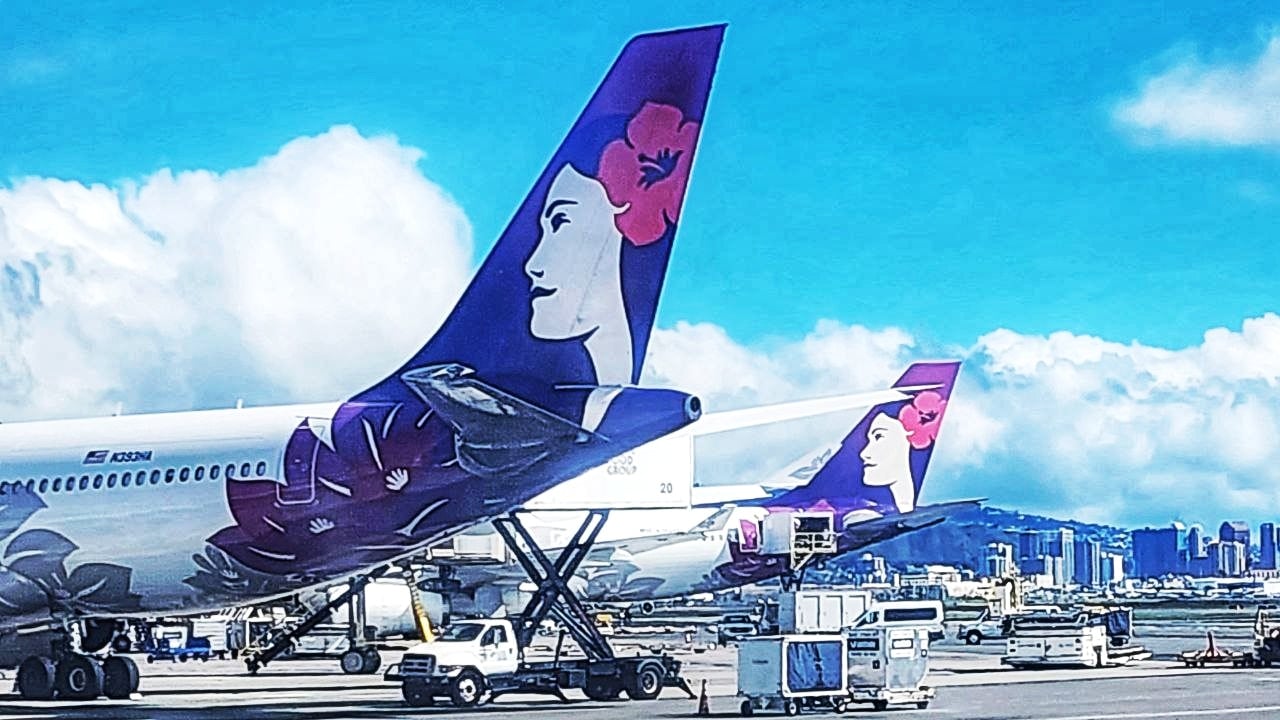
You could be dragging through JFK at midnight, stuck on a long connection at LAX or waiting for a flight at Sydney, and it would still hit you the exact same way. You are not looking for that to happen. You are thinking about boarding groups or whether your upgrade cleared, or just checking your phone. Then you glance out the glass and there she is. The Hawaiian Airlines tail rising above the jet bridges and service trucks, unmistakable from halfway across the airport.
You didn’t need to see the name painted on the fuselage or hear any flight announcement. That single image alone was enough. And what it triggered was not “there’s the airline that flies to Hawaii.” Instead, it felt closer to seeing Hawaii itself parked at the gate.
The Face On The Tail.
Pualani was not dreamed up by an outside branding firm trying to capture the best “island vibes.” She was inspired by Leina’ala Drummond, who was Miss Hawaii 1964, and later became a Hawaiian Airlines flight attendant. She died in September 2023, but for decades her face had already traveled endlessly across the Pacific and back. That rooted the airline’s identity in someone who actually represented the state rather than merely a marketing exercise.
Over time the artwork was refined as the company’s fleet modernized and aircraft changed, but the core image stayed unchanged. While other airlines to this day cycle through fonts, color palettes, and abstract designs frequently, Hawaiian held that ground. That consistency signaled confidence. The airline was not chasing trends or trying to reposition itself every few years. It knew exactly what it was supposed to represent and who it was.
The Tail Matched The Experience.
The reason the tail worked is that the experience onboard did not in any way contradict it. You were handed a unique chilled passion, orange guava juice without any effort to neutralize its flavor for greater mass appeal. The announcements and the inflight safety video leaned into local musicians and hula instead of generic corporate presentation. Flight attendants often spoke sounding like islands they came from, with warmth that did not sound scripted. It was not slick in any mainland way. It all felt grounded in Hawaii.
Most airlines decorate the outside of the plane and then deliver something completely interchangeable once you step on board. Hawaiian did not feel interchangeable, especially on interisland flights where its identity was first forged. Pilots understood the winds between Maui and the Big Island and the impact of volcanic eruptions. Crews were accustomed to fast turns and short hops that are part of how daily life works in Hawaii. Even the ground teams operated with the rhythm of a place where aviation is core infrastructure, and not a luxury.
When An Airline Becomes The Place.
In one national branding study, Hawaiian ranked #1 among U.S. airlines for emotional connection. Alaska ranked #9. Studies come and go, and may not even matter now, but that gap reflected something travelers already felt for decades. Hawaiian was not just a transportation provider to the islands. It had become inseparable from the very place it served.
When you strip out schedules and airfares, most airlines largely blur together. It often feels like if you change the logo, they would mostly be indistinguishable. Hawaiian never blended in quite that way. Seeing that aircraft in Seattle, San Diego, Sydney, or Tokyo did not feel like spotting a random carrier that happened to serve Honolulu. It felt like Hawaii had shown up. And if you live here, or if you were visiting, you knew you were almost home.
For first-time visitors, that tail made the trip to the islands feel real even before wheels up. For returning travelers, it felt like long-anticipated recognition. For us Hawaii residents far from home, it felt like a reminder that the islands were not as distant as they can seem.
What That Means Now.
Hawaiian Airlines is no longer operating on its own. The airline reached a point financially where it could not continue as it was, and what followed was inevitable. But that inevitability does not erase this storied history.
Hawaiian achieved something very few airlines ever did or will. It became so closely identified with a place that its aircraft functioned as ambassadors without ever saying a word. The tail did not need explanation. It carried decades of consistency, experience, and cultural alignment in one single image.
Get Breaking Hawaii Travel News




Leinaala (Teruya) was my classmate at Kamehameha, class of 1964. She was
a special friend to all of us classmates. I spent 27 years with Aloha Airlines but also flew on many of her flights, always greeted with a smile and a hug. Always true aloha, inside and out !!
Will the “Pualani” tail remain on HA/AS aircraft??
I’m a moderate business traveler. That tail is indeed very distinctive. To me, every time I saw it, my thoughts always were “I wish I was going that way.”
Haha, I was already planning on getting teary eyed to day. So there! 😢
In the early 2000s I used to do several medical missions yearly in Southeast Asia, which required multiple flight flights both going and coming. On one trip after spending a couple of weeks in very remote Laos, returning home to Honolulu, changing planes at Inchon airport and seeing Pulani on the tail of my flight home gave me a great comfort , relief and happiness.
It’s very sad what has happened to Hawaiian Airlines subsequent to the merger with corporate Alaska Airlines because it seems to have lost its soul.