
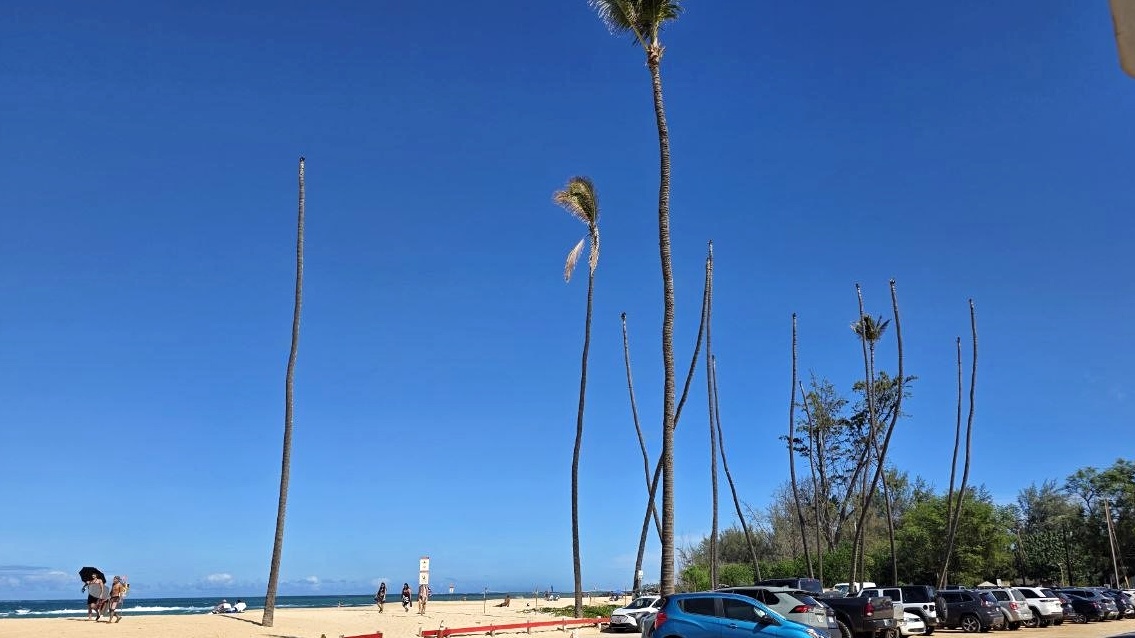
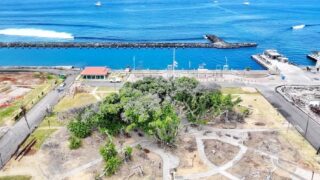
We were walking one of Maui’s most familiar beaches recently, and a longtime favorite of ours, when the absence became obvious, not because anything dramatic was happening at that moment, but because something defining was simply gone. Only after standing there for a few minutes did it fully register that Baldwin Beach Park no longer looked the way it always had.
Palm trunks with no healthy fronds still stood close to the ocean, some already surrounded by sand that looked unstable even at low tide. In many cases, the frond section was either gone entirely or visibly dead. It made the ocean seem closer than it used to, not in any sudden way, but close enough that it was easy to see why those trees might not be coming back to this spot.
In the past week alone, eighteen coconut palm trees were removed here. At Baldwin, that is not a small adjustment, because those palms shaped how the shoreline has long appeared and how the beach is photographed from nearly every common angle.
The county says the ocean forced its hand. But many residents say that the explanation skips over years of poor care, and being there in person did not feel like a clean either-or choice between those two stories.
We spoke with lifeguards while we were there, and they were candid but unsure of the cause. They said it could be encroaching seawater, a lack of proper care, palm beetles, or something else entirely, and that none of it felt settled from their vantage point.
Why Maui County says the trees were doomed.
According to Maui County, the coconut trees removed were already in decline and could not be saved. That part was hard to miss in person. They were among roughly 70 palms historically lining the Baldwin shoreline, and these 18 sat closest to the water, where repeated submersion during high tides and flooding allowed saltwater to seep into their root systems over time.
County arborist Timothy Griffith explained the issue bluntly, saying, “If these trees had died due to over-trimming, we would be seeing similar losses across the island.” He said coconut trees can tolerate some salt exposure, but they are not resistant to repeated flooding that leaves roots sitting in saltwater. Once that threshold is crossed, decline may be slow, but recovery is unlikely.
Griffith also addressed claims that trimming practices were responsible for the losses by pointing to the broader system the county manages. He said Maui County maintains more than 30,000 trees across the island, including about 1,600 coconut and palm trees, and that they are pruned twice a year in accordance with industry standards. If trimming were the cause, he said, similar failures would be showing up well beyond Baldwin rather than being concentrated along the shoreline.
Parks and Recreation Director Patrick McCall said the county plans to add trees in the future and will continue dune restoration work at Baldwin Beach Park. He also pointed to the park’s master plan, which already relocated infrastructure inland, including the pavilion that once stood much closer to the shoreline and was removed earlier because of erosion.
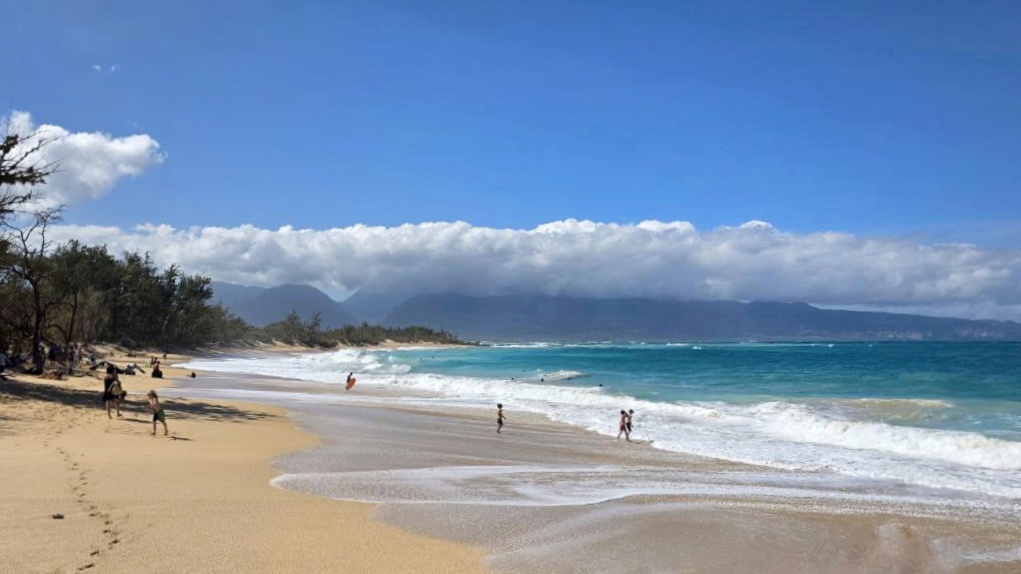
The Maui shoreline has been moving for a long time.
This did not begin recently, even if the changes feel sudden to us now. A county vulnerability and adaptation study cited shoreline retreat of roughly a quarter mile over the past century in this area, and the distance becomes clearer when you look at where the beach’s fixed features used to sit compared with where the water actually reaches today.
High tides now push into areas that once stayed dry, and sand that previously protected root systems no longer holds in place the same way it once did. Trees planted decades ago were never meant to sit with their roots soaked by saltwater again and again, especially without consistent dune buildup in front of them, which may well be why the trees closest to the water failed first.
Why locals are not buying the explanation.
Local reaction has been blunt and skeptical. Commenters familiar with Baldwin and other Maui parks say they have watched palms decline for years and do not believe saltwater intrusion explains everything they have seen there.
Many point to aggressive and frequent trimming that leaves palms tall, exposed, and stressed, while others say over-pruning during drought conditions weakens trees and makes them vulnerable to disease. One commenter described how park trees are handled as treating them like liabilities rather than features worth protecting.
Several people have referenced a longtime local caretaker often called the “coconut man,” who once treated and maintained coconut trees around the island. Others raised blight or disease as possibly contributing to the problem and argued that not every dying palm should be written off as a casualty, the way the county depicted.
County officials, however, have rejected those claims and say that the remaining 50 coconut trees farther inland at Baldwin are healthy and protected. The separation between trees that failed and those that remain nearby them closely follows how often the ocean reaches them.
What beach visitors will notice now.
Baldwin Beach still feels like Baldwin in the broad sense. The sand remains wide, the wind perennially cuts across the park, and the parking is still sometimes a challenge, the way this North Shore beach has long been.
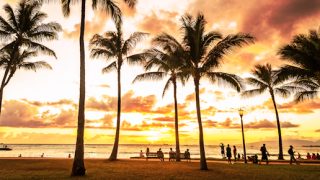
The palms once framed the beautiful beach and graced the view from the parking area, and without them, the shoreline feels exposed and less attractive. The ocean’s advance is harder to ignore entirely, and longtime visitors will notice the change immediately as we did. First-time visitors may not realize what is missing. The photos they take now will not be the same as the images that drew them there in the first place.
Retreat is already underway here.
What sets Baldwin apart from many other Maui beaches is that the problems here are no longer theoretical. The pavilion there was removed earlier due to erosion, and the park’s master plan calls for future infrastructure to be placed farther inland rather than along the old shoreline. New trees are also planned.
Seeing it up close.
We were just there photographing what remains and what is already gone, and the scale of the change is clearer in person than in the photos. It is easy to see why the county says these trees were not coming back, and it is just as easy to understand why people feel something important slipped too far before any action was taken. Baldwin Beach Park is certainly not disappearing overnight, but it is changing in ways that are no longer subtle, and the palms gone missing are unlikely to be the last visible sign of that shift.
Do you see this as unavoidable shoreline retreat finally catching up at Baldwin, or as a loss that better care and earlier intervention might have slowed before the trees were gone?
Photo Credit: Beat of Hawaii at Baldwin Beach, Maui.
Get Breaking Hawaii Travel News


If they have to come down turn them into lumber and make a sun deck so people have a way to get out of the direct sun and find some shade.
interesting idea, but they should plant a tree for every tree they remove. We have that in Washington, DC. I lived there for 30 years and still go back a couple of times a year and still love the trees! So many neighborhoods near Rock Creek Park (including mine) which actually goes al the way from Maryland to Virginia!
It is distressing that the cause is not known. CRB can be diagnosed by doing an autopsy on the dead trees, examining the crown for beetles. Once attacked the tree is gone almost regardless of treatment. The best defense is to removed the dead tree and kill the remaining live beetles if any to stop their spread to other nearby trees. If this is not done the spread will continue. Healthy trees are a good solution, not overtrimming and deep root feeding. Coconut trees which are overtrimmed will display trunks which are narrowed at the point of overtrimming. These trees look even in trunk diameter so overtrimming is not apparent. Coconut trees grow at a rate of one foot per year. If the trees were not diagnosed and the cut trees not treated for live beetles that is a real problem because the beetles will continue to spread.
I was going to say the Coconut Rhinoceros Beetle (CRB), an invasive pest, so named because of it’s one (1) single distinctive horn in the middle of it’s head. However the Hawaii DLNR website says that mostly Kauai & Oahu are severely affected, less so the Big Island, and least of all Maui. This insect is apparently severely decimating palm trees on the affected islands.
A few years ago, I was walking down the beach just south of Lahaina Shores Beach Resort, when I heard a loud “thud” behind me.
It was a large coconut that would have given me a concussion or worse, had it hit me in my head.
So there must be a liability issue associated with the coconut trees.
Now when I walk on the beach, I steer clear of the coconut tree hazards..
Got a question for you guys. What the heck is up with parking at Nakalele blow hole on Maui. Apparently it started a few months ago, but the cost is set at $17 per car. Most people spend maybe 30 minutes observing the blowhole. If that’s not screwing tourists I dont know what is. What’s your opinion.
Wow, Steve. I did not know that. Haven’t been there in ages and don’t even remember the parking lot, probably very small? You should be able to pay per hour, but I don’t know …If they charge $17 no matter how little time you spend, that’s not good because people will park on the road somewhere and/or on private property. Hope that is not the case. They should put a time limit or free for the 1st 30 minutes ….?
We went to Dominican a few years ago. We were pleasantly surprised that there were so many palm trees that we could stay out in the beach all day in the shade. We also had free beach chairs that reclined and just had to move the chairs when the afternoon sun shifted.
The coconut rhinoceros beetle (CRB) is not currently established in the Caribbean, but it’s a major concern because it has recently appeared in Mexico, raising fears it could spread to the Americas, with the Caribbean being highly suitable for it. While it’s a huge pest in Asia and the Pacific (Hawaii, Guam, etc.), its detection near the Americas (Mexico) means authorities are monitoring for its arrival in vulnerable areas like the Caribbean.
Shore lines are receding, I’ve noticed that happening over the years. Two beaches in particular, HanaKaoo cemetary and just north of it have been eroding for some time. Not sure why, but it doesn’t bode well for beach goesrs.
No palm tree maintenance. Decaying palm trees and the tourism industry.
what’s new? Take away the shade and the tourist’s will have no break from the hot sun. Just another way to control where tourists can go and make it uncomfortable or inconvenient.
Is this happening on other Maui or Hawaii beaches?
Yes, North Beaches in Kaanapali, probably to improve the view of the villas built ocean front! Very sad.
Hi Eva
Was just there today and it is a flat fee of $17. Regardless of the amount of time. I was blown away.
I wonder how they will enforce it, since it’s hard to get there …maybe that is the reason it’s expensive! Who will give out the tickets? How will they get there? And if they need to tow? I guess I will drive there when the weather improves to see what’s happening ….
I get to Maui 4 times a year and Baldwin is one of my favorite beach parks. These trees have been in trouble for years. the Pavillion was ruined by high tides and sat unprepared and not even shored up for safety’s sake as it withered further. Homeless folks further damaged it as well. The parking lot is horrible and its surface has been treacherous at least the last decade. The shower and bathhouse suffer the same fate as other beach parks: the bare minimum of cleanliness and maintenance. Again, like many other each parks on the island, Baldwin is in embarrassing shape. I’m sure the new Green tax/fee will all those problems!🤪🤪
Rhino beetles. Happening on Oahu. Once the crown is damaged, it is too late, you lose the tree. The beetles move on to other locations. Ko Olina is treating their trees using drones. Waikiki better be doing the same.
As usual, we have an outsider (from Seattle in this case) decide what’s best for the islands. I am 100% in agreement with the locals. Wish we could bring the coconut man back. We need more trees, not less. I was shocked when all the trees in Wailuku were cut …loved driving under them for years. Why hire a lawyer from Seattle who protects cars from trees, rather than the other way around? You will not tell me that all those trees that were cut in the last few years were diseased! People who don’t like nature and trees shouldn’t work for Maui County.
I’d love to hear the lawyer from Seattle story.
He is in the original story above. Check out County arborist Timothy Griffith …google, Facebook, LinkedIn or elsewhere. I would rather have the “coconut man” taking care of trees!