

The first time we got into a Waymo with no one in the driver’s seat, we weren’t entirely convinced we’d survive the experience. The vehicle malfunctioned and wanted to let us out in oncoming traffic. It required the help of a real person to extricate us. But that was a while ago. Now, when we’re traveling away from Hawaii in a city where Waymo operates, we tend to use it quite regularly and, despite that first experience, have actually come to like it.
Then we come home to Hawaii, and Honolulu specifically, where there is no Waymo. Why? That absence is becoming harder to ignore as the company expands into places we wouldn’t necessarily have expected to reach before Honolulu. Waymo isn’t just expanding geographically either. In its more mature markets of San Francisco, Los Angeles and Phoenix, it now accounts for an estimated 15% to 16% of ride-hailing spending, putting it squarely into territory long dominated by Uber and Lyft.
This week, Waymo began offering fully autonomous rides to its first public passengers in Denver, San Diego and Tampa bringing the number of cities where it is carrying riders to 14.
Las Vegas, Seattle, Portland, Boston, New York, Chicago, Detroit and more are coming. Hawaii isn’t on the list, even though Oahu has nearly one million residents, millions more visitors arrive each year, and an unusually large share of them immediately need the kind of transportation Waymo provides.
We started looking curiously into why, expecting perhaps to find a Hawaii law standing squarely in the way. Instead, we found that Hawaii transportation officials have already been talking to Waymo, and that the state’s transportation director offered an explanation that we found hard to understand once we looked at Oahu’s numbers.
Hawaii DOT has already been in talks with Waymo.
During a Hawaii House Transportation Committee hearing in February, Rep. Trish La Chica asked Hawaii Department of Transportation Director Ed Sniffin about the state’s autonomous vehicle program and whether companies were interested in coming here.
“There hasn’t been interest from the industry to move to Hawaii,” Sniffin said. “It’s mainly because we just don’t have the volumes that they’re looking for.”
He said autonomous vehicle companies had been concentrating on larger cities. Then he disclosed something we hadn’t seen reported previously: “We’re working with WAYMO now to see what interest they would have in Hawaii because they’re looking at expansions at this time.”
When La Chica asked where an autonomous vehicle pilot might make sense in Hawaii, Sniffin pointed toward downtown Honolulu and the corridor between the airport and Waikiki. In other words, Hawaii DOT was already looking at essentially the same place that made us wonder why Waymo isn’t here.
That conversation happened about seven months ago. Waymo has announced many more markets since then, but Hawaii still isn’t one of them.
Oahu doesn’t look like a low-volume market.
Sniffin’s explanation caught our attention because Oahu has nearly one million residents before visitors are counted. About 5.7 million visitors came to the island last year, while Honolulu Airport handles roughly 22 million arriving and departing passengers annually.
What those visitors do after landing makes the situation even more interesting. An Oahu Metropolitan Planning Organization visitor transportation survey found that 47.5% used a hired car, taxi, limousine, Uber or Lyft to get from the airport or bus terminal to their lodging. Rental vehicles accounted for another 26.9%, while just 2.6% used TheBus.
Nearly half of those surveyed were already paying someone to provide essentially the transportation that Waymo could offer. That doesn’t mean Waymo could capture those trips, but it makes “not enough volume” an odd explanation on its face.
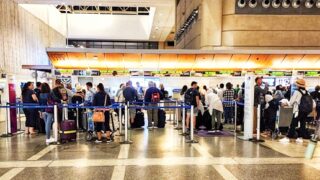
We’ve written many times about what happens after visitors collect their luggage at HNL. A taxi or rideshare to Waikiki can easily cost $30 to $50 or more, and our own checks of Uber prices in Hawaii have produced some almost comical swings from one search to the next.
Honolulu now has another inexpensive option. The $3 W Line airport bus to Waikiki works well if your luggage meets its restrictions, while Honolulu rail finally reached the airport after 14 years, yet still hasn’t reached the destination most visitors want, Waikiki.
Those choices still leave an enormous number of arriving passengers paying for taxis, rideshares, shuttles, and rental cars. Whatever volume Waymo needs, the issue plainly isn’t as simple as Honolulu lacks enough people who need rides.
Waymo keeps adding places while Hawaii isn’t one of them.
Waymo’s expansion map looks dramatically different from what it did even a year ago, with 14 rider markets. Another group is listed by Waymo as coming next, including Las Vegas, Seattle, Portland, Sacramento, Minneapolis, St. Louis, New Orleans, Charlotte, Pittsburgh, Detroit, Chicago, Baltimore, Philadelphia, New York, Boston, Washington, D.C., London, and Tokyo. Waymo separately announced Munich in August, where mapping and supervised testing are beginning ahead of planned public service.
Oahu isn’t directly comparable with any of their other locations. Orlando and Tampa are embedded within large mainland regions, while Honolulu’s potential market sits alone in the Pacific. But Oahu’s nearly one million residents, huge visitor population, and concentrated HNL-Waikiki traffic make the idea compelling.
Hawaii law wasn’t designed for a Waymo with no one aboard.
Hawaii isn’t starting from zero on autonomous vehicles. The state has dealt with the technology for years, and its current rules expressly allow autonomous vehicles to be tested on public roads.
Those rules were designed around supervised testing, with a licensed human operator physically present and able to take control. Hawaii’s rideshare law likewise assumes that a transportation network company has an individual driver with a license, driving history, background check, vehicle registration, and insurance.
What the state doesn’t yet have is a clear regulatory framework specifically for a commercial Level 4 service in which paying passengers get into a vehicle with no driver and no one else inside. Hawaii’s own Autonomous Vehicles Legal Preparation Task Force warned about this years ago, recommending in 2020 that lawmakers establish such a framework for higher levels of autonomous operation like ridesharing.
A comprehensive commercial driverless system was not developed. Instead, lawmakers returned to the subject this year with a proposal that would have moved Hawaii in a very different direction.
Hawaii almost required putting the human back in the vehicle.
HB 1797, introduced during the 2026 Legislature, would have required that an autonomous vehicle used for commercial passenger transportation have a human supervisor physically present inside it.
That would be an untenable requirement for a service whose defining feature is the absence of a driver. Autonomous vehicle industry groups opposed the proposal and warned that it would effectively prevent fully driverless commercial passenger service in Hawaii.
The measure cleared the House Transportation Committee but went no further. It died without reaching the Senate and never became law, so Hawaii does not currently have the human-supervisor requirement HB 1797 proposed.
We also can’t say Hawaii law is part of what has kept Waymo away. The problem is less clear than that. The state has rules for supervised autonomous testing and commercial transportation laws built around human drivers, without an obvious, established pathway tailored to Waymo’s paid driverless service.
Hawaii already deployed autonomous vehicles at HNL.
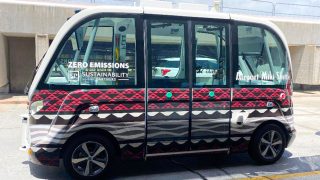
You’ll recall that Honolulu Airport isn’t entirely unfamiliar with autonomous passenger transportation. HDOT launched autonomous electric passenger shuttles in HNL in 2024 as part of an 18-month pilot to augment the familiar Wiki Wiki service.
Four electric Miki shuttles operated between airport locations with an attendant aboard, so this wasn’t anything like calling an empty Waymo for a ride to Waikiki. A year earlier, HDOT and the University of Hawaii had launched a 14-passenger autonomous electric shuttle project, also with a human available to take control.
Hawaii has therefore been willing to experiment with autonomous passenger transportation before. What hasn’t happened is the next step into commercial driverless vehicles carrying paying passengers on public streets.
Hawaii’s roads don’t explain it either.
It’s tempting to blame our rain, potholes, faded or confusing lane markings, mopeds, visiting drivers, or some other peculiarity of Hawaii roads. We can’t find evidence that any of those things explain Waymo’s absence.
Waymo is moving into places with snow, heavy rain, dense urban streets and plenty of difficult driving conditions. Denver is already carrying its first public riders, Seattle and Portland are coming, and Miami, Orlando and Tampa make tropical weather a particularly unconvincing explanation.
One difference may be this, although Waymo hasn’t publicly identified it as a reason. A Waymo market needs vehicles, charging systems, maintenance, technicians, fleet operations, roadside response, and depot infrastructure, and Honolulu can’t share any of that with any nearby Waymo city.
That perhaps makes Sniffin’s comment about volume somewhat more understandable. That is, if he was talking about the economics of supporting an entire standalone operation rather than simply the number of people needing rides. Waymo is also preparing for London, Tokyo, and Munich, however, so geographic separation by itself clearly isn’t enough to stop expansion.
So just why isn’t Waymo here?
The strongest answer we found isn’t that Hawaii forgot about Waymo or that Waymo never considered Hawaii. HDOT was already in direct talks with the company early this year, and Sniffin himself suggested Honolulu and the HNL-Waikiki corridor as places where autonomous vehicles might indeed make sense.
What we do know is that Waymo keeps expanding into new cities, while Hawaii remains off its announced map, even after HDOT looked into its interest.
We’ve gone from wondering whether our first Waymo ride might kill us to actively choosing one when we’re in a place that offers it. We’d be likely to make that choice at Honolulu Airport too, which leaves us wondering how long it will be before Hawaii finally gives us the option.
What’s your take or experience with Waymo? Is it a service you would use? We invite your comments. Mahalo!
Photo Credits: © Beat of Hawaii using Waymo on the mainland.
By Rob and Jeff, Beat of Hawaii.
Some of the most meaningful parts of Hawaii are the ones visitors walk right past without knowing they are there. We’ve spent nearly 20 years finding them firsthand for BOH as full-time Hawaii residents reporting on travel, culture, and island life, and telling you what they mean for your trip. Join us →
Get Breaking Hawaii Travel News




Below are all true. But the essay overlooks one important fact: unions own the politicians and the government here. Taxi drivers, bus drivers, tour companies will lose out because we don’t want to pay exorbitant fees ($30 -50) just to get 10 miles into Waikiki.
Fortunately the threat of a strike by a union at the airport is like putting a knife to the throat of Hawaii’s economy as it’s decided that nothing is more important than the tourist.
Re: luggage size limitations on the W Line, doesn’t exist in reality. I fly to O’ahu monthly and ride the W Line to Downtown. The bus drivers do nothing to enforce luggage limits, most visitors riding the route have their checked-in sized luggage. And those huge luggage go rolling down the aisle when not secured, definite a safety hazard. I’m surprised hotel transfer companies haven’t complained, as they are likely losing business to the W Line.
As a frequent visitor to Hawaii I would welcome another alternative to rental cars. Parking in Waikiki has gotten so expensive and challenging that we don’t rent for our entire stay anymore.
We’ve ridden Waymo a number of times and overall loved it. The first five minutes were kind of unnerving and after that it felt pretty normal. I’m surprised Honolulu isn’t already on their list.
I’m not getting into a car with nobody driving it. At least not yet. Maybe I’m too old fashioned, but Honolulu traffic is crazy enough with humans behind the wheel.
I would use Waymo from HNL to Waikiki in a heartbeat. After using it in San Francisco, I actually preferred it to Uber because there was no awkwardness, no tipping question, and the car was spotless.
If you take a look at Hawaii’s regulatory environment, its taxation and fee structures and its political stance, I think you’ll find your answer.
Waymo has done the math and Hawaii doesn’t make sense.