
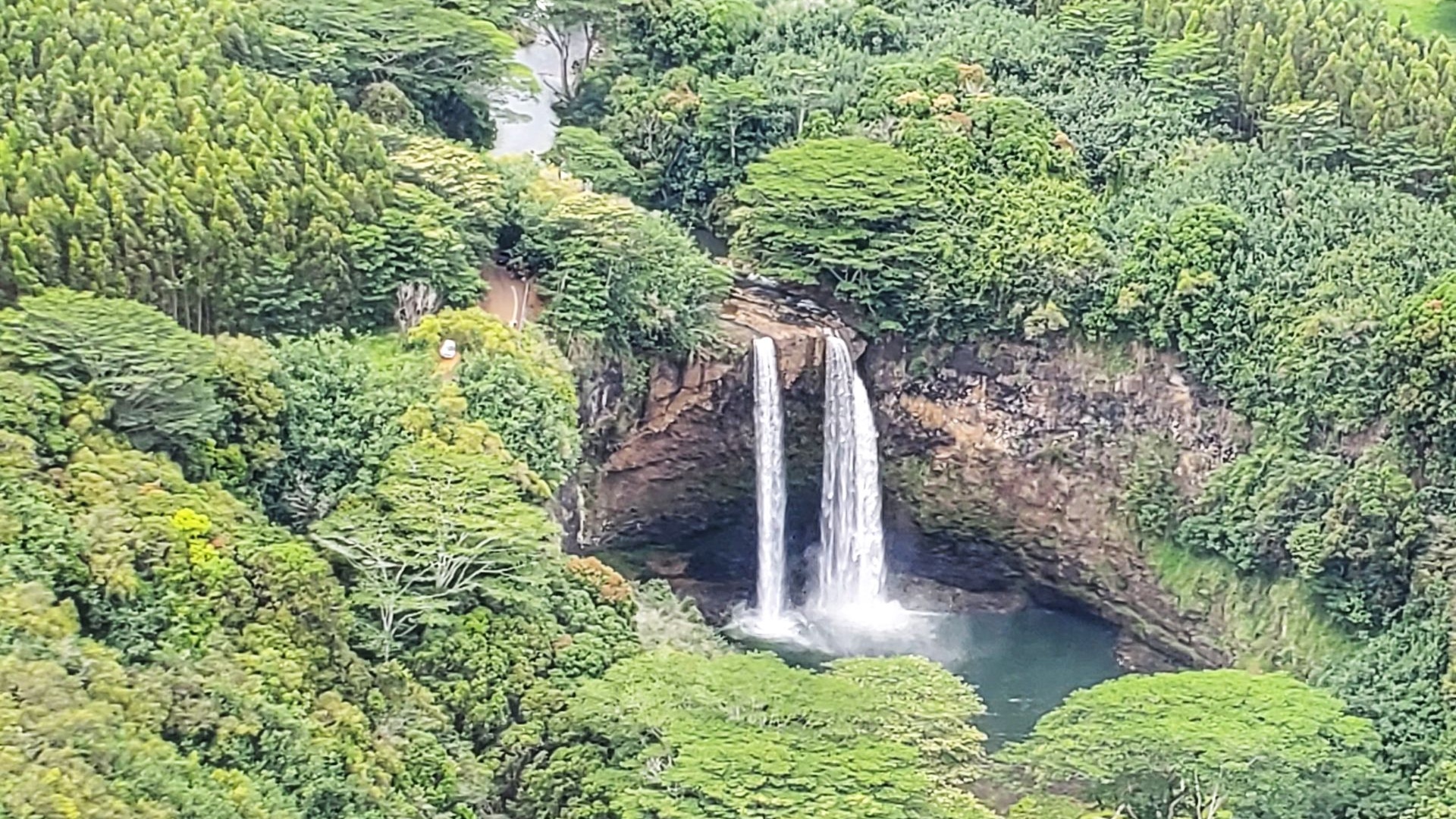
Visitors stopping at Opaekaa Falls on Kauai’s east side are encountering a new fee system that has surprised many travelers and sparked confusion online. Nonresidents are now charged $10 per vehicle plus $5 per person at Wailua River State Park, which includes the Opaekaa Falls overlook.
The change took effect in late February and applies to several stops within the park. The receipt functions as a day pass that also covers other Wailua River State Park locations, although many visitors appear unaware of that when they pull into the Opaekaa Falls lot.
Instead of a booth or gate at the entrance, visitors describe workers walking through the parking lot with mobile credit card readers and approaching cars directly. Several visitors reported they had barely opened their doors before being told there was now a fee, while others learned about it only after walking back to their car to leave. One woman said she had pulled in only to check maps on her phone and was immediately asked for $20.
$10 per car plus $5 per person.
The fee structure at Wailua River State Park is $10 per vehicle plus $5 per person for nonresidents, credit card only. A couple pays $20, and a family of four pays $30.
Opaekaa Falls is not a half-day park, and it is not a hike. There is no canyon drive with multiple overlooks and trails. The stop is a paved pullout along Kuamoo Road, a short walk to a railing, and a view across a valley toward a 151-foot waterfall with no legal trail to access the base. It’s just a quick stop for a photo that now costs bucks.
The Kauai Visitors Bureau confirmed to Beat of Hawaii that the receipt functions as a day pass. Visitors who pay at Opaekaa Falls can also access other Wailua River State Park sites the same day without paying again.
Most travelers stopping at Opaekaa are not visiting multiple park locations. People heading north toward Hanalei, back toward Kapaa, or toward the airport usually pull in, step out for a quick look, and leave again within minutes.
The state uses the same fee structure at places like Waimea Canyon, where visitors often spend hours moving between overlooks and trails, but Opaekaa Falls typically takes five to fifteen minutes from the moment you park to the moment you drive away. The view itself has also become increasingly blocked by vegetation over the years, and several visitors said you can barely see the falls unless you stand close to the road. One couple on social media reported they walked back to their car and said out loud, “$20 for that?”
Surprise fees and card readers in the parking lot.
Photos circulating online show signage explaining the new fee structure at the pay station. Visitors say they did not see any clear notice when entering the lot and that the first thing that happened was a person approaching their car with a card reader.
Many travel sites and guidebooks still list Opaekaa Falls as a free stop because the change is brand new. Several visitors said they thought it was some kind of a scam.
One visitor said she refused to pay, circled around the lot, and parked across the street instead. At the Wailua River marina, a visitor said an attendant stopped their car as they were leaving the parking lot and asked to see the receipt before allowing them to leave.
Another traveler said their group stopped at the marina on the way to the airport, only to use the restroom, and were told the full fee applied even though not everyone in the car stepped out. The same thing is happening at Wailua Falls, where workers walk through the lot, approach cars, and collect payment.
Repeat visitors are reacting hardest. Visitors who have been coming to Kauai for decades say they will skip the stop entirely now, while a Canadian traveler told us that once currency conversion is applied, the $30 family fee can feel closer to $40 in their home currency.
Visitor tip: plan a half day at Wailua River State Park.
Part of the confusion comes from how Wailua River State Park is laid out. The different attractions are not connected through a single entrance, unlike Waimea Canyon and Kokee State Parks. Instead, visitors drive to separate pullouts and parking areas for each location, leaving and re-entering the park area multiple times during the same drive.
That layout makes it easy for first-time visitors to assume each stop requires a separate fee. In reality, the entry fee is paid once per day, and the receipt functions as a day pass for all Wailua River State Park sites.
A visitor could begin at Wailua Falls, drive over to the Wailua River Marina and Fern Grotto area, and then continue up Kuamoo Road to Opaekaa Falls. All of those stops fall within the same state park system, and the same receipt covers them for the day.
Travelers who only stop at one overlook often feel the fee most acutely. Visitors who plan a short loop drive of the Wailua River sites on the same day tend to see more value in how the system is intended to work.
14 parks and counting.
In November 2025, the Department of Land and Natural Resources announced that four additional parks would join the paid parking system for nonresident visitors and commercial vehicles. Wailua River State Park on Kauai was one of them, along with two parks on the Big Island and one on Oahu.
The system went live at Wailua River State Park in late February 2026, bringing the total number of Hawaii state parks charging nonresident parking and entry fees to 14. Residents are exempt from any fee with a valid Hawaii ID.
DLNR says the program is intended to control unsafe parking and generate funding for park maintenance and improvements. State park revenue was about $2.9 million annually as of 2020 and was projected to reach roughly $15 million after fee increases and expansion. Officials said the four newest parks could add roughly $3 million per year.
DLNR has not disclosed how revenue is split with private parking operators or shown clear evidence that break-ins have declined at parks already using the fee system. We looked at those gaps previously in Hawaii’s Park Fee Logic Falls Apart.
The marina parking lots inside the same park largely serve private commercial operators running kayak rentals and Fern Grotto boat tours on the Wailua River. Some residents question why a government parking fee is being collected in a lot that serves mostly those businesses.
The river was a mess before the fees.
A former Wailua River guide who spent years working on the water there said problems along the river had long been building before the fee system took effect. The Wailua River marina parking area would often fill up early in the day and cars lined Kuamoo Road when spaces ran out, while rescue calls increased as inexperienced visitors pushed farther upriver without understanding conditions or distances.
Canoe clubs were dealing with inexperienced kayak renters clogging the river channel while commercial rentals continued launching new groups. Trash also became a problem upriver, including debris of all types caught in branches along the banks after busy days on the water.
The river corridor is sacred to Native Hawaiians and contains some of the oldest rock work on Kauai. Residents had been asking the state to step in for years. Some residents wanted the river managed, but say the rollout at Opaekaa has been clumsy, with a short roadside overlook now treated the same as a full park visit.
Arrivals are down, and fees keep climbing.
Hawaii ended 2025 with nearly 10 million visitor arrivals, down 0.6% from 2024 and still nearly a million below the 2019 peak. Hawaii hotel stays now carry a combined tax burden of roughly 19% once the state transient accommodations tax, county surcharges, and the general excise tax are added together.
Visitors are watching this waterfall fee on top of lodging taxes, rental car surcharges, resort fees, higher food prices, and reservation systems now required at several parks and beaches. Some longtime repeat visitors say they are comparing Hawaii against other destinations where they feel less nickel-and-dimed at every turn.
The story spreading right now is not about a beautiful waterfall but about being chased down in a parking lot with a card reader, and that is what is nagging.
Have you stopped at Opaekaa Falls recently, and if so, what happened when you pulled into the lot?
Photo Credit: © Beat of Hawaii viewing Opaekaa Falls by helicopter.
Get Breaking Hawaii Travel News




Thanks for the heads up. I make sure to not bothering to come to Kauai in the future. I remember going to to slippery slide out in the cane fields back in the good old days.
Waterfall charges are ridiculous! No wonder tourists are not coming back to Hawaii!
If you visit Wailua Falls, the marina, and Opaekaa all in one day the $20 fee is not horrible. But I agree that almost nobody knows it works that way. Why is that?
Same situation at Rainbow Falls on the Big Island. Rainbow Falls is a 10-15 minute stop, if you read every word of the signage and take 10 pictures.
But is that fee good for all the places you visit that day??
Well we wrongly thought it was a scam at first. My husband actually rolled the window up because we had no idea who the person even was.
Honestly, $20 is not such a big deal for people spending thousands on a Hawaii trip. But if you’re going to charge it, at least make the process clear and organized and respectful.
It wasn’t the fee that bothered me. It was the way it was collected. Sometimes Hawaii seems so clueless about handing things. And approaching your car with a card reader where visitors/guests don’t understand what they’re paying for just feels weird.
Mark my words, charge tourists for the popular spots and you’ll just push them into the places you really don’t want them.
Property owners, condo owners with a current tax bill & out of state drivers license or ID should not have to pay Visitor fees in State parks.
Time share owners directly pay the property tax too. Even though that’s true, the have the audacity to charge us 19%, including 19% on the property tax we pay.
So glad we have been to see everything in Kauai over the years. Now, we just sit on the beach because between needing reservations for everything and crowds everywhere it is just too much work. We come for the beauty and relaxation but I see a time coming where we won’t visit. Kauai is not what it used to be. I guess if you don’t know what it was you know no better. It saddens me so much.
The many times I have stopped at Opaekaa Falls…the lot has Never been full. Let’s call this what it is…a money grab. You wonder why visitors treat Hawaii like a theme park.
The picture looks like Wailua Falls yet the story is about Opekaa. Is there a fee if we only want to go to Wailua Falls ?
Thanks .
Rainbow Falls in Hilo on the Big Island charged us $17 for parking on our recent trip.
The view of the falls was disappointing since there was a bunch of over grown vegetation obscuring the view. You would think with the charge for parking that DNLR could afford to trim the bushes to allow for visitors to have a better view.
For a stop that is just 10″ or so. I would park on the street somewhere and walk to the falls instead.
The Pali lookout on Oahu charges as well, although not as much. I was surprised to be approached by someone with a card reader saying it was $7/vehicle when I stopped so my guests could take a photo. I am a resident, so after showing my drivers license I didn’t have to pay, but I thought it was ridiculous. This is not a trailhead, or part of larger park area that I know of.
No one explained this. If the fee covers the whole Wailua River State Park for the day, it actually makes some more sense. This wasn’t handled well at all.
We stopped there last week and had the experience described. Someone literally came running up to the car window before we even got out. It felt awkward and honestly a little uncomfortable. We just left.