
Kauai was doing just fine with arrivals before Hurricane Lowell. During the first six days of September, an average of 2,299 passengers a day arrived directly on domestic flights, actually up about 5% vs. comparable days last year.
Then Lowell hit; visitors were asked to reschedule trips or visit another island, and the number collapsed. During the latest five days available, September 19 through 23, direct domestic arrivals averaged just 859 passengers a day. The comparable number last year was 2,247, down nearly 62%.
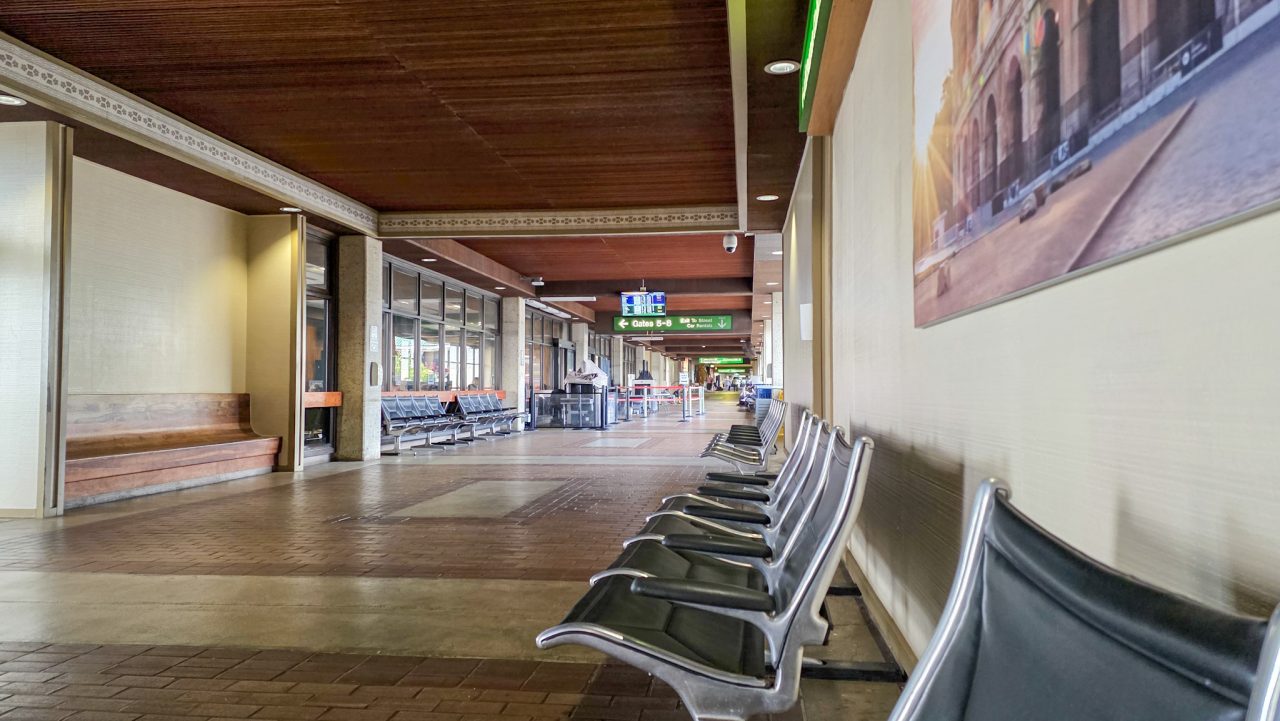
We noticed this long before we ever saw these tourism numbers. Last week, Lihue Airport was nearly dead when we were there. The island was only beginning to move beyond the immediate emergency, and we wondered in our story about when visitors should return to Kauai how an island could tell travelers it needed space, then tell them when it was ready again.
Much of that message has now changed. Kauai is welcoming visitors back, businesses need customers, and most accommodations, restaurants, shops, tours, and activities are operating. Arrivals haven’t followed at nearly the same pace, however.
The drop happened virtually overnight.
DBEDT’s daily passenger data gives us an unusually clear before-and-after look because Kauai wasn’t experiencing an arrivals decline immediately before Lowell. From September 7 through 13, the average fell to just 461 a day, down nearly 79%.
September 8 recorded no direct domestic arrivals, according to the state. But by September 9, the number had climbed to 1,028, then fell back to 449 the next day and 377 on September 11.
These aren’t visitor counts in the strictest sense. The state includes returning residents and other arriving passengers along with visitors, while interisland passengers aren’t included in their metrics. But it does provide comparable prior-year dates, giving us a very useful look at what happened to direct domestic traffic into Kauai.
Arrivals have climbed from the bottom, but the recovery remains modest. From September 14 through 18, they averaged about 580 a day. Over the next five days, that increased to 859, still less than 40% of last year’s comparable level. On September 23 alone, 768 passengers arrived directly on domestic flights, compared with 2,123 on DBEDT’s comparable day in 2025.
Kauai is welcoming visitors, with a few major exceptions.
Immediately after Lowell, asking visitors to stay away made sense. Power was out across much of the island, roads were damaged, fuel and other supplies were strained, and crews needed room to work. Beyond that, it took time to assess exactly what had happened and what it would take to return to any kind of normalcy.
The Hawaii Tourism Authority’s September 23 update now says most accommodations, restaurants, shops, tours and activities have reopened. Travelers are being told to proceed with their trips when the essential parts of their itinerary are available, while rescheduling if those pieces aren’t.
Some of Kauai’s biggest outdoor attractions remain unavailable.
Waimea Canyon and Kokee State Parks remain closed, along with Haena State Park, Polihale State Park, and the Na Pali Coast State Wilderness Park, including the Kalalau Trail. Kokee Road also remains closed until further notice, and all state park camping on Kauai remains closed.
Wailua River State Park is one of the limited exceptions. The river and designated landing and trailhead have reopened, but hiking beyond the trailhead and access to Secret Falls remain closed. The Waimea Valley section of Puu ka Pele Forest Reserve has also reopened on a limited basis, while its major trails remain closed.
That’s a changing picture from what we reported about Kauai state parks still closed after Lowell. Yet for anyone coming primarily for Kokee, Kalalau and Haena State Park, Waimea Canyon, or other state lands, a major part of the trip still isn’t available.
Beaches add another layer of confusion because county beach parks and state parks are entirely separate systems. Many county parks have reopened, but Haena, Black Pot, Hanamaulu, Poipu, and Salt Pond beach parks remained on the County’s September 23 closure list. A beach can also be physically accessible while the government park associated with it remains officially closed, so people on the sand don’t necessarily mean parking, restrooms, lifeguard facilities, and other park infrastructure have reopened.
For travelers trying to sort through the changing picture, Open Kauai tracks hundreds of businesses and visitor experiences as open, partially open, or closed, sometimes with expected reopening dates. The nonprofit Activities and Attractions Association of Hawaii created the site, and HTA now recommends checking it when planning a Kauai trip during this time period.
Businesses are waiting for the visitors too.
The creation of Open Kauai reflects another critical aspect of the recovery. Businesses that have reopened need a way to tell travelers they’re operating even while other parts of the island remain closed, and the site grew out of an online meeting where so many businesses were sharing their status that keeping track became difficult or impossible.
There are also indications that changed travel plans could extend beyond September. One Kauai business owner told the Associated Press that customers were canceling trips as far out as November. We don’t know how widespread those cancellations are, and the daily DBEDT numbers can’t tell us what future bookings will look like.
A canceled Kauai trip doesn’t automatically come back.
Travel decisions made during Lowell were often much bigger than canceling just one aspect. People changed flights, moved vacation rentals, switched islands, or postponed Hawaii entirely. Some were told explicitly that Kauai needed time to recover before their visit, while others were told to come anyway.
Once those decisions were made, there was no reason to expect all of them to reverse when conditions improved a week or two later. Airline schedules may account for some of the remaining difference, although we haven’t found evidence of any continuing reduction in mainland capacity remotely approaching the decline in arriving passengers.
September is normally a slower travel period for Kauai, which in fact makes it highly desirable for visitors in the know. But even that doesn’t explain the enormous year-over-year gap.
Lead Photo Credit: © Beat of Hawaii at Lihue Airport on September 15.
By Rob and Jeff, Beat of Hawaii.
Some of the most meaningful parts of Hawaii are the ones visitors walk right past without knowing they are there. We’ve spent nearly 20 years finding them firsthand for BOH as full-time Hawaii residents reporting on travel, culture, and island life, and telling you what they mean for your trip. Join us →
Get Breaking Hawaii Travel News

It takes time. When they know the Island has fully recovered, they’ll start coming back in droves. Another factor is that this super-charged El Niño is still spurning hurricanes in the Pacific. So some are probably waiting until after hurricane season is officially over.
The Waimea canyon & Haena state parks are literally the reason tourism is still Way down.
A message to visitor-related entities: Treat your customers right or they will never come back. It includes refunds to visitors for a product that was not delivered in spite of being out of their cancellation window but having them hold on to the reservation for two weeks or more so they can check back in to witness the impressive, inspirational progress of recovery. Most importantly, tell them we are sorry about not having all the expected landmarks open and offer our gratitude while assuring them that Kauai is still a special place with special people no matter what and that they will not regret their stay.
My family and I had an absolutely wonderful time in Kauai and left just before Lala. We are Canadian and the trip was crazy expensive all in USD (flight, food accommodation), etc. but we chose Kauai because we love Hawaii, we love the culture, people and its unapparelled beauty. Keep your heads-up Kauai, you will recover and people will come back. Affordability is an issue and tourism needs to recalibrate post COVID – just too expensive everywhere. On a final note; if I were not working still and my early teenage boys were a bit older i’d be on a plane with my chainsaw to come and help – !
Where are the tourists?, well it appears they are demonstrating their dislike in what has happened to Hawaii over the years. No longer reasonably priced, and the Aloha Spirit and experience has vanished! Human greed is of course the blame, as it always is.
But Hawaii is not alone, it has happened all over the world. At 80 years old, I have had the unfortunate pleasure of watching it happen everywhere.
With regards, and Aloha,
Kawika K
As far as we can determine the Kapaa area where we usually stay suffered only moderate storm damage. We will be staying for several weeks arriving
on October 16th. Does anyone know how our favorite swimming area
at Lydgate Park survived? Sometimes in past years it’s ended up full of sand and logs?
I helped with the beach clean up a few days ago. It’s in very good shape! We were picking up some debris from the recent rains, but it looks good! The water wasn’t clear for a few days after Lala, but it’s fine now.
Aloha and Bonjour! First, thank you very much for your wonderful website- love the relevant and accurate information, as I am planning a trip soon, with my daughter. Just wanted to inform you that the posted link “(openkauai”) did not work for me. However, the actual website is works just great. Thank you also to internet users who mentioned in comments that many islanders still welcome visitors like me and my kiddo, as I don’t want to be in the way. I want to contribute as a regular visitor and help your local economy – not be in the way or exploit. I too live in a tourism-heavy locality. We are looking forward to activities that are/will be available in October. I already could see with great excitement that many boat tours will have resumed — we dream of seeing the wild Na Pali coast from the ocean! The island is so wonderful, there will be plenty of options anyway! Mahalo to all!
For better or for worse, many people come to Kaua’i for hiking. Moreso than maybe any other island. When DLNR just says parks are closed “for the foreseeable future” with no staged reopening or updates, what are visitors supposed to do? Come anyway and have a radically different vacation than what they had planned? Waimea Canyon and Napali Coast are quintessential Kaua’i experiences that can’t just be swapped out with a day shopping for tourist trinkets in Poipu.
Residents are now asking visitors to return and spend money. What do visitors get in return? It may not be meant this way, but it’s very insulting. Tourists are people not walking ATM’s where money can be withdrawn on a whim.
I don’t blame you for feeling that way one bit. The whole reason people come to visit Kauai is for the outdoor activities. If folks wanted to mostly shop, or take advantage of the restaurant life, they would go to Oahu.
The truth is, you’re being invited back quickly because they need your money to keep people employed and their businesses running. Unemployment on Kauai is skyrocketing. They’re not as concerned about your experience.
Some people are ok with that because they want to help with the recovery. Some, like you, are not because of the severely diminished return. As I said, I don’t blame you one bit. It’s an individual choice, as it should be.
Don’t be surprised when vacation prices skyrocket next year as businesses and owners try to recoup losses from Lowell.
As best we can tell the East side of Kauai only suffered moderate damage.
We will be arriving October 16th and staying for several weeks.
Does anyone know the condition of our favorite swimming beach
at Lydgate Park?
We are scheduled to fly LAX to LIH tomorrow (Sat 26th) am non-stop on AA. KIUC just got our power back on from Lowell Thursday night, and now it’s Nolo time. So far, our flight has not been canceled, but I think the plane will be mostly empty, since they upgraded us 48 hours before departure, and that never happens on flights to Hawaii. If we did not have a house on island, I would wait until storm season over.
FYI – The link for the “Open Kauai” site wasn’t working for me this evening (9/25). In case this was ‘operator error’, I’ll try again tomorrow.
Hi Lissa.
Thanks. We encountered it working only intermittently as well.
Aloha.
We are receiving at-least weekly updates from our timeshare on the South Shore. Power is resumed and debris is being cleared away. But – a). the pools must be drained, and sterilized, but the pumps are inoperative and will be down for several months awaiting parts, – b). some elevator shafts need to emptied, and then subject to rigid inspection, – c). the propane lines for the jacuzzis and pool heaters must be cleaned and pressure tested before resuming operation, – d). and so on and so on. – It doesn’t sound like they are ready for our return to me…. Considering the damage inflicted on this one property, I find it hard to believe your reporting that the rest of the Island is ready for us to return. Have all of the Ziplines been completely tested? Are the beaches really totally cleaned? Has the mud been cleaned out of the non-main streets? very report I read includes statements that residents are bracing for the next storm, not waiting for the next plane full of tourists.
The answer to all of your questions is unfortunately, no or probably not. All of that takes time and the skilled workers required to accomplish the task do not live on Kauai. I would double, triple check before spending an inordinate amount of money just to be stuck at the resort or aimlessly driving around with nothing to do. The main reason tourists are being invited back so soon is because people are being laid off, left and right. It’s a bloodbath and they need those tourist dollars so that people can eat. I can’t say I blame them, but that’s the unfortunate result of having tourism as the main industry. Most people work in it or their work is closely linked to it.
We own a condo in Poipu. Immediately after the hurricane, within days, we had ten cancellations up to and including the first half of December. “Lowell Damage” was the reason. Even though we tried to explain that much was still open and that they could have a wonderful time – especially a month or more out – they still cancelled. That’s many many thousands of dollars out of our pocket that we can’t just cover.
When queried, guests said their decision was based on the mayor’s comments to avoid Kauai. How sad. How short sighted. Could he have not taken a day or so, talked to businesses and understood that there was damage, but that the island was still open?
The economic damage from Lowell, I believe, will eclipse the physical damage. Good to see messaging really turn around, but it may be too little too late. The damage has been done.
It was a natural disaster. Certainly not as bad as Iniki, but everything costs far more than in the early 90s. Cancelling an expensive vacation with a hurricane heading that way, or in the aftermath, is absolutely understandable and should be expected. The blame, and plenty there be, should be on the incompetent and overblown tourism entities at the KVB, HVCB and HTA. So many employees and managers and they can’t get the messaging out in any direction. For the 35 years I have been watching closely. They have everything and everybody, including substantial budgets and public funding, and have never had a crisis manager. And the crises have been many—Iniki, 9-11, SARS, Denge, volcanic eruptions, tidal waves, floods, Covid, airline consolidations, devasting brushfires, and two more very recent hurricanes. And the lamest, uncoordinated responses. There are many folks who can’t even get their money back on vacation rentals due to the hurricanes. Get rid of the dead wood and get a pro.
Well said Martin! We’ve been coming to Hawaii for 60 years, and most of those are trips to Kauai where we have a timeshare in Princeville. Talked to our manager today and he informs me that they are receiving guests and that most everything is open, including restaurants and shops. However, it is obvious that over the last 10 years or so Hawaii’s incompetence and inability to organize and deal with natural disasters and seasonal tropical storms is beyond comprehension. It seems like the incompetence of Hawaii government and institutions are systemic and perpetuated from generation to generation. Nepotism and the good old boy network controls everything. This is not sustainable long-term.
Today Hawaii has lots of competition for tourist dollars, and it won’t take long for tourism to experience a major downturn just like Las Vegas has experienced over the past year or so.
Aloha to all.
Wow…well said you too Daryl. I didn’t even make the Las Vegas connection. I think we’re at the beginning. The ongoing upward pressure of prices and the growing disdain of the local population towards visitors has been making it increasingly challenging for tourists to choose Hawaii. This very bad weather year we’re having is probably the straw that breaks the camel’s back.
No surprise. Tourists have simple on/off or Pause buttons. They can’t be expected to cancel
Everything then two weeks later be told okay, you can come back, Right Now (please)! It doesn’t work that way. They’ve moved on already. And that doesn’t mean just the tourists in the short two weeks after an event. It includes tourists in the long run, further into the future, months from now even. The Hawaiian Islands need to have more coordinated messaging and not allow sites like Reddit Facebook to be driving the message
I meant they DO NOT have simple on/off buttons
Thank you for these updates. They are very informative and helpful. I have clients coming to Kauai Oct. 19-23.
What your missing is the super El Nino currently has three Tropical Storms/Hurricanes brewing in the Pacific as I type.
I was there for Lowell and left my condo 3 weeks earlier than planned.
I’m planning on buying a solar generator to at least power the refrigerator and coffee maker and a fan or two.
I’m not coming back till beginning of December, well after the hurricane season.
We’re still coming. Reluctantly. Something I thought I’d never say about a trip to Kauai. We still don’t know where we’re staying for the second half of our trip. One host wouldn’t let us out of our contract. The other strung us along till less than a week from our departure and cancelled. This has been an anxiety ridden roller coaster. Damn Lowell to hell.
FYI – The Open Kauai link isn’t working right now.
Have been coming to Kauai for 40 years. So upset with what the hurricanes have done to the Island and it’s people. Changed our trip to next May. Let the island heal. So I did some shopping online to all the places I go to when I’m there and will make a nice donation to Kauai food bank. Aloha 🌺🌺🌺. I will miss you Kauai !!
I’m a tour guide on Kauai and I know from the Lahaina fires people were coming to Kauai instead of Maui for months after the all clear to come back was given. Mainlanders see these posts on social media from frustrated locals and remember those and it just reads as don’t come here, period. Every time a public figure talks about Kaua’i I wish they would remind the viewer for the next few months that we are open.
It’s too bad that a small minority of residents who hate tourists use every excuse online to tell them to stay away. I recently spoke up and said that the islands hurt worse when tourists stay away, hoping to “let us heal”, and was lambasted by those few. Of course people have to be realistic but the news shows the same bad areas over and over and it’s almost never as bad as it makes it seem.