
Most Hawaii trips are as solid as something that can be tightly packed and cleanly delivered. Pick the island, book the accommodation, reserve the car, add an interisland flight if needed, lock in activities, and assume the rest is just logistics. This past week showed how fast that can break entirely.
The major Kona storm brought flooding rain, damaging winds, power outages, road closures, flight disruptions, shelters, and emergency declarations across the state. On the Big Island, Kilauea had just been erupting before the storm, dropping tephra onto roads and closing Highway 11 for clearing.
So while Hawaii vacations are still marketed like a finished consumable product, in reality, that’s only true until the islands decide otherwise.
What a Kona storm is like.
A Kona storm is not some weird fluke. It is a known cool-season weather pattern we expect every winter that can stall over the islands for days or longer and drag in heavy rain, thunderstorms, flooding, and strong winds. Visitors still tend to think of Hawaii weather as a brief shower, a cloudy beach day, or one missed sunset. One that you can skirt around by simply picking another beach, another region of an island, or another island entirely. A Kona storm is completely different because it can hit all of the islands at once and start messing up entire trips.
A lot of visitors come here with a tightly stacked schedule because Hawaii is expensive, and nobody wants to waste a day of it. They split time between islands, book nonrefundable accommodations and activities, leave almost no slack between flights, and count on roads, parks, and weather holding together reasonably well. Once a storm like this one moves through, those weak points get magnified. What looked efficient on paper starts to look more fragile than anyone expected, whether a visitor or a resident.
This Kona storm was big by any standard.
The state issued multiple emergency proclamations, with the second extending relief through March 18. Well over 100,000 customers lost power statewide. Wind gusts topped 100 mph in some areas. Maui saw as much as 32 inches of rain in about 72 hours on parts of the island. Oahu opened seven emergency shelters. Travelers were still stranded through at least most of the week.
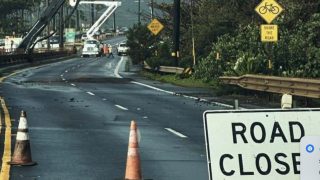
Maui took some of the worst damage early. The Road to Hana was closed. Flooding and debris cut off access in East Maui. Other roads were closed due to washouts, bridge concerns, and utility hazards, which can wipe out an entire side of a trip for visitors staying in one area and planning a full day elsewhere. A lot of people book Maui thinking they can drive where they want when they want. That works until this week, it did not.
Oahu had its own problems. Emergency shelters opened as conditions worsened. A Wahiawa Dam evacuation warning went out for parts of Waialua and Haleiwa before it was later lifted, which is the kind of thing that changes how everyone moves around the island and what abruptly no longer feels optional or safe. The 30th Annual Honolulu Festival, which had drawn roughly 2,500 performers and visitors from Japan, lost its Grand Parade down Kalakaua Avenue and the Nagaoka Fireworks Show over Waikiki Beach to the storm.
Kauai held up better than Maui and the Big Island, but better does not mean normal. Polihale closed. Kalalau Trail closed, as did all other parks. For many visitors, those are not side activities but central reasons to book Kauai, and once they are gone, the trip changes immediately, even if the hotel is open and the airport is still technically running. There was just nowhere to hide and nothing to do.
The Big Island got hit from two directions.
Kilauea was erupting, and the storm was moving in. Tephra fell in and around Volcano, with reports of up to 6 inches in Volcano Village and nearby areas. Highway 11 had to be closed for clearing equipment and debris. Visitors and residents who thought they were dealing with one problem were suddenly facing multiple problems.
It was a Kona storm layered on the heels of an active eruption, road closures, and park-area disruption, which is the best way to understand what happened on the Big Island. Visitors usually think one risk at a time, but Hawaii stacked them up this week. Rain is one issue. Fierce wind is another. Closed highways are another. Volcanic fallout is another. Put them together, and a Big Island vacation in particular can turn into something very different from the version people thought they bought.
The flights broke down where Hawaii trips are most vulnerable.
A lot of Hawaii vacations depend on interisland flying more than visitors realize, especially for mainland travelers trying to connect from another island to or from the mainland, or combine Maui and Kauai, Oahu and the Big Island, or a resort stay with a family stop on another island. Those flights are not extra. They are the connective tissue of the trip and of the islands for residents. Once those start failing, the whole structure starts coming undone.
This storm hit the air network hard. Maui saw between 27 and nearly 40 inches of rain in parts of the island over about three days, and Kahului Airport recorded more rainfall in four days than it typically sees in an entire year. Honolulu had 35 delays with long lines forming at TSA security. On Friday alone, Honolulu recorded a single-day rainfall total that broke a record dating to 1951.
Some travelers were stranded for days. Airlines offered waivers, but a waiver does not create empty seats, reopen roads, or get you to the island where your hotel and rental car actually are, especially for interisland travelers with short stays, prepaid activities, and onward tickets that depend on everything lining up to some degree.
A weather waiver sounds helpful, and sometimes it is, but it does not solve the larger problem if the entire infrastructure is jammed across multiple islands. Flights are limited. Hotels may already be full. Rental car reservations do not always line up cleanly. Once one part gives way, trips can quickly lose their shape. That is the part visitors do not always understand when they book Hawaii, as if it were one place with a simple backup plan.
This week’s Kona storm exposed what was already there: many Hawaii vacations are built on a chain of assumptions about roads, flights, weather, and island access, and once one part breaks, that carefully built trip can unravel a lot faster than the booking confirmation ever suggested.
What has your own experience been when Hawaii weather, road closures, or flight disruptions turned a carefully planned trip into something else entirely?
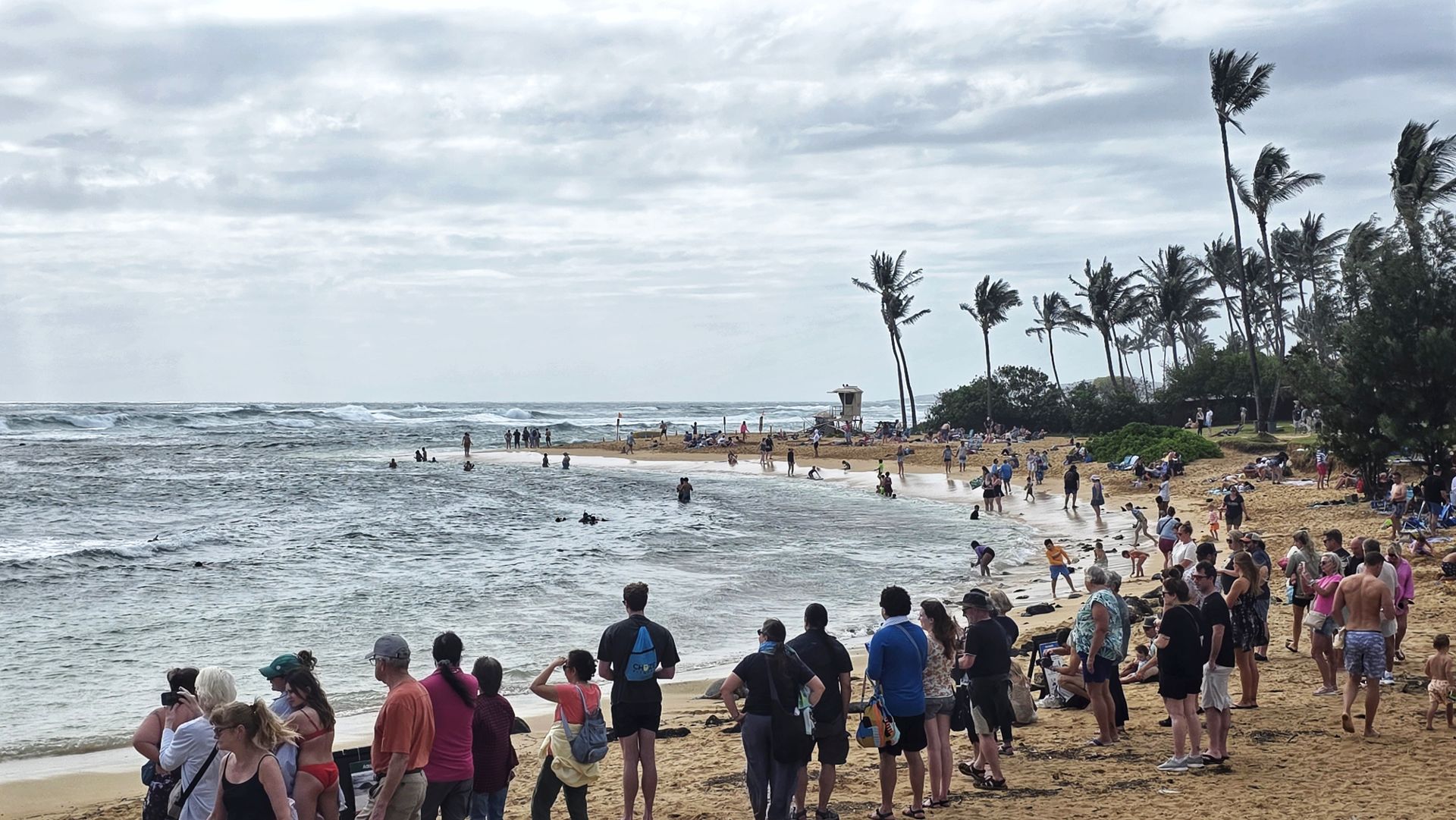
Lead Photo Credit: © Beat of Hawaii at Poipu Beach on Sunday, March 15.
Get Breaking Hawaii Travel News

We were on Kauai during one of those big rain events years ago and the hardest part was not even the rain itself. It was that every alternative plan was the same plan everybody else had at the same time. Restaurants packed, stores packed, every indoor spots packed, roads crawling, people frustrated. Hawaii does not need a total shutdown to stop feeling like any vacation you had in mind.
I hope that Hawaii will not be ruined for months or years by this big one. Storms hit, cleanup happens, and people move on usually. Hawaii is slower but still.
Most mainland forecasts make Hawaii look like a few clouds and a passing shower. They do not explain what island, what side, what road, or what it really means if a big storm comes and then stalls. Visitors think they are checking the weather, but a lot of times they are not checking the right weather. Even the NOAA forecasts were weird and I only got to the bottom of it through the detailed discussions by forecasters.
This is just an example why we always stay put on one island now. Too many moving parts otherwise and too much stress.
There are always people in these comments who say they’ve never had a problem, so therefore everyone else is exaggerating. That usually means they’ve just been lucky. Hawaii can be smooth as glass until suddenly it isn’t, in one way or another, and then you find out how tight your trip really was.
Some of this comes down to how people plan Hawaii. If you try to cram two or three islands into one week, you are asking for trouble even without a big storm. Hawaii is definitely better appreciated by slowing down.
People don’t realize how little margin there is here in Hawaii until something breaks like this. One delay here can knock out the whole rest of the trip. And residents are in clean up mode across the state right now.
This is one reason why we stopped doing two islands in one trip. Too much can go wrong and when it does there is no easy recovery. This was unusually bad for sure.
Curious about how the storm affected MolokaI and Lanai. Any updates from there?
As a resident on the Big Island in Kau we got the brunt of the storm. the weather gauge on our property recorded 21″ of rainfall overnight and high winds made the situation even worse. Roads north to Kona and south to Naalehu were cut off to say nothing of trying to reach the parts of Volcano. The local stores and many businesses were and still are closed. We are just now picking up the pieces and have several roof repairs. This is the worst storm we’ve seen.
I have been following the Hawaiian weather closely since I will be visiting from March 20 to March 31. It looks like the storm will be mostly gone for my visit.
We have another weather front coming in on Thursday for a couple of days according to weather reports but it shouldn’t be as devastating as this one. However the hills and land are saturated with water now so stay safe.
Aloha! We canceled our trip to Kauai in late February due to the intense rainy season they are having this year. We’ve rescheduled to go to the big island in May to see the Robert Cazimero lei day concert in Waimea.
A part of knowing and respecting Hawaii, is to be in touch with what is happening there and adjust as need be. Tourists, travel agents and companies need to be more knowledgeable about these types of situations.
When I called Costco to cancel and reschedule, the designated Hawaii agent had no idea about the bad rainy season they are having and he said that he hadn’t heard about any bad weather conditions or flash flooding.
The authors are correct about just how fragile a trip to Hawaii can be. We knew that alot of rain was likely but had no idea about the extent of the Kona front until we arrived. And we checked multiple weather sources leading up to the trip (apparently not the correct sources). Not sure we would have come had we known. Our family arrived at OGG at around 8 PM on March 13. We had no problem getting our rental car, but the hotel we were at for the 1st night was experiencing flooding problems(ankle deep water) in the lobby. We had concerns abt travel to Napili the next day, but got up early, waited for a break in the rain and then headed out. We had just a short debris clearing delay plus a slight detour on highway 30, but otherwise the drive was uneventful. I applaud the Maui County road crews for their work keeping traffic moving safely.
This week will be different than prior trips. Keeping 2 young grandsons entertained indoors will be a challenge. Not alot to do here indoors.
A source for weather reporting is YouTube “worldwide weather watch”. The meterologist was reporting the Historic Kona Low ten days ago. He works for Alaska Air and has family on the Big Island, so has accurate Hawaii info.
My husband and I were in Oahu on September 11, 1992 when Hurricane Iniki hit. Our plans to go to Hanauma Bay that day for snorkeling obviously got canceled. We were leaving the next day for Kauai for 5-nights, but since its eye made landfall on Kauai, the island closed down so we changed all our reservations very easily and went to the Big Island instead. After that we went on to Maui. First time ever in a hurricane, but it really didn’t ruin our trip at all. I still have my t-shirt that say, “I survived Hurricane Iniki.”
Can you explain what the difference is between a Kona storm and any other storm?
Thanks
Kona storms (also called Kona lows) are a type of seasonal cyclone in the Hawaiian Islands, usually formed in the winter from winds coming from the westerly “kona” (normally leeward) direction.[1] They are mainly cold core cyclones, which places them in the extratropical cyclone rather than the subtropical cyclone category. Hawaii typically experiences two to three annually, which can affect the state for a week or more. Among their hazards are heavy rain, hailstorms, flash floods and their associated landslides, high elevation snow, high winds which result in large surf and swells, and waterspouts.
Karma not the weather. The greed that Hawaii has thrown at tourists has come back to bite them. How long will this storm damage last in Hawaii time? Probably months. IMO purchase travel insurance and good luck to those who booked their vacations 3-6 months ago to encounter this. Welcome to Hawaii’s aloha storm spirit.
I posted here a week ago that travelers should cancel their trips. Live webcams now show beaches that have lost most or all of their sand. Hawaii will not be the same for months or years. 😥😢🥺