

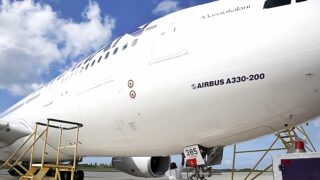
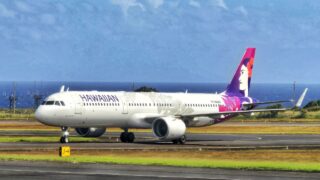
Honolulu air traffic controllers alerted Hawaiian Airlines to a possible fuel leak on a widebody aircraft shortly after takeoff. The A330 flight bound for Seattle, which we wrote about yesterday, returned to Honolulu after controllers observed what appeared to be fuel streaming from one of its engines. The crew worked to assess the situation, ultimately declaring an emergency and preparing for a precautionary return landing. A potent discussion between the flight crew and airport fire personnel over deplaning procedures added another layer to the event, as heard in the YouTube video below.”
Passengers react as an emergency unfolds.
The flight, identified as Hawaiian Airlines 22, had just departed Honolulu when ATC observed what appeared to be a fuel leak trailing from the aircraft. Controllers alerted the pilots despite no immediate cockpit warnings, who began emergency protocols to assess the situation.
Passengers onboard first noticed something unusual when the aircraft leveled off unexpectedly instead of continuing its climb toward Seattle. Some reported seeing fluid streaming from the wing and informed flight attendants, adding to the situation’s urgency.
With a precautionary landing now necessary, flight attendants secured the cabin while the crew prepared for a safe return. The aircraft landed without incident at Honolulu International Airport, where emergency vehicles were staged for arrival.
Debate over deplaning.
As the aircraft came to a stop, a discussion arose over whether passengers should remain onboard or deplane immediately. The aircraft commander advocated for deplaning, citing the unknown risk of the fuel leak and the aircraft’s reliance on emergency battery power after the engines were shut down.
Airport fire command initially suggested keeping passengers on board, believing any potential fire risk could be managed while expressing concern about deplaning on an active taxiway. The exchange, captured in air traffic recordings reflected in the YouTube video below, reflected a fascinating, rarely heard discussion regarding safety priorities between the flight deck and emergency personnel.
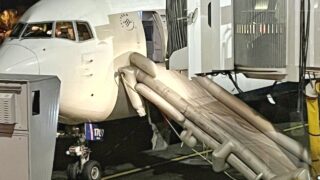
Ultimately, the captain’s decision prevailed, and passengers deplaned via airstairs to an adjacent grassy area before ultimately being transported by bus to the HNL terminal.
The second aircraft takes over.
As we previously reported, Hawaiian Airlines swiftly arranged for a replacement aircraft to complete the flight to Seattle. The substitute flight departed later that evening, touching down early Monday. The original aircraft was moved to a separate gate for further inspection but soon thereafter returned to service.
Hawaiian has not yet disclosed the cause of the fuel leak.
While resolved without injuries, this incident highlights how quickly midair mechanical issues can escalate and are managed by expert teams. The coordination between ATC, the flight crew, and emergency responders was crucial in preventing a more serious outcome.
For passengers, it served as a reminder that while flying remains statistically safe, disruptions like these can lead to delays, rebookings, and unexpected complications.
YouTube video of the incident follows. This video is courtesy of VASAviation.
Were you on this flight? We’d love to hear about your experience. Mahalo.
Get Breaking Hawaii Travel News

Over 20 years flying to the islands, my experiences have declined over the years. Aircraft with mechanical problems last minute of course, delays, close to inedible food served even in first class! The attendants have always been very pleasant. Come back Hawaiian!
Given that under the FAA Rules the Pilot in Command is the final authority on the safety of the trip, I’m glad to see that he “won” in the final call. The ground pounder was not the PIC and should have deferred to him immediately.
Very interesting. Actually good back and forth between all parties. There is so much coordination required during an emergency and am glad to see this did not go “south”.
Weird how all these happenings are involving Hawaiian Airlines. May everybody move all their bookings to Alaska as well as your mileage points and airline credit card. I think United and Delta fly Airbus planes and they have never had many engine problems or these funky incidents. Maybe it’s because all the topics involve Southwest,Alaska, and Hawaiian Airlines only.
Don, Delta and United have had their share of incidents mainly with older equipment. Delta is mainly Airbus but to Hawaii they fly a number of older B767 300’s.
Generally Airbus have made big inroads with minibuses (320/321 series) which are popular across the main carriers but Hawaiian have had bad experience there and Alaska are very Boeing aligned on narrow bodies. I try to fly B777 300 or B787 9/10 or A350 900/1000 to Hawaii (sometimes via Mainland sometimes via Japan). Nice new equipment….
I have been concerned for some time with the elderly aircraft (A330, B757, B767 and B772) which are flown to and from Hawaii by some carriers. The older the equipment the more care it needs in maintenance, be it frame crack checks, pipes, hoses, wiring, mechnicals etc. I am always much happier on a newer B787, B773 or an A350. (I am only listing heavies as I try to avoid single aisle aircraft for Oceanic flights.)
The ATC was interesting. Having seen the almost explosive like fire of the A350 when I was at Haneda last year, I think the Captain was right in deplaning on safety grounds. Additionally as the crew elected not to start the APU lest it cause a fuel ignition, keeping a full plane of pax onboard in Hawaii heat without AC or ventilation for 10-15 minutes could likely have made the situation much worse.
My wife and I were on this HA 22 Honolulu to Seatac.
We had arrived in Honolulu on HA452 from Sydney a few hours earlier.
On our HA 452 flight of 10 hours we were provided a cold small sandwich cut in half with inedible lettuce, in a paper container with a small blueberry very cold roll…that was it the entire flight. Upon stretching my legs during flight I walked forward between First and Economy and discovered snacks in a plastic bag on the counter in front of two Flight Attendants. I asked if these were for passengers..yes..well why not dispense these? Their answer we don’t have enough for all passengers.
Flight HA 22 we commend the pilots! The Emergency Fire Captain at least twice suggested to our Captain our plane not be deplaned without busses sitting below the portable doorway and even stated the leak was still obvious and we should be towed to the gate, with the leak! Thanks to our Captain we exited into the grass. Thank you Captain, for your concern for our safety!