

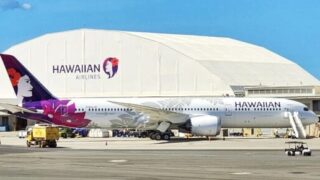
Hawaiian Airlines’ A330 flights not from Hawaii but between Seattle and Anchorage. That has been extended through the summer and it will be two flights daily instead of one. The schedule change hints at a bigger and fast-evolving strategy as the merger with Alaska reshapes how Hawaiian widebody aircraft are used.
As noted in our previous article New Routes, “Discipline Will Be Forced” on Hawaiian, Says Alaska, the route was initially planned for just one daily flight. However, the latest extension reflects a more robust deployment strategy, with two daily roundtrips now scheduled through early September 2025.
The Alaska route and the Hawaiian aircraft.
Hawaiian’s A330s are large, long-haul aircraft with significant cargo capacity, traditionally used by Hawaiian for Trans-Pacific routes. But now, two daily roundtrips between Seattle and Anchorage will e added to the operation with this aircraft. This is a departure from the airlines’ standard aircraft for this typically 3.5 hour flight, where smaller, narrow-body Boeing 737 NG and MAX are used.
The new schedule has Hawaiian operating flights with the A330 as follows: departing Seattle at 11:25 a.m. and arriving in Anchorage at 2:10 p.m. (HA681), with a second evening flight departing Seattle at 10:00 p.m. and arriving at 12:45 a.m. the next day (HA697). From Anchorage, flights are scheduled to depart at 2:30 a.m., arriving in Seattle at 7:00 a.m. (HA698), and a second return flight leaves Anchorage at 3:50 p.m. and arrives in Seattle at 8:20 p.m. (HA682).
It’s a significant shift for Hawaiian, but it makes sense given the current climate. The A330s, with their large and comfortable cabins and ample cargo space, can move more passengers and freight than Alaska’s 737s, which typically serve. But what does it mean for Alaska’s broader strategy?
Why extend the route now?
There are a few reasons this makes sense. Summer travel between Seattle and Anchorage has been consistently strong, with a mix of leisure traffic, business travelers, and cruise connections. Adding widebody capacity during this period boosts both seat availability and cargo lift.
This route competes directly with Alaska archnemesis Delta Airlines, which flies it multiple times per day, using Boeing 737 NG planes.
But there’s another angle—aircraft positioning. The A330s may return to Seattle for their upcoming Hawaii or international assignments, such as flights to Tokyo and Seoul. This extension allows aircraft to remain active and generate revenue while keeping costs in check on another aspect of the schedule.
A broader strategy.
This move signals how Hawaiian and Alaska are increasingly blending their fleets. While the A330s may not permanently replace 737s on this route, the extension shows that Alaska is increasingly comfortable using Hawaiian aircraft outside the planes’ traditional network.
Hawaiian’s A330s aren’t just being parked at the airport; they’re being retooled and redeployed in the smartest ways possible, even when that surprises long-time fans of the Hawaii bellwether airline.
But why is this route significant? It’s not just that Hawaiian is using A330s for domestic flights. This move signals how Alaska may use Hawaiian’s fleet for its operational goals. With the A330s helping to expand Alaska’s reach, especially in high-demand summer markets like Seattle to Anchorage, the lines between the two airlines are being erased.
This is exactly the kind of efficiency Alaska needs in its plans to continue growing its reach domestically while still honoring Hawaiian’s legacy as an island-focused carrier. Using the A330s also hints at the future direction of fleet management. As the merger continues, expect to see more and more widebody aircraft used in ways that may have seemed unusual just months ago. Transcontinental flights using these planes also seems inevitable.
Passenger experience and future implications.
What does this mean for passengers? Hawaiian’s A330s are a different experience compared to the 737s traditionally used on this route. More seats, additional space in the cabin featuring two aisles, and larger overhead bins offer a more comfortable journey without question. Business-class passengers will likely find the lie-flat seats a treat compared to the offerings on Alaska’s narrow-body jets.
However, while the aircraft offers more comfort, the integration challenges remain apparent. Seat assignments, loyalty benefits, and merging two different systems are some of the growing pains passengers are experiencing and reporting to us. Travelers will likely need to keep a close eye on these changes as they continue to evolve.
The future of Hawaiian’s fleet.
As the merger unfolds, expect to see more and more tweaks to Hawaiian’s route network. This is the second one already this week. The A330s may continue to serve Trans-Pacific and international routes, but this extension is an early indication of how the aircraft could also be used profitably on mainland routes. If this deployment proves successful, it could pave the way for more Hawaiian widebody aircraft to enter the domestic market. That appears inevitable..
What’s clear is that Hawaiian Airlines’ future, now under Alaska’s umbrella, is still evolving. While the deal has not been without challenges, the quiet extension of this Seattle to Anchorage route signals a larger shift in how the airline operates regarding fleet usage and market positioning.
BOH thoughts.
This schedule extension may seem minor, but it reflects a more significant shift in strategy as Hawaiian’s A330s are integrated into Alaska’s mainland network. Whether this leads to permanent changes or remains a short-term solution, one thing is clear: the lines between the two brands are blurring, and Seattle is emerging as the new hub for Hawaiian’s widebody fleet.
As the merger continues to take shape, we’ll likely see more adjustments like this one. For now, Hawaiian’s A330s are a sign of flexibility and adaptability, and Alaska is using them wisely to strengthen its position in key markets. What’s next? Only time will tell—but one thing is certain: the world of Hawaiian Airlines is changing, and Seattle is at the center of it all.
We welcome your comments. Mahalo!
Get Breaking Hawaii Travel News





I’m just really disappointed that the A330s are being replaced by 737s on the HNL to JFK route. As a window-seat person, the 3-3-3 seating arrangement just doesn’t appeal, especially for a long-haul flight.
Cargo. Cargo. Cargo
I think the widebodies will be popular on the SEA-ANC route. As an Alaskan elite member, I will avoid them though. On Alaska I get upgraded to First Class. On Hawaiian, maybe a Comfort Plus seat. No thanks.
Maybe Alaska can have one or two A330s repainted with Alaska Colors?
Just a thought.
This really isn’t rocket science. HA ALWAYS had most of their planes RON at west coast airports. Like at PDX, the A330 from HNL would arrive around 9p, then leave the next morning around 8a. That equates to 11 hours of the plane sitting, earning Zero revenue. The SEA-ANC 10p flight, getting back to SEA at 7a is great utilization. To be able to actually utilize the aircraft, and maximize profit, planes have to fly, not sit. It is all about where AS sees the revenue ability, as well as the reason AS bought HA, not the other way around.
Well said David C.
Same goes for the now canceled HNL/AUS nonstop. The HA 330 sat on the tarmac for over 10 hours overnight before it returned to HNL.
Everyone is upset about what is happening to HA post “buy out,” however, as we all know, AS saved HA from certain bankruptcy and the eventual complete dissolution of the airline piece by piece. It would not have been pretty. Bottom line is no matter what one thinks, AS saved HA so it could fly another day. You may not like what the new AS/HA airline looks like, but it’s still around and flying.
Regarding A330s going to SEA, much more will happen once the single operating certificate is obtained. Don’t bet on AS not ordering some A321 XLRs for South Pacific routes from HNL, then basing all wide-bodies at SEA. HNL might still get one daily widebody turn flight each from SEA, SFO, LAX, and LAS, with the rest being A321 or B737 metal. BOS and JFK might still keep widebody service, but maybe not as the A321 could do the job. And look for a new livery and uniforms post-merger. Maybe no more Alaskan and Hawaiian faces on logos. Never say never….
Although it is the same company, it just seems strange to have a Hawaiian branded plane flying into Alaska when Alaska’s roots lie in that state.
HA at one time flew HNL ANC.
Wow, it’s a bit jarring to think about how much has changed in such a short time. Hawaiian used to be the leader in offering a great premium service to the islands, and now the A330s are showing up on a lower 49 route. I’m curious to see how this affects their overall joint brand. Interesting times for sure.
Lower 48.
I think this is a smart decision. The A330s can offer so much more capacity, especially on busy routes like Seattle to Anchorage. If Alaska can make this work, we might see more of these shifts across other domestic routes. More power to them as it was this or BK for Hawaiian.
Interesting move by Alaska, but will this be the new normal? Hawaiian Airlines has always had a strong identity, and it’s hard to imagine them blending into Alaska’s operation too much. I’ll be keeping an eye on how they handle the transition.
I have mixed feelings about this. It’s good to see Hawaiian’s A330s getting more use, but it feels like the soul of the airline is slowly disappearing. The widebody fleet was a symbol of the Hawaiian experience, and now it’s being used on a route that doesn’t seem to match.