

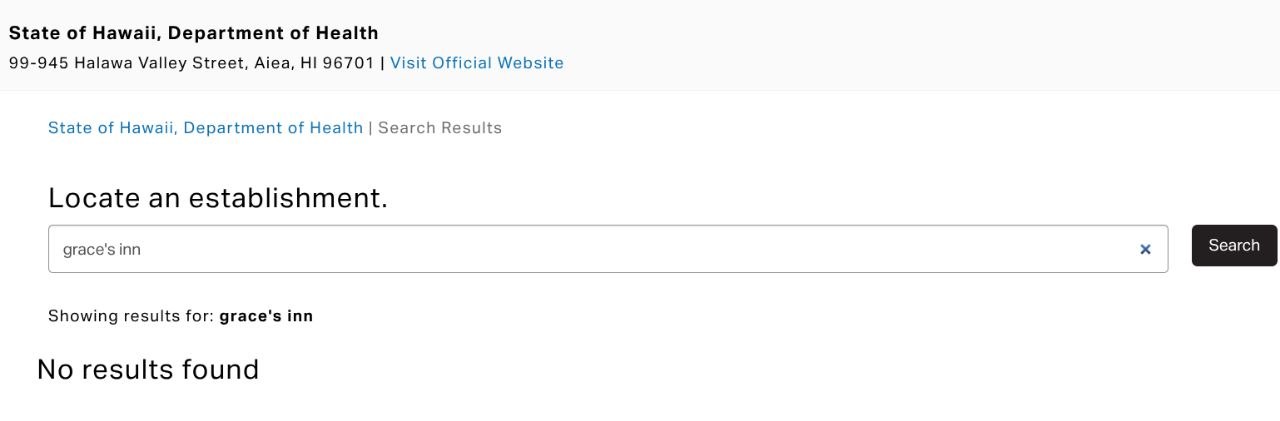
A Honolulu restaurant was red-placarded this week after inspectors found raw sewage backed up onto the kitchen floor, which should be more than enough to get anyone’s attention. But when we searched Hawaii’s official food safety inspection website for the restaurant, Grace’s Inn, we could not find it at all. That was until we started trying variations of the name and found it under Graces Inn, without the apostrophe.
The only reason we knew about the closure was that the Hawaii Department of Health issued a press release. That is the part Hawaii visitors should understand, because the state announcement said a restaurant had been closed, while the restaurant inspection tool did not show it when we looked for it under its official name, Grace’s Inn.
A plate lunch spot people have trusted for decades just got shut down.
The Department of Health said Grace’s Inn LSY, at 1296 S. Beretania St. in Honolulu, was issued a red placard on June 1 after a follow-up inspection found a critical food safety violation. The agency said the plumbing system was not being maintained in good repair and that raw sewage had backed up onto the kitchen floor.
DOH said the restaurant must remain closed until a licensed plumber assesses and repairs the plumbing system, all critical violations are corrected, and a follow-up inspection clears the restaurant to reopen safely. Those closure facts come from DOH, and that is the only outside source we are relying on for this article.
Grace’s Inn is not some unknown joint tucked somewhere visitors would never notice. It is a longtime Honolulu plate lunch spot near Times Supermarket on Beretania, the kind of counter-service spot generations of residents recognize and visitors can easily wander into when they move around nearby Waikiki.
Then we searched the state’s own food safety website.
The Department of Health announcement directs readers to the state’s restaurant inspection portal for inspection reports. So we went there and were rather shocked in multiple ways. First, the page still hasn’t improved, and it is a total mess of red text, warnings, and dates. And when we searched for Grace’s Inn, the name any normal diner would type, the restaurant could not be found until the apostrophe was removed.
That is not a small problem. We were not starting cold, and we were not guessing whether an inspection had happened. We had the state’s press release in front of us, knew the restaurant’s name, address, and closure date, and still could not pull up the record in any public-facing search when we first began searching.
A visitor would have far less to work with when checking Hawaii restaurants. Someone planning lunch would not know the corporate name, an exact inspection date, or precisely how the restaurant might be listed in the state’s database, and they almost certainly would not be reading the DOH press release before deciding where to eat.
The search continues to fail as it has before.
This is not the first time we have hit this wall with restaurant safety. When a takeout counter inside Don Quijote was shut down for raw sewage in February, we ran into the same portal problem, and we have tested the search after other closures as well.
The portal may exist, but finding what you need can become just a guessing game. That is very different from a public tool working the way normal diners would expect it to.
When we tested the portal ourselves last year in Hawaii Hides Restaurant Health Violations From Visitors, We Proved It, obvious searches did not always produce obvious results. White Guava in Hilo only surfaced under its exact name, and a Maui closure we went looking for appeared only under the listing Maui L & L Food, a string almost no diner would think to type. That is the same pattern that now includes Grace’s Inn.
A search tool that only works when you already know what you’re looking for, and only if you know the right hidden words to use, is not a useful tool for Hawaii visitors.
The state’s own press release points you to the tool that fails.
DOH did the right thing by performing the inspection and then issuing a public closure notice. A restaurant red placard involving raw sewage in the kitchen is exactly what Hawaii diners should hear about quickly.
But the agency’s own announcement also points the public toward its inspection portal. That is where the problem sharpens, because the portal is still a total mess and does not reveal the closure, at least when we searched the restaurant by name or browsed recent inspections.
Hawaii visitors and residents want to easily find such violations by typing the restaurant name, viewing the inspection history, and seeing whether it is open or closed. That should be a basic function in Hawaii, where visitors spend heavily, many guests and residents eat out daily, and restaurant trust is vital for the travel experience.
What a red placard means and what the portal should show.
A red placard is a serious enforcement action. It does not automatically mean a restaurant has a long history of problems. It also does not mean the restaurant will stay closed for long, since many places correct violations, pass reinspection, and reopen quickly. But that is why public access to current information is so important. Diners should be able to see what happened, when it happened, whether corrections were completed, and when the state allowed the business to reopen. In visitor-dependent Hawaii, that information should be made easy to locate.
The official tool should not lose to private platforms.
One especially odd part is that other information sources can sometimes show diners more related information than the state tool does at first glance. Yelp, for example, has displayed a yellow health score for Grace’s Inn via a third-party health data feature, while the state portal search returned nothing for the obvious restaurant name. That is backwards.
This week, amazingly, our search failed that test again. We knew the restaurant, knew the violation, knew the closure date, and still could not find the critically needed information through the public system.
How Hawaii diners can protect themselves when the search doesn’t work.
For now, anyone trying to check a restaurant in Hawaii may need to search more than once. Try the common restaurant name, then the exact name from any state announcement, then the address, then a wider date range with the zip code left blank if the system starts returning nothing. Then try again later, since the data obviously isn’t timely.
That is not a good answer, but it is the honest one. We have seen too many cases where the first obvious search fails, and stopping there may mean missing the issue for now.
Grace’s Inn may quickly correct the plumbing problem, pass a follow-up inspection, and reopen. That is how the red placard process is supposed to work, and the restaurant will have that ability once the state is satisfied the issue has been resolved.
But the public should have important information too. It should have a restaurant inspection tool that lets people find serious closures by the name on the sign, not only through a press release they happened to see.
Have you ever tried to look up a Hawaii restaurant inspection record and come up empty even though you knew the restaurant had been inspected?
Get Breaking Hawaii Travel News






Search strategy: search on as little as possible. Would searching on just “grace” have found it?
Answer: https://inspections.myhealthdepartment.com/soh/search?searchStr=grace
Yes – about 3/4s of the way down. I’m not surprised that a computerized system doesn’t handle apostrophes, most databases hate punctuation in general.