
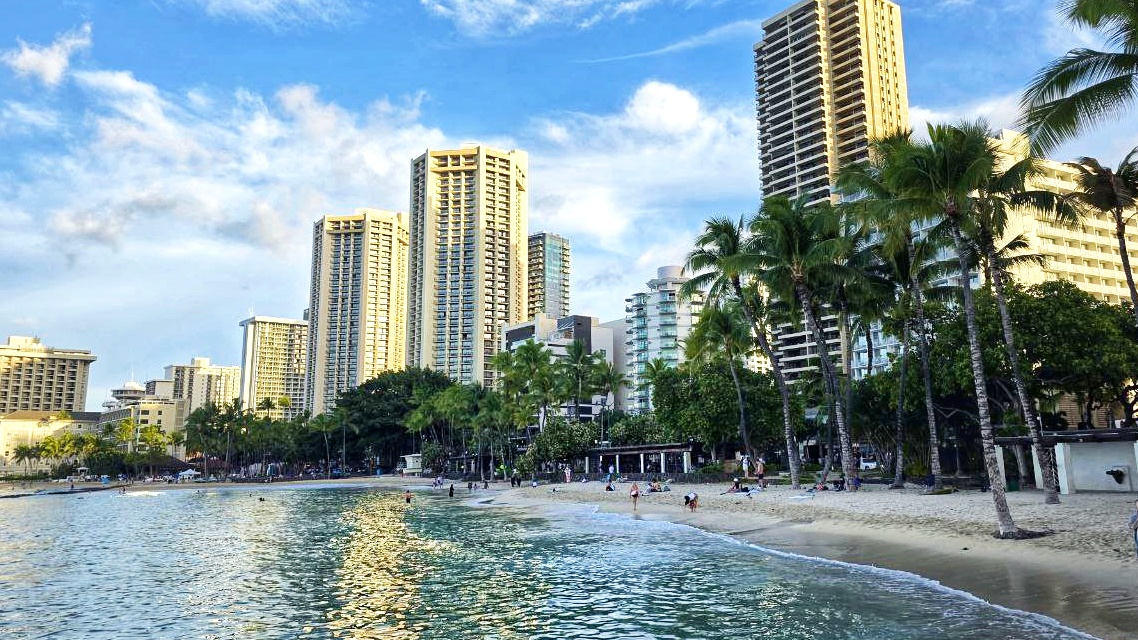
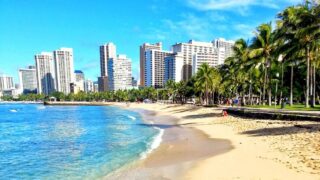
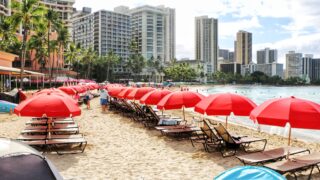
If you have walked Waikiki’s Kuhio Beach, you saw it. Large sections of grass were dry or simply worn away to mere dirt. Sprinklers were broken or watering useless areas and not the ones that needed water. The coconut mounds were worn and stressed. This is the iconic strip between Kalakaua Avenue and the sand, where surf schools set up each morning, and visitors lay out towels before heading into the water. Even as hotel rooms nearby can top $500 a night, the park in front of them has become severely neglected.
Suddenly, Kuhio Beach is getting a $1M upgrade. Irrigation systems will finally be repaired. Landscaping will be redone. Portions of natural grass will be replaced with resort-grade artificial turf that should withstand the constant foot traffic. Funding will also support the presence of safety ambassadors along the beachfront. That’s a huge about-face.
That money arrived for one simple reason. Hilton needed City Council approval for its new Ka Haku timeshare development in Waikiki, and as a quid pro quo for obtaining that approval, the company agreed to fund needed improvements at Kuhio Beach Park.
Waikiki is Hawaii’s breadbasket.
In discussions around the project, Honolulu Council member Tommy Waters described Waikiki as the state’s breadbasket. That is the economic reality. A massive share of Hawaii’s visitor spending moves through this small stretch of Oahu. Hotel taxes, restaurant bills, activity bookings, and retail sales here feed government budgets across the islands.
That is what makes the decaying condition of Kuhio Beach so hard to understand. Waikiki is clearly Hawaii’s revenue generator. Yet visitors were walking across dead grass and broken irrigation systems. They were sitting between palms surrounded by patches of bare dirt. It took this development approval to unlock $1M for visible repairs in the center of Waikiki. That might just be the model going forward. It isn’t a new tactic. Developers here have long funded public improvements tied to approvals. What stands out is the location and the fact that basic upkeep needed leverage to happen.
Artificial turf on Waikiki’s shoreline.
Heavy foot traffic destroyed the natural grass. The salt air didn’t help. Constant use from sunrise to sunset every day meant no recovery time. Artificial turf will hold its color, need no watering, and stand up to daily pounding from beach chairs, coolers, and beachgoers.
Replacing natural grass with synthetic turf probably won’t ever be exactly what visitors think of as Waikiki Beach. If it fixes the appearance immediately and ends the cycle of brown patches and reseeding, however, most visitors will probably accept it. It also reflects the reality that keeping the real grass alive under current use has stopped working, so a durable solution may be preferable to repeatedly trying the same prior approach.
Safety ambassadors are part of the package.
The agreement will also fund safety ambassadors along Kuhio Beach. Waikiki has not exactly been free of problems. There have been theft complaints, late-night incidents, and issues that don’t contribute to visitor comfort in a place that is supposed to feel carefree. A visible presence is meant to be calming and intervene before small issues turn into bigger ones.
Including safety staffing in the same deal as irrigation and turf is a telltale sign. This stretch of Waikiki needs more than just lawn care and sprinklers. It needs better management. It is the busiest public beachfront park in the state, surrounded by high-rise hotels and packed every day with surf schools, tour groups, and first-time visitors trying to figure things out.
This is not new in Hawaii.
Community benefits tied to development approvals are common in Hawaii. Developers fund sidewalks, road improvements, or public amenities in exchange for entitlements. That’s the familiar part.
What makes this different is the location. Kuhio Beach sits at the epicenter of Waikiki’s shoreline. Visible deterioration lingered for so long that a private project became the trigger for much-needed basic maintenance upgrades.
The park will look better once the work is done, and we’ll be back with photos. Sprinklers will work again. Astroturf will stay green. Landscaping will look as it was intended. Visitors arriving need never know these improvements were tied to a timeshare development’s approval, and that one of Hawaii’s most important public spaces did not get fixed until the government found a big developer that needed something.
Photo Credit: © Beat of Hawaii at Kuhio Beach, Waikiki.
Get Breaking Hawaii Travel News

So what happened to all the fees visitors are paying? Why not use those to fix Kuhio Beach? Buller? Buller? Anyone?
Meanwhile, the County of Maui continues to ignore the severe beach erosion on Kaanapali. The beach walk is gone in front of the Kaanapali Alii and the Hyatt has no beach left either.
The Alii has offered to rebuild their section and has been rebuffed by the County. Maybe we could use some of that sweet environmental fee money to take care of the basics.
Isn’t this the kind of thing the “green tax” should pay for?
But Astroturf gets hot so instead of walking or sittin on it- they will all crowd on the areas without it.. As it degrades it can break off and get in the ocean affecting sealife down the road. Where is the research ? Who is signing off on this ? Is this the best you can do?
Makes no sense. Waikiki is the cash register for the state. If that park looks worn out, something is broken in how money flows back into maintenance for even the most important things.
The safety ambassador funding is the bigger story. That tells me there have been ongoing issues they don’t want to highlight publicly right now.
Artificial turf on Waikiki? That’s really depressing. I understand the durability argument to some degree, but plastic grass on the beach feels wrong and will look terrible. Isn’t there some better alternative being considered?
As a resident, I’ve watched that grass and mounds decline for years. This didn’t happen overnight. The city ignored it until someone with leverage showed up and developed this plan. What will keep it going after the initial phase?
I don’t really care who paid for it. If Hilton wants to build another tower and the park gets fixed, that’s how the world works nowadays. At least something is getting maintained in Waikiki.
I walked Kuhio last year and couldn’t believe how rough the plantings looked. It didn’t even match the room rates we paid.
While I’m glad the improvements are going to happen for this sad section of Waikiki Beach, it’s pretty egregious that government action wasn’t taken a long time ago, given that it’s Hawaii’s “breadbasket.” Is corruption to blame?? We’re in Maui and there a section of the Ka’anapali Beach walkway that was washed out a few-ish years ago and still hasn’t been repaired. Why? Surely the timeshare, condominium, and hotel properties around here could afford to fix that small section of boardwalk. I guess they don’t care? I’ll look forward to photos of the Waikiki update! Thank you!
Resident of Waikiki here. Astroturf is a horrible idea, it looks so cheap. I can’t believe this was their solution. Perhaps a hearty native coastal grass could have been considered.