
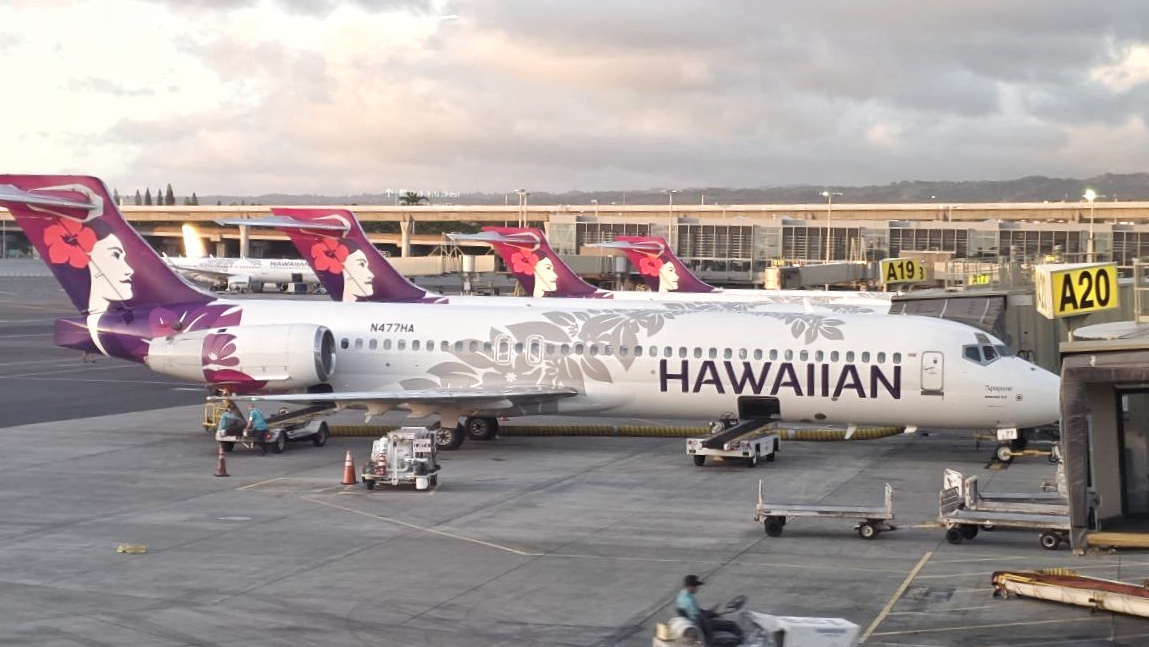
Hawaiian’s future is moving toward a decision it can no longer put off. The airline’s aging 717 fleet is nearing the end of its practical life, and what replaces it will say far more about Hawaiian’s direction under Alaska ownership than any branding language or merger talking point ever could.
When Hawaiian was independent, basing its fleet in Hawaii was a foregone conclusion. There was no mainland operation to fold into, no alternative hubs to leverage. That is no longer true. Under Alaska ownership, with an established mainland base and a fleet strategy built around West Coast operations, keeping planes in Hawaii becomes a choice rather than a default.
We have been circling this question for some time, in conversations with pilots, mechanics, and other industry watchers observing how the operation is evolving from the inside. As fleet plans simplify and cost pressures ratchet up, the logic behind certain outcomes becomes harder to dismiss, even if no one is eager to frame it publicly that way.
That is why a large number of recent reader comments stood out. Not because they introduced a new idea, but because they repeatedly articulated the same conclusion many people inside the system have been quietly reaching.
“The real question is how Hawaiian replaces the interisland 717s. I always liked the Southwest model where planes fly in from the mainland, spend a day or so shuttling between islands, then head back. I can see that happening here once the Alaska fleet simplifies.” BOH reader.
The comment skips the usual insider baseball arguments and goes straight to the uncomfortable part. Replacing the 717s may not really be about replacing an airplane at all. It may instead be about deciding what kind of airline Hawaiian Airlines will be once those aircraft are gone.
One model for what that future could look like is already operating in Hawaii.
It is not hypothetical. Southwest Airlines runs a flow-through operation here, with mainland aircraft flying in, spending roughly a day shuttling between islands, and then heading back out. That comparison matters because it reframes interisland flying not as a standalone system that needs its own dedicated fleet, but as something that can be folded into a larger network built around aircraft utilization and competitive cost control.
- Hawaiian’s Boeing 717s are not just slowly approaching retirement. The interisland fleet has been flying hard for more than two decades in one of the most cycle-heavy aircraft operating environments anywhere, with constant short hops from early morning through late evening.
- Many of these aircraft are now well past 120,000 cycles, even though they were manufactured with a lifetime of 70,000 cycles and have been extended through maintenance. In Hawaii, that cycle number is far more important than calendar age because wear comes from landings rather than years. At this stage, maintenance stops being something you plan neatly on spreadsheets and starts becoming something you deal with in real time.
- Maintenance checks get more complicated, and parts can get harder to source, even if money is not the limiting factor, which, of course, it is. Reliability takes more labor and more downtime just to keep the schedule going. Boeing is not building replacements, and the support ecosystem around the 717 only shrinks with time. There is no realistic path for these aircraft to remain viable much beyond the next five years, and possibly not that long.
What makes this moment different from past fleet discussions.
Hawaiian itself has already shown another way that works, even if it has not been publicly framed that way. The A321neo flights that include interisland hops before or after mainland segments quietly demonstrate internally that short-haul flying no longer needs to live inside a sealed-off, dedicated fleet. Aircraft can avoid sitting around waiting. They can be moving through the larger flight ecosystem and earning on longer routes too, while still covering shorter interisland ones.
Once you look at interisland flying that way, a lot of other decisions stop feeling haphazard. The picture does not suddenly become comforting, but it does start to make the most financial and logistical sense.
The airline now steering Hawaiian’s future survives and thrives by running leaner than the Big Three, and that reality shows up very clearly in fleet strategy. Fewer aircraft types mean fewer maintenance programs, fewer crew qualifications, fewer spare parts inventories, and fewer specialized bases that exist only to support one narrow slice of the airline’s flying.
A large, standardized 737 fleet can handle West Coast routes, longer mainland flying, and interisland segments without requiring a separate structure built solely for Hawaii. That kind of simplification can show up everywhere, from training pipelines to crew scheduling, to how quickly an airline can reshuffle aircraft when something breaks in the chain. Airlines do not walk away from such serious advantages lightly, and they never do it for sentimental or historical reasons.
Another reader put it more bluntly. “The ‘Aloha Spirit’ doesn’t pay the bills. If Hawaiian wants to survive, change isn’t optional.” That framing may be uncomfortable, but it reflects the financial reality shaping these crucial airline decisions.
The Southwest comparison is not theoretical.
Southwest already runs this model in Hawaii. They keep very few aircraft here overnight. SW told BOH that effectively one extra plane lives in Hawaii beyond what their schedule demands, and they rely on mainland aircraft flowing in and out daily. Bottom line, it works.
Those aircraft arrive, spend roughly a day or a day and a half flying interisland segments, then head back across the Pacific. The planes do not sit idle. They keep working all of the time, which is exactly the point of the model.
Hawaii, however, is not a perfect fit for a pure flow-through system, and suggesting otherwise misses real constraints that exist here. Morning and evening commuter peaks are intense, and frequency and on-time performance are critical to residents. Interisland travel here is also heavily origin-and-destination focused rather than being connection-driven, which limits some of the network benefits airlines elsewhere rely on.
There are also routes and schedules where a larger jet is simply the wrong tool. And a 178 passenger Alaska MAX 9 is a heck of a lot more plane than a 128 passenger Hawaiian Boeing 717. That reality argues strongly against an all-or-nothing shift, even if the core of the system changes in this way.
What makes the most sense may be a hybrid.
Flow-through 737s could handle the bulk of interisland capacity tied naturally to mainland schedules, while a smaller number of aircraft cover thin routes and frequency gaps within Hawaii. The real change is not eliminating Hawaii-based aircraft flying entirely, but shrinking how much of the system depends on an expensive, geographically dedicated Hawaii-based fleet.
The number of comments about this has even surprised us. Readers pushed the discussion further by focusing less on ideal outcomes and more on what is realistically possible. One described the likely sequence bluntly. “The 717s are going to start being retired. Alaska will simply take its 737s flying from the mainland and run them on a continuing interisland flight or two, really like the Southwest model. Staff then gets slowly retired or repurposed to other routes.”
Another reader cut to the economic constraint behind that thinking. “A small sub-fleet based in the most expensive place to do business in the U.S. isn’t happening,” he wrote. “Whatever replaces the 717s will cost more to operate, and Alaska Air Group is looking for the least bad option, not a perfect one.”
Once the airplanes shift, will jobs follow?
If interisland flying is largely handled by aircraft based on the mainland, the labor associated with those aircraft would follow as well. Pilots, maintenance, scheduling, and support functions tend to concentrate where planes are based and serviced, not where the brand originated.
Mainland basing is cheaper in ways that compound over time. Labor costs are lower, infrastructure costs are lower, and flexibility is higher when crews and aircraft live largely in the same places. It could simply become the default outcome once aircraft, crews, and maintenance are logically aligned.
The commitments made during Hawaiian’s acquisition process were narrow.
These were time-limited, and they were written carefully. They focused on service levels, not where aircraft would overnight or where long-term maintenance investment would land. Many of those commitments expire within the next years, and airlines are adept at honoring precise promises while repositioning quietly once the clock runs out.
When the 717 retirement plan finally becomes explicit, it will be framed as a technical necessity. Aging aircraft, maintenance challenges, and modernization. All of that will be accurate, but in the end it may not be the most important part of the story.
The real signal will be what replaces them and where those replacement aircraft live. An entirely dedicated fleet based in Hawaii would point in one direction. A system built around mainland-based 737s flowing through the islands would point in a very different one.
That original reader comment cut through the noise and avoided prediction theater. It does not try to guess an optimal aircraft subtype or a route map. It identified the logic driving the decision.
What replaces the 717s will tell travelers and employees alike what kind of airline Hawaiian Airlines is becoming, regardless of how familiar the paint may still look on the ramp.
Get Breaking Hawaii Travel News




I just had a very pleasant experience flying back home to Honolulu from a stopover in Vegas. Flight 875 had all the memories we love from Hawaiian pre Alaska. Local crew, excellent service with true aloha spirit that didn’t stop until we exited the plane in Honolulu. Quick luggage retrieval was the icing on the cake. We arrived earlier than scheduled despite a short delay out of Vegas. StarLink continues to amaze and is faster than my internet at home. A330 is a beautiful aircraft and I look forward to the upgrades they have announced.
Using the A321 is problematic, takes to long to load and unload pax and luggage. The last time I was on one Kona departure was delayed because the brakes had to cool down after arrival. Using the mainland planes for interisland cause flight delays as an inbound flight may arrive late, than that trickles down to the interisland flights visa versa. They could have a fully based 737 fleet here for interisland only that don’t have to be ETOPS. Just my opinion , but what do I know??
I appreciate that this does not scream any sort of doom, but it also does not sugarcoat what the likely direction is and the financial realities. That balance feels correct.
I keep seeing in your comments people arguing about which airplane is best, but this makes it clear that the airplane choice is almost secondary to the system.
Prediction – The 717’s will likely be replaced by the 737 with the Southwest scheduling style. The A321’s will be sold off. The A330’s will be used as a way to fill the gap until 787’s can fully replace it. The livery on the 787 will be spread through the entire fleet in the name of “brand commonality”. In the end it will be 787’s and 737’s and the Paulani livery will be a distant memory. I don’t like it, but it’s time we locals get comfortable with what is already happening.
I worked in aviation maintenance for 30 years. Where the planes are based determines where the jobs are, every time. The rest may not just be branding.
Southwest figured this out years ago. Hawaiian thought this was an abomination at the time. Now I’m surprised people naively thought Hawaiian would somehow be immune to the same math.
This sounds efficient on paper, but Hawaii is not just another spoke. Morning peaks are intense and reliability should still matter more here than about anywhere else. I hope. Will be interesting to watch play out.
The part about basing being a choice now, not a default, really hits homes. That is a big shift that most people probably have not thought about and honestly I didn’t either.
I fly interisland several times each month and I honestly do not care much what plane it is, but I do care more where crews and maintenance are based. That part worries me more than planes and seat counts.
This feels inevitable once you lay it out. The 717s were a Hawaii-specific solution for a different era, and that era is clearly over. Sad reality.
With Alaska’s recent large purchase of Boeing 737’s, Hawaii will probably see flow-through 737s, once the 717 retire. It’s “Hello, Mr. Eskimo and Aloha Oe, Pualani” against its fuselage and aircraft tails.