
The first new sunscreen ingredient since the late 1990s was just approved by the FDA. So you buy it for the Maui trip, pack it, and assume you did exactly what health experts have spent years telling people to do. Then you find out Maui County does not allow it.
US finally approved this new sunscreen ingredient.
On June 9, the FDA approved bemotrizinol, also known as BEMT and marketed as Parsol Shield. It is the first new UV filter added to the agency’s sunscreen framework since the late 1990s, ending a long drought that sunscreen makers and consumer advocates had both criticized for years.
The ingredient can be used in concentrations up to 6 percent and was approved for adults and children six months and older. It has been used in Europe and other countries for more than twenty years, and products containing it are expected to reach U.S. shelves later this year.
For many people, it is being considered as a consumer win. For Hawaii travelers, the story gets complicated right away, because federal approval does not mean a product clears every Hawaii sunscreen rule.
Maui’s rules are completely different.
Maui County adopted one of the country’s most restrictive sunscreen laws when Ordinance 5306 took effect in 2022. The law allows only mineral sunscreens containing zinc oxide, titanium dioxide, or both.
Those rules apply across Maui County, including Maui, Lanai, and Molokai. The Big Island later adopted a similar approach, while the statewide Hawaii law remains narrower, focusing on oxybenzone and octinoxate.
That is where the new FDA approval runs into trouble in Hawaii. Bemotrizinol is not a mineral sunscreen ingredient, which means it falls outside Maui County’s mineral-only standard even though federal regulators have now approved it for nationwide use.
A sunscreen that looks like the newest and in some ways smartest choice may be the wrong thing to pack for a Maui beach or the Big Island. But the same is not true on Kauai.
The advice gets even stranger.
The problem isn’t just limited to new Parsol Shield. Some national sunscreen advice still points consumers toward products containing avobenzone, though one that is known to degrade in sunlight.
That advice makes sense in most of the country, but not so in Maui County. Avobenzone is non-mineral, so it is not permitted under Maui’s mineral-only rule. So a Hawaii visitor can follow the latest national sunscreen advice and still arrive on Maui with product the law does not permit.
That does not mean visitors should skip sunscreen.
Bemotrizinol’s real advance is said to be photostable UVA coverage and protection against deeper-penetrating rays most associated with premature aging and skin cancer, in a non-mineral form because it does not break down in the sun the way avobenzone does. Mineral zinc oxide, the kind Maui allows, however, already blocks UVA well, so the rule doesn’t leave visitors exposed even as it keeps the newest and soon-to-be most highly touted option off the shelf.
Maui and the FDA are responding to different issues.
It would be an oversimplification to say Maui is rejecting the science. FDA approval is about human safety and whether the ingredient functions as an effective sunscreen filter.
Maui’s law is aimed at a different concern. Its rules were built around marine protection and a precautionary approach that limits visitors and residents to mineral sunscreen ingredients.
Strangely, Bemotrizinol is often marketed internationally as a reef-friendlier option, but marine research remains too limited, so Maui’s rule is not changing on whether this science is right or not. It comes down to which risks Hawaii focuses on for the beach and pool.
Hawaii sunscreen rules are a travel planning question.
Sunscreen now sits on the same list visitors must ponder that includes reservations, beach access limits, resort and rental car sticker shock, and more. In this case, a product is FDA-approved and nationally recommended, yet it’s still absolutely the wrong thing to pack if Maui or the Big Island is on your itinerary.
In Hawaii, the question is not just whether a sunscreen protects you and how well, but whether it is allowed where you plan to use it.
What Hawaii visitors should pack.
For now, the simplest answer remains mineral sunscreen. Look for zinc oxide, titanium dioxide, or both, and don’t assume that this new FDA approval automatically makes the product okay everywhere in Hawaii.
That may feel unsatisfying for some after decades of waiting for new sunscreens to get approved in the US. But for travelers who want one answer that works everywhere in Hawaii, mineral sunscreen is still the one safest bet.
America waited more than two decades for a new sunscreen ingredient, and one of the places visitors most need sun protection is among the first to still say no.
You can do the research, buy the product, pack carefully, and still find that Hawaii’s rules are different from everyone else’s. And it even varies island by island.
What sunscreen are you packing for Hawaii in 2026?
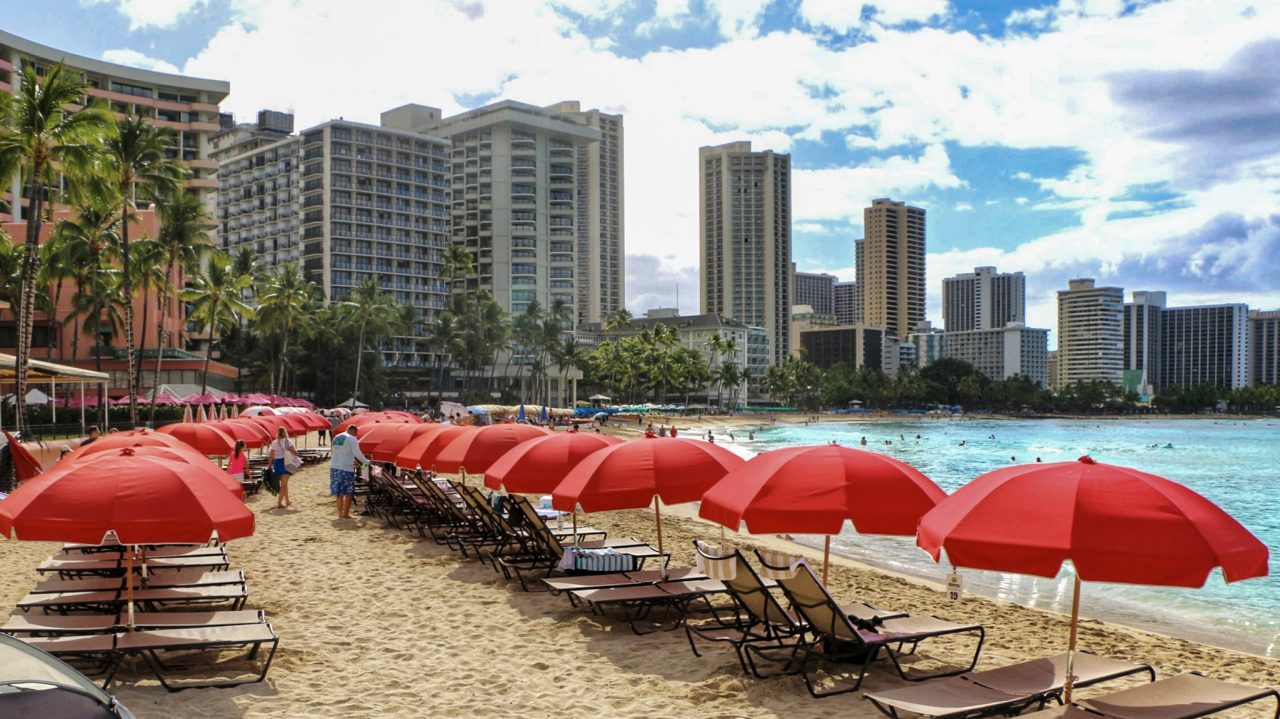
Photo Description: Waikiki Beach on Oahu, where the new sunscreen is allowed, unlike on Maui.
Get Breaking Hawaii Travel News



If interested, this is from Dr. Katelyn Jetalina, a Harvard epidemiologist, from her article about sunscreens.
“What about the risks to the environment, like reefs?
“‘Reef safe’ is a marketing term; there is no official standard behind it.
“The term arose from a deeply flawed 2015 study, which led to public pressure that resulted in bans on specific sunscreen ingredients, usually oxybenzone and octinoxate, in some places, such as Hawaii.
“But, there’s no good evidence that sunscreen harms coral, except in laboratory experiments where coral is exposed to unrealistically high concentrations. In 2022, the National Academies convened many leading environmental scientists to review evidence on sunscreen’s environmental impacts and compile it into a 400-page report. They confirmed what leading coral scientists stated when the original 2015 study was published: the impacts of sunscreens pale in comparison to far more significant stressors, like warming weather.”
I suggest Beat of Hawaii address the sunscreen issue head on. Do we continue to believe that non-mineral sunscreens harm the environment? Is that what the latest science says? Does the National Academy of Sciences report indeed state there is no impact on marine life from all the coral and fish studies performed? Shouldn’t we follow that? If this is true why has the state of Hawaii kept the law limiting our use of sunscreens on the books? Maybe it’s time to try to clear this up. Thanks!
The stores should be informed & required to post disclaimers next to products so that people know the item they are buying cannot be used on Maui beaches.
Last week I was on Maui at the airport, rent a car agency, resort or beach no one including government official, resort management or locals questioned us or anyone else if our sunscreens were in compliance.
Fact is the week before Maui we were on BI were all the agriculture inspection stations were down and not working.
A regulation or law is only a regulation or law if someone is enforcing it.
If the state wants to enforce and actually protect these resources, then it needs to provide clear, unavoidable education from the start. There should be disclaimers when purchasing flights that require visitors to acknowledge local laws and expectations regarding sunscreen use, respecting wildlife, packing out trash, reading posted signs, and protecting natural areas. I regularly see visitors leaving trash on beaches, using aerosol sunscreen, and approaching or following wildlife on beaches and while snorkeling. They need to be serious about enforcement, there should be reminders at every stage of the visitor experience; during ticket purchases, in-flight announcements, informational flyers, rental car counters, hotels, and popular visitor destinations. Then, when violations occur, the laws should be enforced with meaningful fines that are directed back into local conservation efforts. Education combined with enforcement is the only way…maybe publicly announcing the perpetrators 🙂
I think mineral based sunscreens should only be required where you are getting in the ocean to protect the reefs. Otherwise, I think anything effective should be allowed where you are just applying it for daily use to protect your skin. If I am not swimming in the ocean, I use La Roche-Posay Anthelios Melt-in Milk Body & Face Sunscreen Lotion Broad Spectrum SPF 100 sunscreen. It’s expensive for a 3 oz tube.
Recently, I have also started to buy skin protection sunwear that you can swim in as an extra layer of protection.
I don’t think it’s hard to understand or accept that there is a discrepancy between the FDA’s latest approved products vs the State of Hawaii approved products. It’s simple. The State of Hawaii has to consider its own unique marine life environment and has to issue an additional layer of requirements for sunscreens. It doesn’t matter that the FDA Ljust approved a new chemical sunscreen product and it was the first approved change in many years.
Just do the smart thing and respect the unique environment by waiting until you arrive to purchase sunscreen.
Along with everything else that are Hawaii problems beginning with COVID restrictions and continuing through the Lahaina fire and all the taxes on tourism and unwelcoming atmosphere, we just don’t travel to Hawaii anymore after 30+ years of travelling there multiple times a year. The State is grossly mismanaged and our dollars are better spent elsewhere including French Polynesia, Caribbean and Mediterranean.
So if you don’t come here anymore why are you on here commenting.
I get it. You’re done with Hawaii. Enjoy your other vacation spots.
Mahalo BOH for keeping visitors and residents up to date on news and updates. My question, apart from the prohibition of sale of non-mineral sunscreens, how does Maui County stop anyone from possessing “non compliant” sunscreens? It seems like a lot of heat but no fire.
Hi Peter.
That’s a good question and one many visitors will likely wonder about. The law is one thing, but how it is enforced in practice is another, and we have not heard of any such efforts.
Aloha.
Chances are, 9 out of 10 visitors will comply. Even if that 10th visitor does not comply, it still reduces the harmful chemicals by 90%. I’d call that a win!
How does Maui county know the new sunscreen isn’t reef safe? Did they do any research on this? The article states in certain places it is marketed as reef safe.
If you follow Hawaii news at all, you’ll know that this is not new information. The minimum amount of research before traveling to Hawaii – or anywhere – goes a long way to ensuring an enjoyable and respectful visit.
Always pack mineral sunscreen that is reef safe. There are plenty of choices so there is no excuse for using the wrong ones!
Hmmm… Sun screen police? Maui doesn’t sell it but they certainly don’t inspect your bags for the contraband.
We don’t pack sunscreen. Just purchase what they have at the ABC
The first time I used mineral sunscreen in Hawaii, my face burned after not having experienced a burn for decades. So I refuse to continue using it. I have had multiple skin cancers and I’m not taking the risk. I wear a rashgard if I go in the ocean to snorkel and don’t use sunscreen on my face. If I’m not going in the ocean I use my regular chemical sunscreen. I’ve never had an issue doing this in Maui.
You haven’t had an issue with chemicals, but the reef, and sea life does. If you apply zinc or titanium correctly, it will protect you better than chemical sunscreens.
Clearly those two counties are looking at reef impacts and the FDA is looking at human safety. Those are different questions. Whether people agree with Maui and Big Island’s answer is another story. I think that a statewide agreement on this would be useful for everyone.
A bit weird, but okay, thanks. I don’t understand how average visitors are supposed to keep track of state laws, and county specific laws. It feels like a bit too much before a vacation. Hope Hawaii can have the same standards to simplify this.
Most visitors are never going to know this. They will see a sunscreen on the shelf, assume it is approved everywhere, and just bring it. Weird how people safe is going in one direction and reef safe in another.
I switched to mineral sunscreen years ago and never gave it another thought. Some of the older forms are a little harder to rub in, but if it keeps me from worrying about which island I’m on, that’s worth it. BTW the newer products go on much easier!
This is the kind of thing that drives me a bit crazy. We follow the science, buy the newest approved product, and then find out that two islands in Hawaii have a different set of rules than the others. Seems like there could at least be consistency.
I have a sun allergy which makes me use sunscreen when I’m outdoors for a long time. My allergy manifests itself in hives when overexposed. Chemical sunscreens do not protect me like zinc and titanium.
Something to consider…
Here’s a safer alternative. Use the new FDA approved sunscreen but don’t even think about swimming off Maui or you’ll have to deal with the runoff from 12,000 cesspools.
The real answer. Across all islands, 53 million gallons of raw sewage discharge into the ground, and then shore waters, daily.
Incredulous? Then point your browser to Hawaii’s “Wastewater Branch,” “Act 125,” and “Cesspools in Hawaii.”
I don’t pack sunsreen, I get it when I land in Hawaii. Specifically for this reason.
A tempest in a tube? It’s simple. Mineral sunscreen protects our fragile reefs. Stick to mineral sunscreen and you won’t have any problems.
What are the brands to seek out?
1. US Brands (Releasing 2026)Because of an 18-month market exclusivity agreement, you will primarily see the ingredient sold under the manufacturer’s name initially.Parsol Shield: Manufactured by DSM, this will be the premier and exclusively available BEMT-formulated sunscreen in the United States.
There are also European, Asia, and Australian brands available online.
My personal favorite is Surfmud. It’s an Australian product sold widely in Hawaiian surf shops. On the Big Island, there’s a local brand called Little Hands, gentle enough for infants. Comes in varying tint shades so you don’t look like a ghost.
Kokua SPF 50 sunscreen has been our family’s go-to sunscreen for many years. Works extremely well. Pricy on the mainland but you can grab it at an ABC Store once in HI.