
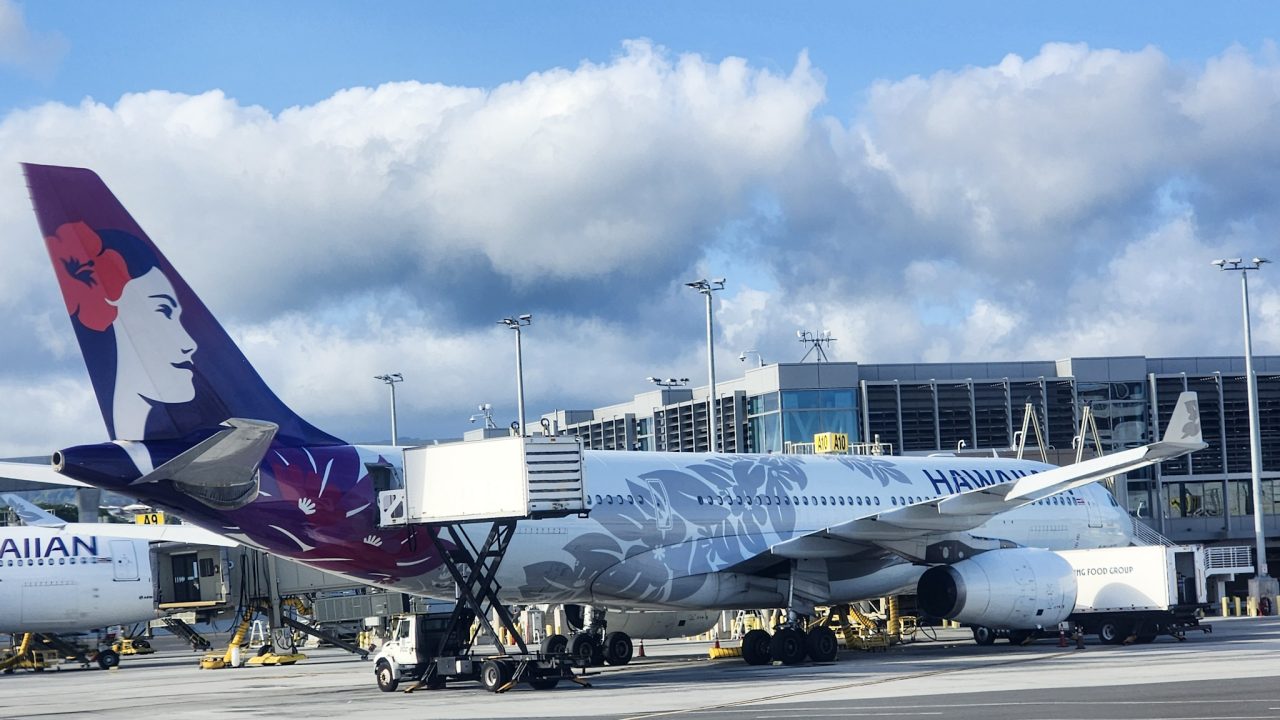
Hawaiian Airlines did not have its new oneworld aircraft in Honolulu on June 30 for its celebration. The plane that’s being painted in Singapore ran late, so the airline revealed the design through renderings and used a standard A330 as the stand-in at the event.
That may seem like a small timing detail, but it fits the larger moment. Hawaiian is showing the world what it wants the brand to look like next, while Alaska is still deciding how much of Hawaiian remains operationally distinct underneath the paint.
The new livery carries the phrase “Aloha a puni ka honua,” which, in Hawaiian, translates to “Aloha all around the world.” The design keeps Pualani on the tail and the maile lei along the fuselage, preserving the visual pieces most island travelers recognize first.
Hawaiian also marked the Honolulu event with $10,000 donations each to Iolani Palace and the Polynesian Voyaging Society. Alisa Onishi, Hawaiian Airlines managing director of Hawaii marketing, called the livery “a powerful symbol of what it means for Hawaiian Airlines to be part of the oneworld alliance, sharing aloha, Olelo Hawaii and our deep connection to Hawaii with more people around the globe.”
That is the promise Alaska wants travelers to believe.
Hawaiian will still look and feel like Hawaiian. The question is how much that means once the systems, contracts, aircraft planning, and global strategy are increasingly Alaska’s.
Hawaiian joined oneworld in April, which gives its passengers something useful: more places to earn and redeem miles, broader elite status recognition, and better access to airline partners. For Hawaii travelers, who often have fewer choices and longer flights just to get anywhere, that is real.
The livery gives that change a Hawaii face.
To anyone glancing at the renderings, it still looks like Hawaiian Airlines, which is exactly the reassurance the combined company wants travelers here to believe.
That helps. But travelers will not judge this by a rendering, a single aircraft, or an event. They will judge it by the flight they board, the crew they meet, and whether Hawaiian still feels like Hawaiian in the places that count.
Alaska Chief Operating Officer Jason Berry described the structure this way in a new interview: “Think of Atmos as a house of brands. You have the Hawaiian brand, the Alaska brand, and those two together are a pretty powerful force.”
Berry also set a broad goal for Hawaii flying. “Our goal over time, as we continue to evolve, is to really have every flight to or from Hawaii be a Hawaiian Airlines branded aircraft. And you’ll get that Hawaiian Airlines experience. We’re not there yet.”
That was the strongest version of the brand promise we’ve heard since the acquisition of Hawaiian was announced. Every flight to or from Hawaii would become Hawaiian branded, which was simple, memorable, and exactly the kind of reassurance many travelers wanted to hear again.
Days later, however, Hawaiian CEO Diana Birkett Rakow gave a more nuanced version in an interview. Not every Hawaii flight will be Hawaiian after all, she said, with a significant majority on Hawaiian and some Alaska aircraft still serving the islands because the combined airline does not want to completely separate its fleets.
Berry also described the combined company as a global airline, and Alaska has moved quickly behind that ambition. The company has added or announced service to Tokyo, Seoul, Rome, London, and Reykjavik from Seattle, and Alaska has said Seattle-Tokyo has reached profitability, with loads at about 90%.
At the same time, Hawaiian’s own Asia map has been shrinking. Fukuoka is gone, and the Honolulu-Seoul route Hawaiian served for more than 14 years ended in November. Alaska now has Seoul on its Seattle map, which makes aloha all around the world somewhat different than it did even a year ago.
Hawaiian gets the global language, while Alaska gets the global routes.
Hawaiian’s oneworld entry is not just symbolic. It gives Hawaiian travelers alliance benefits, partner access, and recognition that the airline simply never had on its own before joining Alaska.
The house-of-brands framing may be the most honest version yet of what’s happening. Hawaiian is not losing visibility, and Alaska is not insinuating that the name has little value. We all know that it does.
For many travelers, especially those arriving in Hawaii for the first time or returning after years away, the Hawaiian brand still means something important before the aircraft ever leaves the ground on the mainland.
Our readers have been telling us for months what they will be watching. Some remember Hawaiian as the airline that made the trip feel different before takeoff, with the greeting, the music, the crews, the meals, and the sense that the flight was already part of Hawaii.
Others say Alaska may be the only reason Hawaiian survives at all, and that keeping the brand in some form is better than watching it disappear entirely. The place where those two views meet is simple: people will not judge this by this aircraft rendering. They will judge it by the flight they fly.
Recent interisland reliability numbers.
Hawaiian had fallen from nearly 90% of interisland flights arriving within 14 minutes to under 80% since December, with March below 70%, before June recovered to about 84%.
For residents, those numbers are arguably more important than for vacationers. Rakow has been direct about the stakes of that network, stating in an earlier interview, “We don’t make money on our Neighbor Island network,” while stressing it is a service the airline intends to protect.
Another concern is who keeps Hawaii flying once the aircraft change. Mechanics, crews, and ground workers are not part of the aircraft livery, but they are a huge part of what makes the airline work here, especially on interisland routes.
Here come interisland 737s.
Shane Tackett, Alaska president and CFO, said in an interview, “The default at this point will be 737s” for the new interisland fleet. “I think it’s the most likely answer to replace the 717s.”
Tackett also made clear that such a move is not imminent, and the 717 remains a purpose-built aircraft for Hawaii’s short, high-cycle, salt-air operation. That buys a little more time, but it does not answer whether the next aircraft will maintain the same amount of work, crew logic, and operational control based here in the islands.
The 737 is not the only path, and which one Alaska picks is its own kind of answer. Hawaiian already runs an Airbus operation in the islands, with A330s staying Honolulu based and getting new interiors, and an A321neo fleet whose future has not been settled. Alaska can default to interisland replacements of Boeing 737s that match its own mainland fleet, or it can build on something else. The aircraft is a fleet decision, but the direction Alaska picks will be seen as a statement about what preserving Hawaiian actually means.
The flight attendant contracts.
AFA-CWA covers Alaska, Hawaiian, and Horizon flight attendants as separate groups today, while joint contract negotiations continue toward a combined agreement. Union updates indicate that the Alaska contract is being used as the language basis for the combined agreement, with Hawaiian provisions reviewed and folded in where they are strongest. That may be normal in any airline merger, but it also informs Hawaii crews about which system is the new template.
“Hawaiian Airlines is here to stay. “
Berry continued, “It’s so important for the neighbor island flying and the service they bring to the Hawaiian community. There was no way we were going to give that up.”
We do believe Alaska understands the value of what it bought. The question is whether a preserved brand can carry the same meaning once the airline underneath it has been absorbed into another carrier’s systems, contracts, fleet planning, and global strategy. That remains to be seen.
Berry’s own words contain both sides of the answer. Hawaiian is here to stay, and Alaska is building the global airline around what Hawaiian brought into the company. That is why this oneworld livery is more than a design. It is the visible version of Alaska’s promise that Hawaiian can remain Hawaiian inside the house of brands where Alaska flies the world.
What’s your take on the latest news from Hawaiian and Alaska?
Lead Photo Credit: © Beat of Hawaii at HNL.
By Rob and Jeff, Beat of Hawaii.
If you want the next development in this lane the moment we have it, and the resident voices behind it, leave your email, and we will send it straight to you. That is the trade. You stay ahead of how this merger affects your next trip, and we keep doing the on-the-ground reporting no one else is. Join us →
We have followed this merger from the first announcement, and we are nowhere near done. Every change to how you fly to Hawaii and between the islands, the fleet, the crews, the fees, the loyalty program, we report and interpret uniquely, from here in Hawaii, as it happens, usually before the mainland press notices.
Get Breaking Hawaii Travel News



People love seeing Hawaiian planes when they fly in . . . They are like billboards saying Aloha !!! :)0
Hawaiian Airlines no longer exists. The flights are operated under Alaska’s operating certificate. The flight crews are being integrated. Hawaiian Airlines is literally nothing more than a paint job, a domicile, and a division of Alaska Airlines. It was bought for the 787’s on order. Pretending otherwise, doesn’t make it so.
We have been flying to Hawaii from the Bay Area regularly since 2009, doing it once or twice a year for the last few years. All but one of our trips has included Kauai and almost all have been on Alaska, with a few on Southwest when it was the only non-stop to LIH on the days we needed to travel. We have been very happy with Alaska and they are our airline of choice. We recently flew Alaska SFO-SEA-FCO (Rome) and return on one of the new Alaska (HA) B-787s using ATMOS points (plus extra $ for premium seating) and it was a great experience. We have also flown to Europe on One World partner airlines on Alaska miles. If Alaska had not bought HA and they had gone bankrupt, I suspect the “airline landscape” for Hawaii flights would be worse now.
” Hawaiian gets the global language, while Alaska gets the global routes.” That says it all, along with the statement that we should “think of Atmos as a house of brands.”
Hawaiian Airlines is now a part of that “house of brands” and nothing else. It’s just like Hampton Inn is part of Hilton Hotels. But somehow an airline conglomerate doesn’t have much feel to it when compared to a hotel chain. Personally, I’m glad that Hawaiian Airlines is still flying and has survived some horrible management decisions in the past that practically bankrupt the company permanently. However, this new Alaska version of Hawaiian Airlines will never feel the same.